
Voice-over: This is Leaders in Finance, a podcast where we find out more about the people behind a successful career. We speak with the leaders of today and tomorrow to discuss their motivations, their organizations, and their personal lives. Why?
Because the financial sector could use a little more honest conversation. We would like to thank our partners for their ongoing support: EY, Mogelijk Vastgoedfinancieringen, and Lepaya.
Your host is Tom van Disseldorp.
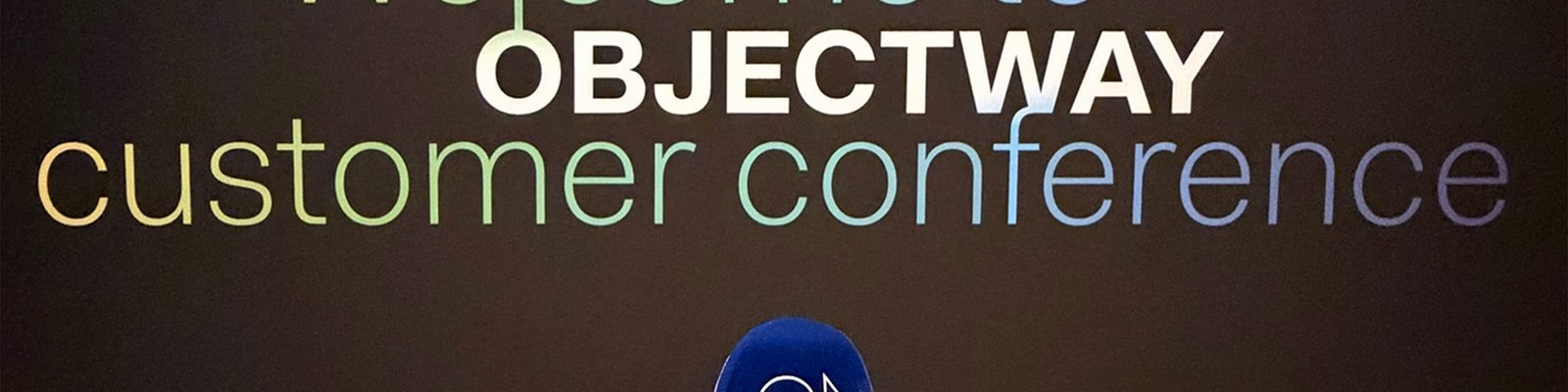
Tom: Welcome everyone to a new episode of the Leaders in Finance podcast. I am Tom van Disseldorp, Event and Stakeholder Manager at Leaders in Finance. Together with my colleague Kees, we are coming to you live from Italy, where we are attending OWIN26, a multi-day event hosted by Objectway.
We are here with around 200 professionals from across the financial sector, gathering to share insights, network, and inspire one another.
Leaders in Finance is more than just a podcast. We organize large-scale events in partnership with industry leaders like Objectway, offer in-depth training through our academy, and host exclusive network lunches throughout the year. Whether through live events, digital content, or educational programs, our mission is clear: to connect and strengthen the financial community.
Today, between sessions at OWIN26, we are taking a moment to sit down for a short but powerful conversation. I am honored to introduce Karl de Borger, Head of Sales and Relationship Management at KBC Securities Services, Thomas de Nil, Head of Savings and Investments at vdk bank, and Kurt Vanhee, CEO Continental Europe at Objectway. Hello all.
Karl: My name is Karl de Borger. I represent KBC Securities Services, which on the one hand is an operational entity where we deliver services to other KBC departments and entities for the handling of financial instruments. In addition, we are also a commercial organization offering brokerage and custody services to third parties such as wealth managers, banks, and brokerage houses, not only in the Benelux but also in Central Europe.
Tom: Great to have you here, thank you. Kurt, could you please introduce yourself?
Kurt: My name is Kurt Vanhee. I am CEO Continental Europe at Objectway. I have been in the industry for a long time and am responsible for several target markets in Europe.
Tom: Thank you. And last but not least, Thomas.
Thomas: Good afternoon. I am Thomas de Nil, Head of Savings and Investments at vdk bank for almost 12 years. I am responsible for everything client-facing: product offering, as well as the tools we use in our branches and those available to our clients.
Tom: Great to have you here. Kurt, to start with you, what has been your experience so far at OWIN26?
Kurt: I think our marketing team did a great job, both from an organizational point of view and in terms of narratives and presentations. A big applause to them. What is interesting for us is that even though clients come from different locations and countries, they all face the same challenges. When you talk to them, it resonates immediately in the topics discussed, creating a strong connection.
Tom: Karl, I see you nodding. Do you agree?
Karl: I fully agree with Kurt. What I found very interesting is that we have been working with Objectway for many years on business process outsourcing projects, as well as supporting independent wealth managers in Belgium. Objectway takes care of digital onboarding for us and provides tools to report to end investors.
What stood out during OWIN26 were the testimonials from various players. It was interesting to hear how things work at other financial institutions. For me, the principle remains the same: the best-of-breed approach, where you select partners you trust and with whom you can jointly serve clients. Clients increasingly expect partners to act as an extension of their own organization. I believe KBC Securities Services and Objectway together manage this quite well.
Tom: Thank you. Thomas, would you like to share your thoughts on OWIN26?
Thomas: As a client of Objectway, we see that many of their clients face similar challenges. We are working in a partnership with Objectway and parties like KBC, and I believe such partnerships will become even more important in the future than they are today. That is a key takeaway for me: partnerships are essential in the operating model we have today.
Kurt: If I may add, I recently spoke with one of our clients, a large family office in the Netherlands. There, too, the trend is not only to look for software partners but also for partners in administration and outsourcing. Essentially, everything that is not core is being outsourced, even within family offices.
Tom: Thomas, what are the biggest challenges when innovating your operating model?
Thomas: One of the main challenges is to keep things clear and easy to understand for clients and advisors. We live in an increasingly complex world, and this will only continue. It is crucial to keep things as simple as possible for the end user.
This means translating complexity into backend systems and working with specialized partners. We need to integrate everything in such a way that we save time for both advisors and clients, allowing them to focus on what truly matters: building personal relationships and providing good advice, rather than dealing with administrative burdens.
Tom: Karl, how does your model work in practice? How do you ensure governance, accountability, and consistency across institutions?
Karl: We always start by drafting detailed project management documentation, often together with Objectway, clearly outlining the responsibilities of each involved party.
From the very beginning, during the sales phase and pre-studies, it is essential to develop a strong understanding of the current situation and the client’s expectations. Managing expectations is key. As I mentioned earlier, your horizon should be three to five years, but you cannot anticipate every possible future scenario.
During implementation and the subsequent run phase, we organize regular alignment meetings. These include operational and tactical meetings with customers, always involving Objectway in the outsourcing model, as well as strategic reviews to discuss new projects and ideas. A modular platform is essential to enable flexibility.
Finally, it is important to evaluate relationships at a senior management level. This ensures that all parties remain aligned, trust each other, and are committed to continuing the partnership in the future. For us, this is a crucial element of governance.
Tom: Okay, thank you. And Kurt, in the panel a few moments ago, Karl referred to a strong partnership. What makes a partnership truly successful in practice?
Kurt: I heard Karl say that the most important word is trust, and I cannot disagree with that. I also had it written down in my preparation for the session. Trust is very important. But for me, trust is a consequence, and it is also a guarantee for the future.
It means that once trust exists, it is because you have achieved things together and there has been a win-win in the partnership, even in a multi-stakeholder partnership. In the past, partnerships were often between two parties, but now they involve multiple partners because you operate in an ecosystem. It is more about orchestration than integration.
At a certain point, trust develops because partners have proven they can deliver, that there is commitment, and that there is give and take. That trust then becomes the guarantee for the future, because continued investment in the partnership and the relationship is crucial for both clients and the ecosystem.
Karl: I fully agree with that, Kurt. What I would add to trust is accountability. A client expects, for example, to go to market with a certain service or product.
We did this for vdk bank for pension savings. The expectation is that you are ready on time, so everyone involved must take responsibility and deliver accordingly. The same applies to regulatory requirements. You cannot delay those. In Belgium, for instance, the capital gains tax was approved in Parliament yesterday evening and must be implemented by the first of June.
We simply have to deliver by that date. There is no alternative. When that level of accountability exists, and partners consistently deliver, trust naturally builds.
Kurt: And in those cases, the client, in this example vdk bank, requests something, and we need to align with each other: what part are you going to deliver, and what part are we going to deliver? That clarity in responsibilities is also part of trust, taking ownership in delivering towards the client.
Thomas: If I may add, it is indeed very important to have shared roadmaps. It is essential to know what we are doing today, what we will do in the future, and how we align that with our partners, KBC and Objectway. Transparency in those roadmaps is, in my view, very important.
Tom: Last but not least, looking ahead two or three years to the next OWIN edition, what is one development that is still underestimated?
Kurt: From my perspective, particularly in the Benelux, there is significant consolidation taking place among banks and wealth managers. As an end client, you will increasingly interact with larger organizations.
Combined with the emergence of a new generation of clients, I believe we will see less stability in client relationships. Historically, banks and private banks have benefited from very stable client bases. It typically takes a lot for a client to leave.
However, with generational change and market consolidation, clients may switch providers more quickly. As a result, offboarding, onboarding, and asset transfers will likely become key challenges in the coming years.
Karl: I fully agree. Consolidation will continue, and clients, especially the next generation, will not necessarily remain loyal to a single wealth manager. Over the next 10 to 15 years, a significant transfer of wealth will take place, and expectations will shift, particularly regarding digital solutions and advisory services.
In addition, a major theme at this conference has been AI. We are discussing agentic AI, and while some institutions are frontrunners, others are still catching up. At KBC, we are probably somewhere in between.
What is clear is that AI will increasingly be applied to processes that no longer require human intervention, such as transaction handling, corporate actions, execution, and settlement processes. We sometimes refer to this as “dark factories,” where processes run fully automated without human involvement. This is something we will likely discuss in much more detail at the next Objectway conference.
Thomas: AI was indeed one of the key topics discussed at this conference and will play a very important role in the future. From an end-user perspective, it is crucial to keep things simple.
We must ensure that complexity, including new technologies like AI, is placed in the background. The user experience should remain intuitive and seamless, while the complexity stays behind the scenes rather than being exposed to the client.
Tom: Gentlemen, thank you very much for taking the time to join us here at OWIN26 in Italy and for sharing your insights so openly.
And to our listeners, thank you for tuning in to this special episode of the Leaders in Finance podcast, recorded here in Sorrento, Italy. We hope this conversation has provided valuable perspectives on the future of financial services, from partnerships and operating models to innovation at scale.
If you enjoyed the podcast, feel free to explore more of our content or join us at one of our upcoming events or networking lunches across Europe. For now, thank you for listening, and we look forward to welcoming you again in the next episode. Thank you, gentlemen.
Voice-over: You have been listening to Leaders in Finance. We hope you enjoyed this episode and would love to hear from you. What is on your mind? Who would you like to hear next?
Let us know in a review, via email, or through our social channels. We would greatly appreciate it.
Finally, we would like to thank our partners for their ongoing support: EY, Mogelijk Real Estate Finance, and Lepaya.
Do not forget to check out everything else we do at leadersinfinance.nl. Thank you for listening.