

Voice-over:
This is Leaders in Finance, a podcast where we find out more about the people behind successful careers. We speak with the leaders of today and tomorrow to discuss their motivations, their organizations, and their personal lives. Why? Because the financial sector could use a little more honest conversation.
We’d like to thank our partners for their ongoing support: EY, Mogelijk Real Estate Finance, and Lepaya.
Your host is Marije.
Marije:
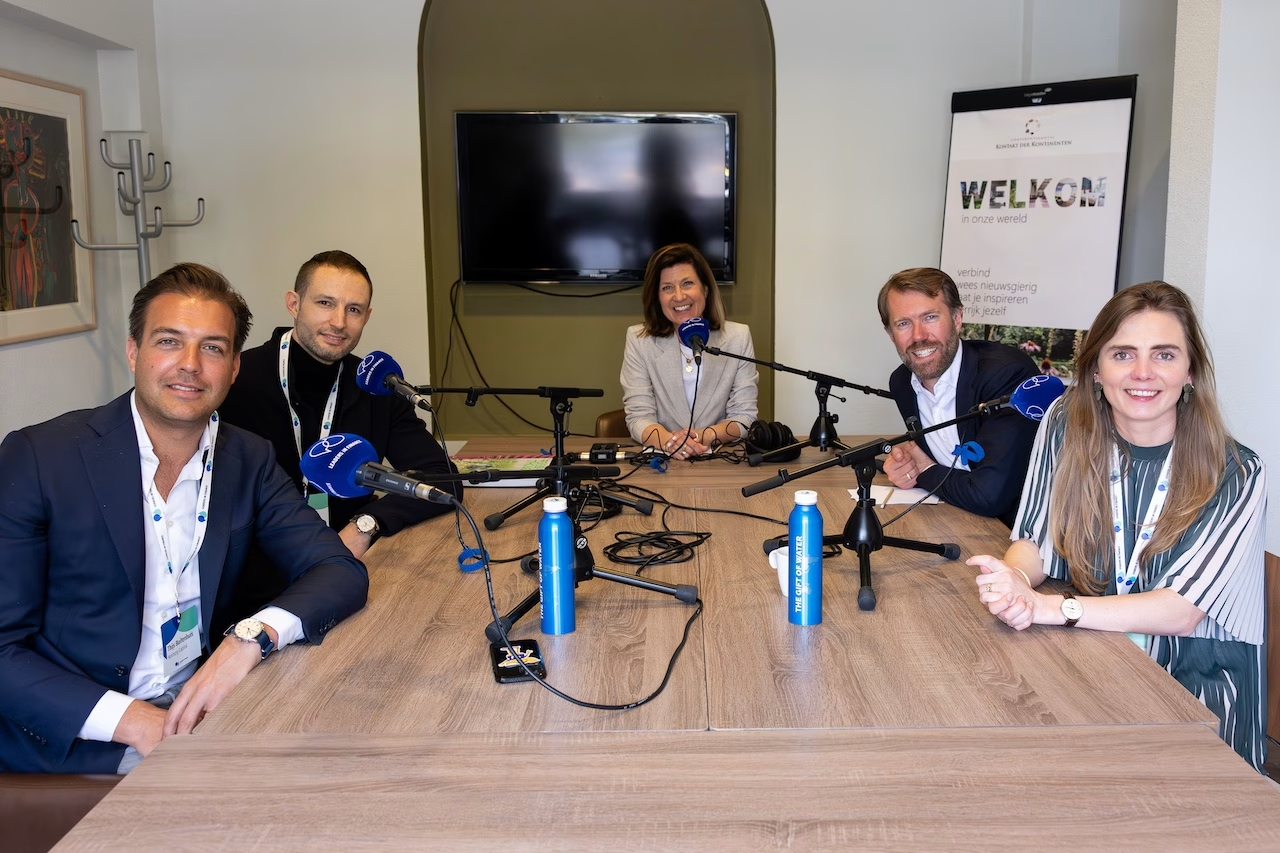
Hi everyone, and thank you for tuning in to this podcast of Leaders in Finance following the Wealth Management event we had today, Thursday 9 April 2026 in Soesterberg. We are currently at Kontakt der Kontinenten following a dense morning program. Hopefully everybody had time to enjoy some lunch.
It’s a nice warm day outside, and very hot in this little room, so let’s get started. Let’s make a round of who we have at the table today. Maybe if you could introduce yourself, tell us who you are, and what it was you did on stage today.
Let me start with Boudewijn on my left-hand side.
Boudewijn:
Thanks, Marije. Boudewijn Chalmers Hoynck van Papendrecht, partner at EY, responsible for the Wealth and Asset Management practice there. I had the honor of doing a bit of scene-setting at the start and a short wrap-up at the end.
Marije:
Wonderful. Next to you is Jessica. Could you please introduce yourself?
Jessica:
My name is Jessica. I’m Head of Segment Value Propositions for Private Banking and Wealth Management at Rabobank, and I was responsible for a keynote on the future generations in relation to wealth.
Marije:
You were actually the closing presentation of today. Let’s move to the other side of the table. We have Thijs, over to you.
Thijs:
I’m Thijs, founder of Norbury Capital, a long-only asset management firm focused on public equities. I tried to give a bit of a challenger perspective to the broader wealth management industry.
Marije:
Wonderful. And then next to you, Yorick.
Yorick:
I’m Yorick Naeff, one of the co-founders of BUX and now Chief Innovation Officer at ABN AMRO. I presented on the role of AI in future banking, and of course what impact that will have on wealth management as well.
Marije:
Exactly. Like I said, we had a very dense program, and we had a team capturing the storyline of today, which was volatility, velocity and value, redesigning wealth management for the next generation. Maybe we can dive a bit more into those themes.
Is there anything you want to add there, and how it applies to your field of expertise, Yorick?
Yorick:
Sure. What I noticed today is there’s so much happening in the wealth management space. If you talk about volatility, I’m flabbergasted by how the market is behaving. I grew up in a period where even the smallest political impact would make markets react tremendously. A few months ago, we had a US president talking about acquiring Greenland, if necessary by force, and the markets didn’t even react. That’s mind-blowing.
And that’s maybe the bridge to velocity. Things are happening so fast nowadays. And then I look at AI and how it is shaping the world, and from a pure technology perspective, how fast things are moving. I’m very impressed, and very lucky to work in this space and witness it firsthand.
Marije:
Wonderful. The challenger perspective, like you said, Thijs, came from you. What did you address regarding this?
Thijs:
Tying into what Yorick is saying, I think we are used to the idea that client loyalty is a given in wealth management. But we may be on the verge of a big change in that loyalty. Five years from now, it may have accelerated tremendously. That means it becomes difficult to assess whether a firm that is valuable today will still be valuable in two or three years.
We should all be aware that the system we have in place now might not be of value in a few years. Everyone should be more on their toes than ever.
Marije:
Right. Jessica, over to you. You gave that perspective of the next generation. You also shared personal examples of what value meant to you, and how you bank differently now than your parents or grandparents.
Jessica:
Yes, and that relates to loyalty as well. I think I’m less loyal than my parents, and I’m more used to switching. And I’m already above my thirties. But the generation now in high school is already experienced. They’re used to apps and start investing at a relatively young age.
That’s very different from previous generations, who would save money first, maybe 10,000 or 100,000 euros, or save their whole lives. Now investing is everywhere. They know about digital assets and are experimenting. And you really have to come with a strong proposition to convince them to put their wealth with you. That’s fundamentally different.
Marije:
I think Anneka Treon of ING gave the example of her son, ten years old, already building his own portfolio. Very interesting to see how differently this new generation is growing up.
Yorick:
And one thing that stood out for me from what Jessica said on stage was: “I’m still using my main bank for daily banking, but I’m flirting with Revolut.” That was such a well-explained way of showing how new generations look at it. It’s all secondary accounts now, but once the wealth shift happens and life events appear, how much of that flirting turns into a real relationship? That’s not going to be linear.
And these things happen in waves, based on life events, geopolitics, technology developments. Revolut today announced their agent model in the UK. I still have a UK account, so I’m going to test it after this event. That’s where they are already. Many banks are still flirting with that stage.
Marije:
And I think that connects well to what Olivier Bouteille from Amundi Technology said. If you are just adding a layer, a little sauce of AI, a lipstick, that’s probably not going to cut it.
Looking back at the program, Boudewijn, was there something that stood out for you?
Boudewijn:
Maybe not something unexpected, but we had a great diverse line-up, and what stood out were the recurring themes. AI being top of mind, obviously. But it’s the combination of what we heard from different speakers. Everyone acknowledges AI will change things dramatically.
But the reality is that much of what people are doing with AI is still at the efficiency use-case level. I would love to see more thinking about how it will fundamentally change the industry. Because it will. We just don’t know exactly how. And it’s probably going faster than many of us think.
That really resonated with people after the event. And the main point now is not to go back and continue doing what you’ve always done. People need to take things forward.
Marije:
That was one of the encouragements indeed. What will you do differently tomorrow when you go back to the office?
Jessica:
And for me, from the Amundi presentation, what stood out was that it is maybe 70% about leadership and people. I know the opportunities of technology, but getting your workforce to adapt may be even harder than implementing the technology itself. That was a big takeaway for me.
Voice-over:
This is Leaders in Finance with Marije Tolsma-Groen.
Marije:
Maybe talking about what stood out, was there a moment or encounter today that made it memorable for you?
Yorick:
Actually, my neighbor. We had a long conversation about the future of wealth management and asset classes. Especially the strength of public equity. I’m a big fan of ETFs. And with European sovereignty becoming more important, the discussion around strengthening capital markets really matters.
There’s a call here for regulators and policymakers as well. There are so many initiatives around the Capital Markets Union, but so much talk and so little impact so far. I hope people are opening their eyes and will now really take action.
Thijs:
In that sense, the current US administration may be a blessing in disguise for Europe, as it has been on defense. I hope the same happens on capital markets. I’m at heart a public equity investor, not an ETF buyer, but I fully support that everyone should be doing something.
The Dutch are kings and queens of saving. Sitting on a lot of money. If we could get our investment percentage to even half of the US level, we would unlock tremendous capital. Innovation starts with making money available.
Boudewijn:
And that links to education as well. How do we get the capital that exists in Europe activated? How do we explain to people who are not investing that they should start?
Because we’re talking about the wealthy here, but often it is people with less wealth who need financial advice the most.
Marije:
Exactly. And how do we get that ball rolling? Yorick?
Yorick:
There’s so much we can do. Education. Adoption. AI. But regulators need to help as well. Make investing tax attractive. Sweden has the ISK. The UK has the ISA. Why don’t we have something similar in the Netherlands?
There are things the private sector, public sector and regulators all need to do. Yesterday, frankly.
Thijs:
Sweden is always the best example. Show me the incentive and I’ll show you the outcome. Sweden alone has more public companies than the Netherlands, Belgium and Luxembourg combined. It can be done.
Marije:
Let’s think positively and fast forward to this time next year. What would you hope has changed?
Yorick:
I hope today’s message resonates. Taking action doesn’t happen overnight. Hopefully next year we can discuss real improvements and things we can be proud of.
Thijs:
And it’s a fascinating crossroads. Technology is moving so fast. Even the Google CEO said yesterday he doesn’t know what next year will look like. That could be very interesting.
Jessica:
I think every company wants competitive advantage, of course. But people are becoming wealthier, so there should be a piece of the pie for everyone. I think that balances out.
Boudewijn:
I’ll stick with what Anneka said: let’s not make industry problems our clients’ problems. I’d love next year to say we’ve made the industry simpler for clients. And that we can showcase progress, and also learn from mistakes. That’s what innovation is.
Marije:
One of the reasons we organize events like this is to bring leaders together. Is there something you would suggest doing next year?
Yorick:
Yes. We have a tendency to think in segments. Retail, wealth, ultra-high-net-worth, institutions. But that creates an internal paradigm. I think we should think less in segments and more in terms of what clients actually want.
That high-net-worth individual on stage today saying he wanted simple products was a great example. We need to build propositions around what clients want, not around internal boxes.
Jessica:
That’s also why I mentioned Robinhood. They are democratizing private banking. You can pay for services regardless of wealth. That makes it accessible. That’s responding to what clients actually ask for.
Boudewijn:
And I’d say, let’s keep having clients on stage. Having a next-gen high-net-worth client in the middle of the program was refreshing. Let’s keep that.
Thijs:
And maybe add a complex family office perspective too. Because I think our segmentation is probably wrong. Maybe we should segment by use case and value people want to extract.
Yorick:
Or AI is going to solve it.
Marije:
Exactly. I think we could talk for hours, but we need to wrap up. For those listening who weren’t in the room, is there one takeaway you want to leave them with?
Yorick:
We’re living in very exciting times. Pay close attention to what’s happening in wealth management in the coming years. It’s more exciting than ever.
Thijs:
There are so many opportunities to invest. I don’t care how you do it, but please start doing it. And tell as many people as possible that they should too.
Jessica:
Be aware of your own biases and the world you are living in. It may be a very different world from your clients or employees.
Boudewijn:
The main takeaway is the pace and diversity of change. Even tokenization hasn’t come up in this conversation, and that’s critical too. There is no room for complacency. Get going, and keep going as an industry.
Marije:
Thank you very much. Which reminds me, while I have you as the last speaker, I should thank the partners again who made today possible. Thank you EY, La Paya, Objectway, DUFAS and the Dutch Banking Association.
Thank you all here at the table. It was great having you on stage and here in this podcast. Looking forward to continuing the conversation and seeing you again soon. Thanks for listening. Bye-bye.
Voice-over:
You’ve been listening to Leaders in Finance. We hope you enjoyed the episode and would love to hear from you. What’s on your mind? Who would you like to hear next? Let us know in a review, an email, or via our social channels.
Finally, we’d like to thank our partners for their ongoing support: EY, Mogelijk Real Estate Finance and La Paya. Don’t forget to check out everything else we do at leadersinfinance.nl.
Thank you for listening.