

Voice-over: Welcome to the Leaders in Finance Compliance Podcast. We talk with experts, advisers and business leaders about navigating risk and compliance challenges within the financial sector. Because the straight and narrow path doesn’t come with GPS. We’d like to thank our partners: Deloitte, Rabobank, Cense and Osborne Clarke. Your host is Jeroen Broekema.
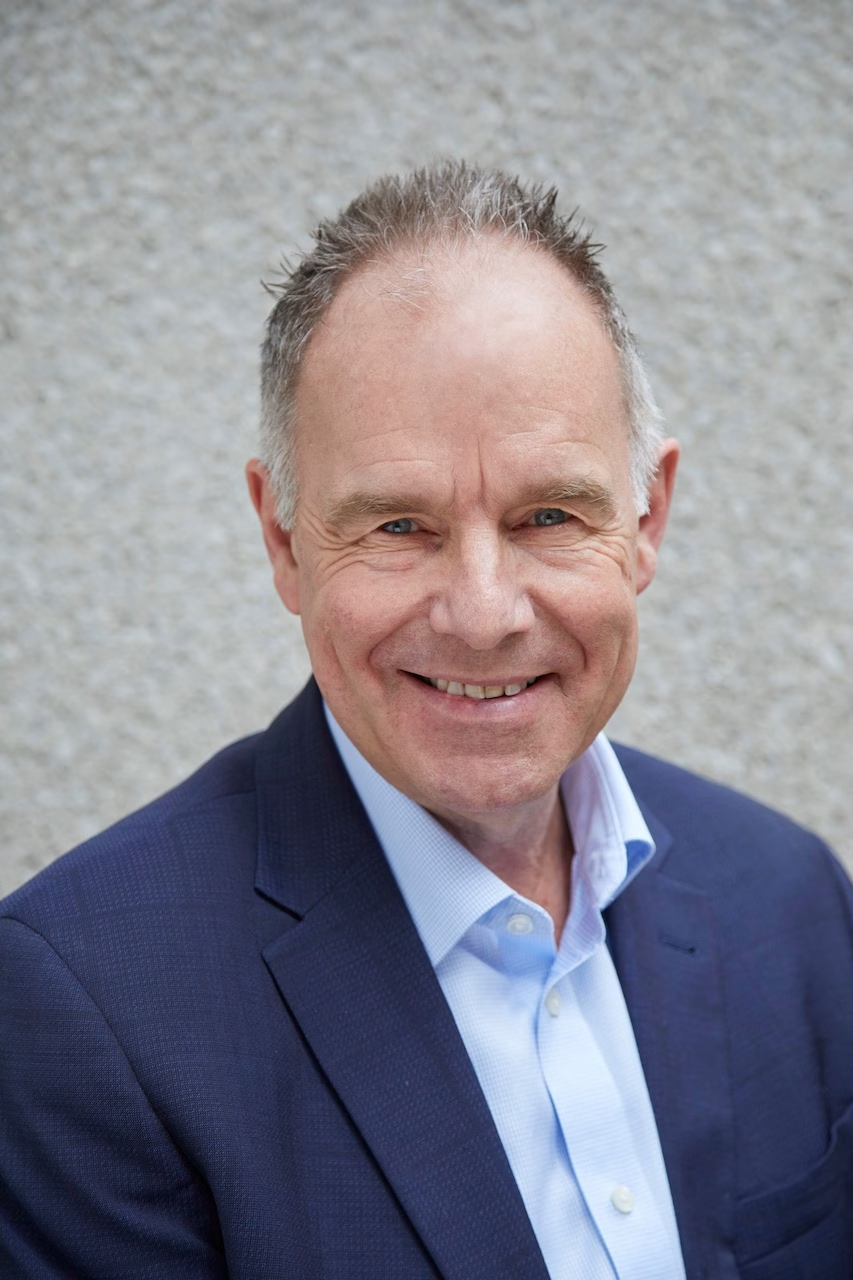
Jeroen: Welcome, listeners, to a new episode of the Leaders in Finance Compliance Podcast. Today with me, here in his office in downtown Sydney, is Math Creemers, the Chief Financial Officer at Achmea Farm Insurance here in Australia. Welcome, Math. It’s a pleasure to meet you. Thanks for taking the time and thanks for hosting me here. First of all, I’d love to get to know you a little bit. And maybe before you start telling me about your background, I would first love to know: how does a Dutchman, because you’re originally from the Netherlands, end up in Australia?
Math: That brings me back to the year 2011, early 2011, when my then boss was asked to fulfil a new role. He would become the CFO of one of Achmea’s foreign operations. And at that time, I had been in my role for about five to six years. And I thought to myself, what am I going to do now? Am I going to lead this myself or am I going to be led? And what I mean by that is: am I going to wait until somebody makes a decision on my new boss, or am I going to search for a new boss myself? And I decided to take that second path and find something else, also because I had already been in that existing role for five or six years. And then I found out that there was a project being started together with Rabobank to see if an insurance operation could be set up down here in Australia. So not so much in Sydney, but in Australia. That’s where I showed my interest in being a participant in that project. And that ended up in a kind of interview, a short interview, because already quite quickly they found out, well, those are the competencies that we would like to have in the project. And that was related to my finance background, but also to the regulatory environment in which an insurance company operates, and the regulatory experience that I had, and that I could use here as well. And that’s the reason why I got introduced into that project. I stepped into that project. That was for about nine months, so that lasted until the end of 2011, when we prepared a business case. Then a decision-making process came. And you can imagine that within a cooperative, that decision-making can take a long time. That had to go through several stages. And I’m not saying that’s negative, because that’s a thorough process. So when the decision was taken to go ahead with setting up that business here, that operation here, I was asked to be part of that as well and to take on the role of CFO of that company, which at that time didn’t yet exist, but soon would. And that’s how I ended up here in Sydney, in Australia.
Jeroen: Thank you. And in preparation for this podcast, I saw that you worked here for a number of years, then went back to the Netherlands and then came back to Australia again. You’ve now been here again for multiple years. So yeah, the follow-up question is of course: why did you leave, and why did you come back?
Math: If you’re sent overseas by a company, there are a lot of, I would say, benefits that come with that. So a lot of it is organised for you. So that’s what you then have to deliver on as well. But after a certain number of years, the company would say, well, you’ve been here for enough time, you’ve done what you needed to do, and we now want to use your experience somewhere else within the Achmea Group. So after five or six years, that question came up within the Achmea Group. Well, do we want to go ahead with Math here in Australia, or do we want him back in the Netherlands? And that’s where I went back to the Achmea Group in the Netherlands. But it could be said that I couldn’t let this go. I think I was so much involved here that I wanted to stay involved in it. And I managed to get a role where part of that role was still related to Achmea Farm Insurance here in Australia. And through that, I had the opportunity to come here every now and then to support them again, but also to have a look at the non-life division in the Netherlands, where the business was actually consolidated. And then, after I had spent five or six years back in the Netherlands, the question was asked whether I would be willing to come back.
Jeroen: Which year was this?
Math: That was at the end of 2023.
Jeroen: Yeah.
Math: And that’s where I was asked whether I would be willing to take up another posting here in Australia, again in the CFO role.
Jeroen: Was it an easy decision, whether you should do it or not?
Math: Well, for me that was an easy decision. I was here in Australia when that call was made. And perhaps I had also been working to steer it in that direction. But I got a call asking whether I would be willing to take on another posting, and I said immediately yes. But I was here. I was on my own. My wife wasn’t here.
Jeroen: You didn’t discuss it with her?
Math: I didn’t.
Jeroen: That’s quite a tricky thing, or not?
Math: Well, if you’re in a good relationship, you know each other well. And I think this was something that I could decide on behalf of both of us, even without involving her at that moment.
Jeroen: That’s good that it didn’t lead to a divorce. That’s great. And maybe you could also spend a couple of sentences on the time before going to Australia. What did you do before?
Math: I started my career with Interpolis in Tilburg. And I started there as an internal auditor. And I did that for about, I’d say, four or five years. And then I moved on to all kinds of finance functions. Eventually, within Interpolis, I was responsible for all the external reporting. That’s also where my regulatory experience comes from. And I was also involved in the mergers and acquisitions of Interpolis. And I was also involved multiple times in the merger between Interpolis and Achmea. Because when that merger happened in late 2005, that was, I don’t know how many, the number of attempts. But there were at least three or four attempts before that. So we were finally successful in 2005. Also, there was the strong relationship at that time with Rabobank, because Rabobank was part of that process as well. And after the merger, my role in Tilburg was made redundant. And I got a similar role at Achmea Group, but then at Eureko, for the external reporting. And that’s where I stepped in. And that was my role until, I’d say, 2011, when this opportunity came up. But I’ve always been working in the finance function.
Jeroen: So I’m speaking to someone with an amazing amount of experience. How many years exactly?
Math: I started back in 1984. So that’s more than 42.
Jeroen: Forty-one, forty-two years. That’s a lot. And that’s maybe a good segue into you explaining to me how different the insurance sector is here compared to the Netherlands.
Math: I have to compare it then with the situation in, say, 2010 or 2011, when I moved here. I found, and actually part of the reason for taking that role here was that I wanted to get out of a situation where regulation was becoming more and more strict. That was actually a deliberate choice for me.
Jeroen: In the Netherlands, you mean.
Math: In the Netherlands, yes, and in the European Union in general, regulation was getting stricter and stricter. And I like to operate in a grey area. And that’s not really a place where you simply have to tick the boxes. And that’s where I thought… I always looked at Australia as a laid-back country, so I expected that the regulations would be less strict than in the Netherlands. And that was, I would say, a lesson that I learned quite quickly. I had only been here, I think, two months, and I thought to myself, Math, what have you done? You wanted to get into an environment where there were not as many restrictions as there were becoming in the Netherlands and the European Union, and in Australia the restrictions, or the regulations, were even stricter than what I had found in the Netherlands. And that’s what I found at that moment in time. And the struggle that you then come across is: to what extent does it limit your entrepreneurial drive, what you actually want to do in business?
Jeroen: Does it?
Math: It does. But in my view, it’s not that regulation should limit it. Rather, you have to manoeuvre within those regulations and the limitations that they bring. And what I’ve also learned myself is to get an understanding of why a rule exists. Why is that rule there? And I could also sometimes ask: why have the rules changed over time? And that’s, I think, also what often happens. Something happens in the market or something happens in society…
Jeroen: A crisis.
Math: A crisis, where politicians respond to it, and that then attracts new or amended regulations. And as long as you can understand where the regulations come from, that helps you understand how you can deal with that in the business and in the operations. But I believe we should always find a way to make sure there is still enough flexibility to manoeuvre within the regulations. If it’s only about ticking the boxes, then the regulations…
Jeroen: Is it more rule-based here? More rule-based here, and you could say more principles-based in the Netherlands or Europe?
Math: Yes.
Jeroen: So do you have an example of something that is striking or something that stands out?
Math: When we started here, we had to apply for a licence. Well, that in itself is not a process that we don’t know in the Netherlands. But in the Netherlands, that licence application, because we also had to apply for a licence in the Netherlands to be active here, was quite a short process. We had to complete some documentation, that went through, and then, because in the Dutch regulations there is even a time limit within which the supervisor has to respond to that application, that was done quite quickly. Here, there’s no time limit on it. So you have to go through that process, and as long as the regulator says it’s not enough, it’s not enough.
Jeroen: So it can drag on for a long time?
Math: It can drag on for a long time. Whereas in the Netherlands, sometimes the regulator would say, well, we’ll stop the clock now because you have to answer questions. The clock would stop. But here there was just no formal end date. And that can make the process quite lengthy. And I can recall that I had a discussion with the regulator that we needed to have what they called a reinsurance policy or reinsurance framework. And then I said to the regulator, why would we need a reinsurance framework? Because we only have one reinsurance contract. And the regulator said, well, that’s fine that you only have one, but you still need to have that policy because that’s what the regulations require.
Jeroen: It’s a rule.
Math: It’s a rule. So that was actually something that was more driven by the rule than by really looking at the context of why it was needed. Because for us, reinsurance was essential. If we hadn’t had reinsurance, and if we hadn’t structured it in that way, there was no way that we could have started that business.
Jeroen: Is it also driven by crises or things that went wrong with other insurers, in your view, that there is so much regulation here?
Math: No, I don’t think that particular point was driven by a crisis. But that particular point is driven by the fact that if you’re a larger insurance company, also with a variety of risks, then the need to have that reinsurance policy in place becomes more relevant. Because if you don’t have a reinsurance policy in place, like Achmea Group in the Netherlands, if they wouldn’t have a reinsurance policy or a framework in place, that wouldn’t work.
Jeroen: But generally speaking, does the amount of regulation here have to do with crises, that there is so much of it, or is it more a cultural thing?
Math: I think it started… It’s a bit of a cultural thing. It is, by the way, a bit different, I think, in New Zealand. Because I can recall when we started here, we also had a look at New Zealand, and the regulation there said you just needed to put 50,000 dollars in a fund and then you could start an insurance operation. That’s a little bit… That country is just three hours away from here. But the regulations here were much stricter at that moment. And my understanding from the past is that there had been a catastrophe involving one of the insurers that failed. And that has also been driving the regulations. And more recently, there has been a Royal Commission on Banking and other financial services, and that again is driving the regulations. And that’s often what you see, I think. Something happens, and then quickly people call for new or additional regulations.
Voice-over: This is the Leaders in Finance Compliance Podcast.
Jeroen: Do you see things where you think, hey, this is interesting for the Netherlands, this could be applied in the Netherlands as well? Can we, the Dutch people, the Dutch insurance industry, learn from here?
Math: I think those learnings are already there. When I left the Netherlands, the regulatory environment for an insurance company was still based on what they then called Solvency I. And when I left, that moved towards Solvency II. And a lot of the regulations that were implemented in Solvency II were already here. So I think the Australian regulations at that moment in time were further ahead than what was happening in, for instance, Europe.
Jeroen: I see. Okay. Comparing the two countries, I just started with it from a regulatory perspective. But if you look at it from a more cultural perspective, you’re the perfect person because you have worked a long time in Australia and an even longer time in the Netherlands. Is there something that is a big difference between the two, especially from a work ethic point of view? I’m not talking about other cultural things, but more about work ethic.
Math: From a work ethic perspective, I believe Dutch people are proud of the companies they work for. I often find that. There’s not really in the Netherlands, I think, what we call a nine-to-five mentality. And if I compare that to Australia, that’s where people move more quickly from company to company. And perhaps I’m the wrong example, with my 40-year experience of loyalty to a certain company and a loyalty to a certain cause. But I always find it interesting to see people hop after two or three years to a new role. What have you actually learned?
Jeroen: You see that here as well in the organisation? It’s also more accepted to do that. It’s not like you won’t get a job because you’ve switched so many times.
Math: I always looked at that when I got CVs.
Jeroen: Yeah, I would be worried about it because, you know, you spend a lot of time educating someone and getting them to know the culture. And then if they’re gone within a year, it’s not a return on investment, I would say, from a rational standpoint.
Math: That’s how I look at it, but that’s not always how Australians look at it.
Jeroen: That’s interesting. And the nine-to-five point also triggered me, because there’s more of a nine-to-five mentality here then?
Math: Yeah, I think that also has to do with that laid-back image that we have of Australia. When they’re in the office, they will work, and there is also a strong work ethic. But they also spend a lot of time on the hard side of the job, or maybe I should say the enjoyable side of life. And that lies in sports, but it could also be, well, going surfing on Bondi Beach, for instance.
Jeroen: And the Dutch are famous for being part-time workers. Do you see that here as well, that people work 20 hours or two days or three days?
Math: It’s an interesting question because we had that discussion, I think, in the last couple of weeks as well. That culture is also, I think, more established in the Netherlands than it is here. So here I would see people more on what they call a 37-hour work week, whereas in the Netherlands it could be anywhere between, let’s say, below 20 and 34 or 36 hours. I think the Netherlands is further ahead in that respect than what we see here.
Jeroen: And comparing, because the comparisons are interesting because I learn a lot about Australia, but also maybe people who are listening can learn from it and apply it in the Netherlands. But if you look at Australia, I think it’s somewhere, I don’t know exactly, don’t quote me on it, but 180 times bigger or something than the Netherlands. I think that’s actually true, something like that. So does that affect doing business, or does it really not matter because of, you know, very strong technological solutions for many things?
Math: It does have an impact on doing business, but that has also changed. If I go back to when we started here, setting up the operation in 2012, mobile phones were already here and I think they were even further advanced than what we had in the Netherlands. But if you would drive out of Sydney, and you were one hour out of Sydney, there was no reception anymore. Internet was here, but if you would go into the non-metropolitan or more remote areas, it would be limited. And that’s where we struggled, especially in the early years when we started setting up our processes. We actually used the processes in the Netherlands as an example, but they were already further advanced because of the technology that was available there. We had fibre in the Netherlands, I don’t know how long we’ve had it already, but for a very long time. That wasn’t here back then, not even in the city. And even now, if I compare my internet speed at home here with my internet speed in my home in Amsterdam, there’s a huge difference. And that also made it difficult to copy the processes from the Netherlands into here. What we also experienced was that the people who had to deal with those tools, with a laptop or with a touchscreen, and had to go onto farms, couldn’t always use those tools properly. And also there, there was a difference between where we in the Netherlands were in using IT versus what was available here. And that has definitely changed over the last 10 to 15 years. We also see that with our clients, our farmers, that a younger generation is now stepping in and becoming more IT-savvy and more comfortable with technology. But still, if you drive out of Sydney, there’s no reception on your phone. And perhaps you can’t imagine it, but from a work health and safety perspective, our commercial staff are driving in the countryside. Most of the time, they won’t have reception on their mobile phone. And that’s where we also had to invest in how we stay in touch with them if there’s an emergency. How do we make sure we can still contact them during work time if something happens? So they all have a tool in their vehicle that is connected to satellites. So they can, I believe, simply press a button in case of emergency, and then we know where they are and what to do.
Jeroen: Amazing. You can hardly believe this.
Math: Yeah. And I’ve sometimes said in the Netherlands, how often is there a train between Amsterdam and Utrecht? I believe there’s one every six minutes. If you go here from Melbourne to Sydney, there’s a plane every 10 to 15 minutes. So that’s a difference.
Jeroen: If we look at your job as CFO at Achmea Farm Insurance here in Australia, where do you spend most of your time? Are you more internally focused? Do you also have external obligations? Are you mainly focused on the regulator? I’m just suggesting a couple of things, maybe all of the above and probably a lot more, but I’m just curious. How does your role look?
Math: My role is… I’ve got two responsibilities, or perhaps even three responsibilities. That’s finance, reinsurance and IT. Risk and compliance sit with my colleague.
Jeroen: So finance, IT and reinsurance.
Math: Yes, correct. Those are my responsibilities. And I would say the majority of the time goes to finance, and then the others are IT and reinsurance. And reinsurance is a bit seasonal as well. So we’re now going into the renewal season, where that becomes more active. And the IT function, that’s a well-established function with management layers, so they can work quite independently on that.
Jeroen: But you have your own IT stack here. It’s not based on what comes out of the Netherlands.
Math: No, so we are actually completely independent from the Netherlands, except from a financing point of view. But except for that, we are completely independent from Achmea Group. So we don’t have to make use of all kinds of group functions. We’ve set up our own IT environment here, and we have our own core systems to run an insurance company, like underwriting, claims and billing.
Jeroen: I see. And you mentioned one of the pillars is reinsurance. So I’m a former banker, so maybe you can explain to me: are there a lot of risks that you need to reinsure externally?
Math: There are two elements why we would reinsure. The first element is to reduce our risk. The risk is then mainly, if I look at the Australian market, on catastrophes. So to make sure that one catastrophe doesn’t hurt… well, it will hurt us, but it doesn’t bring us into a situation where we can’t operate anymore.
Jeroen: Yeah, so a cyclone or something.
Math: So cyclones, bushfires. We recently had bushfires in January. That’s where we seek cover from reinsurers. We also try to avoid having very large risks, very large clients, where a claim or damage with one client could have a severe impact on our results or on our equity. That’s where we then have what we call per-risk cover. So it’s per event and per risk.
Jeroen: Makes sense. And I’m just curious, in times of very, very severe natural disasters, which seem to be becoming bigger and bigger, and I think it’s a fact that there are bigger weather events than ever before, is it always possible to reinsure those things, or are there an increasing number of things that you just can’t insure anymore?
Math: I haven’t come across a situation where we couldn’t reinsure it. If we couldn’t reinsure it, that would probably be for one separate risk where the reinsurers would say that’s just too big. But from a catastrophe perspective, we are still able to reinsure it. The question there is more, I think, at a certain point: what is the price?
Jeroen: Yeah, is the price going up already?
Math: The price… we have been able to maintain it quite stably. I think last year we even managed to bring it down a little bit. But depending on how many catastrophes we have, and the frequency with which we claim under the reinsurance, that will eventually have an impact on prices.
Jeroen: For example, take bushfires. You have many more than 20 years ago, I guess.
Math: There are many more, but it then also becomes a question of where those bushfires are. Are they in areas where we have farms insured? Because you could easily have a bushfire where there’s no damage.
Jeroen: Because assuming that it will only become worse, I think a lot of science points in that direction with climate change and everything changing on that front, do you think it will generally go towards prices going up, or towards excluding certain things because we just can’t insure them anymore?
Math: I think there are two… perhaps flood would be a better example.
Jeroen: Explain that.
Math: Like rivers. So if I look in Australia, they’ve got a lot of rivers and a lot of times those rivers flood. What people tend to do is build a house in a flood-prone area. What then happens is that if there’s a flood, the insurer will pay out. What then happens is that the client, or the owner of that house, will rebuild that house in the same place.
Jeroen: Which makes sense, in a way.
Math: You can imagine what happens three years later when there’s another flood, you get the same situation. So there is a development there where prices go up. But that’s not only because of reinsurance, it’s also because we then have to pass that on to our clients. So we started saying to our clients: if you’re in a flood-prone area, your insurance premium will go up. And that’s explainable, because you are in an area that floods and we can demonstrate it. Reinsurers will do the same. But you could then also say, well, one thing is that the price goes up. Another is: can you help that client to rebuild the house somewhere else?
Jeroen: Somewhere else, yeah, if you can. But I think most people cannot just go somewhere else.
Math: But that’s not… I think it can always be done from, I would say, a technical perspective. But there’s also an emotional component in there. At a certain stage, people need to understand that it becomes… because then people start talking about, my insurance becomes unaffordable. You can also turn that around and ask: are you in an area where insurance can be made affordable? And I think that’s also something psychological that clients, or people, have to go through.
Jeroen: So the answer to my question is probably somewhere in the middle. Prices will go up, but you also push more and more, maybe even to the point that you need to exclude something, because if your house has been hit by a flood for the third time, I guess you’re also not going to insure it.
Math: We have also made our product a bit more flexible now, to give the client the opportunity to opt out of flood cover. And then the premium will of course go down.
Jeroen: Yeah, but that’s a very tricky situation. If you get more and more people not being insured, from a societal perspective… I mean, I understand it from a business perspective, but from a societal perspective that’s quite tricky, I guess, if that number grows over time, with people not being insured. And back to the initial point I made about your role, IT, reinsurance and finance. So you never see clients, or do you actually?
Math: I do.
Jeroen: You do?
Math: I would love to see clients.
Jeroen: You have time for that?
Math: I make time for it.
Jeroen: As in a kind of non-executive involvement role with an account manager, or how does it work?
Math: So I would then join an account manager, or sometimes, if I’m travelling in the country, even if I’m doing that privately, I would still, if there’s an opportunity, visit a client. And what I find important in that is that if I hear things directly from a client, what keeps them busy and what keeps them awake, that helps me again in my finance role to understand what their needs are and what they’re struggling with.
Jeroen: No, that’s very clear. The other topic I wanted to discuss with you, and you already touched upon it a little bit, but I’d love to learn a bit more, because a lot of people work for Dutch financial organisations in other countries. I mean, most work in the Netherlands, but still there are a lot of branches of other firms as well. So can you maybe teach us a couple of things about what is important in that relationship? Because you’re relatively independent here, with your own regulator and your own IT stack, but you are also still very dependent on the mothership, on the HQ. So what could be things that listeners and I can learn about working with an HQ in another country?
Math: What I find important there is that, like me, Achmea Farm Insurance is a relatively young operation. It has only existed since 2013. And if I look at Achmea Group, then I can go back to 1811, when it was actually established by a couple of farmers. There are actually over 200 years of experience in that company. And what I find important in my role is that I can bridge the operation here with my colleagues in the Netherlands. And people who haven’t… if I pick a random person within Achmea Farm Insurance and tell them they have to contact someone in the Netherlands, people start getting frightened because of that head office or headquarters idea. They think, oh, I’m getting nervous, what am I going to go through? Whereas I believe that the fact that I have spent so much time in the Netherlands, with a huge network in that head office and in that organisation, means that I can easily make those connections. What I find important for me is not that I do all those conversations myself, but that I connect people from here with people in the Netherlands, or sometimes the other way around. That’s always what I say here to my colleagues: let me know if I can be of any help in connecting you with colleagues in the Netherlands.
Jeroen: Because is the strategy ultimately made here or in the Netherlands?
Math: The strategy itself is made here, but it is discussed with the Netherlands. So it needs to be supported by…
Jeroen: It needs to fit into the bigger strategy, I guess. Yeah.
Voice-over: The Leaders in Finance Compliance Podcast.
Jeroen: What do you think works best? Making your entity, I mean it could be this entity or any other entity, just to learn from it, it doesn’t have to be about Achmea, but is it better to make it completely independent as much as you can, so people feel like this is my own P&L, I need to perform, the only thing I do is report at the end of the year how my P&L has delivered or not? Or is it better to be fully integrated, or somewhere in between? It’s a difficult one.
Math: That’s, I think, quite a difficult question. I think it is also related to the maturity of a company. If I look at Achmea Farm Insurance, that is actually related to our maturity. And on the other side, if we look at Achmea at the moment, where they are intensifying or expanding their international strategy, and that international strategy is on the retail side where we digitally offer retail insurance, if you have a strategy there and you have operations in multiple countries, I think you will get to a point where the sum of those multiple companies in those countries means that it becomes cheaper or more efficient if you centralise certain functions. That’s what I would expect. And that’s also what I see happening at the moment.
Jeroen: Yeah. But let’s take, for example, a topic like cybersecurity. Does it make sense to build your own cybersecurity here? Or is that something you should typically do at group level?
Math: We built it here ourselves, as we have our own systems, but from a knowledge perspective we also rely on the knowledge they have in the Netherlands. So we use headquarters, Achmea, more as a knowledge centre that can support us in implementing it.
Jeroen: For example, the use of artificial intelligence.
Math: The use of artificial intelligence, yeah. So that’s where we will actually leverage what Achmea does in the Netherlands.
Jeroen: Yeah, that makes total sense to me. I want to ask two final, maybe three final questions because time is going so fast. It’s very interesting, the things you’re sharing, but I’ll come back to that. First of all, about the future of Achmea here in Australia. What are your maybe one or two, or however many, worries and maybe challenges, and one or two or three, or however many, opportunities you see for the business here?
Math: My worry is also my opportunity, I would say.
Jeroen: Smart.
Math: The worry is predominantly on the growth side. So our operation at the moment is actually small. I wouldn’t say too small, but it is small, and it should grow to a certain level, or actually, we should always aim for growth. But to remain sustainable, we need to grow to a certain level. Is that possible? I believe it is possible. We managed to get to, I think, a market share of around 7% in 10 years’ time. There is sufficient room.
Jeroen: Because currently it’s much lower than 7%.
Math: No, we are at about 7% right now.
Jeroen: Oh, you are at 7% right now.
Math: Okay. And I believe that we should at least double that.
Jeroen: Okay, so you came from pretty much zero to 7% in 10 years. Now you need to go to 14% in the next decade.
Math: Yeah, because we started at zero back in 2013. That’s the growth, and that’s also where I see the opportunity. There’s room. Also, if I hear from the market that competitors are seriously looking at us, also just because they take us seriously and see us as a competitor, that’s where I say, well, then there is room and there are opportunities enough. And we also have opportunities because, when we started, we had to select people where they became available. And now, based on the data that we have, we can actually be more selective in the areas where we would like to have a commercial person. So also from a risk perspective, the risks are more limited, or the market is bigger, than in other areas.
Jeroen: Because is the main reason that people switch relatively quickly how much they get paid, or is it something else?
Math: I think it’s maybe…
Jeroen: I’m not talking to the head of HR, but I’m just curious because you mentioned a couple of times that that is a challenge for you. Yeah. And the other question I have, probably my last question, is: I’ve asked every guest on the show, do you have tips for people in compliance or more in the CFO function, it doesn’t matter, or regulatory or risk, but more in that area and that space, who are starting their career today? It could also be a tip to your younger self, but it doesn’t matter. Do you have one, or a couple?
Math: Yeah, so the tip would be what I mentioned before. If you come across regulations and you have to work with regulations, try to understand why those regulations are there. Don’t just take them for granted, because that is, I think, the easiest way. But if you take them for granted, I think you get into a situation where you would just follow the rules. And I think you will fail then. And I think you should, and that is a bit of leadership, create an environment in which there is uncertainty, but also support for working in a grey area without becoming non-compliant with those regulations.
Jeroen: I see.
Math: That’s a good tip. I put some phrases on it. I said, what am I supposed to say? Be disciplined, but not rigid.
Jeroen: Right, be disciplined.
Math: And adapt, but don’t be reckless. So that’s how you find, I believe, the balance between the regulations and the flexibility.
Jeroen: And maybe before I wrap up, I should also ask you about your own future. So do you see yourself going back to the Netherlands at some point, or to another country? I hope you discuss it with your wife this time.
Math: Well, recently I had my birthday and I got a book from my wife that was about retirement.
Jeroen: Ah, was that a hint?
Math: That was a bit of a hint, yeah. So I’m giving my answer.
Jeroen: You’ve been only working for 42 years. You’re just getting started.
Math: So no, I haven’t taken a decision on that yet, but at a certain moment in time you have to say, well, enough is enough, or you have to get into a different situation where it’s no longer a full-time job. Whether it’s a part-time job or whatever kind of job, but not every week. I have no… that’s…
Jeroen: But if you would ever retire, would you do that here in Australia or would you go back to the Netherlands? That’s another topic. It’s up for debate.
Math: Well, I wouldn’t say it’s up for debate, but there are certain things that you have to balance out then. Because we don’t… who is going to take care of us when we get older here?
Jeroen: Yeah, makes sense.
Math: So those are all kinds of questions that are on the table at the moment from a personal perspective.
Jeroen: Thanks for sharing. Did we miss something in this conversation? Something you were like, that’s really what I wanted to share, but we didn’t, I didn’t ask about it? Is there something? That’s perhaps the glass jar concept.
Math: I don’t know if…
Jeroen: I’ve read about it in preparing. There was the glass jar concept where farmers put money in a glass jar, but you can explain it much better than I do.
Math: So we have that concept here. That’s part of our marketing. The glass jar concept in the Netherlands would not resonate that much from a glass jar perspective, but the jar itself does resonate when you go back to 1811, where farmers put money in a jar, actually. And from there, if there was a haystack fire, they would get paid out from that jar. But what I always found interesting in that is not so much that that is actually where insurance started, but that there was one person appointed as the custodian of that jar. So that custodian had to look after that jar. So what I often tell my colleagues here in Australia, and then I’ll go back to that glass jar, the first thing I always mention to them is that there is a bottom in that glass jar. So there can be money in that glass jar, but if you take money out, at a certain point there is a bottom. It is not bottomless. So that’s what I often tell them, that they have to bear that in mind. And the other thing they have to bear in mind is that we as an insurer are the custodian of that jar. And we have to be thorough in selecting the people who are allowed to put money into that glass jar.
Jeroen: Because if we would have… Oh, I thought you would say to take money out, but it’s about putting money in.
Math: Putting money in. Because that’s the way you assess a client or a prospect, a farmer, up front. Do we want to have that farmer in that glass jar?
Jeroen: Ah, do you want that risk in the jar. Right.
Math: If there are only bad risks in that glass jar, or if we have a number of bad risks, that actually isn’t good for the good risks. And that’s what I think the role of the insurance company is as well. I think that is often forgotten, and that even clients or prospects forget that.
Jeroen: Anything else we’ve missed? I’m asking it one more time to be sure. To be 100% sure. You’ve been very clear. Math, I should say, Creemers, the Chief Financial Officer at Achmea Farm Insurance here in Australia, I’m very glad that you took the time to speak to me for the Leaders in Finance Compliance Podcast here, live and in person in downtown, or as you guys call it, the central business district in Sydney, the CBD. Thank you so much for your time. Our listeners cannot see this, but I have behind me, I’m pointing at it now, a small present for you to thank you for your time and everything you wanted to, and did, share with my audience. So thank you so much for taking the time.
Math: It was a pleasure to be with you.
Jeroen: Thank you very much.
Voice-over: You’ve been listening to the Leaders in Finance Compliance Podcast. We’d like to thank our partners Deloitte, Rabobank, Cense and Osborne Clarke. Would you like to know more or leave us a comment? You can do this on our LinkedIn page. If you follow us there, we’ll keep you up to date with our new episodes. We’d be grateful if you could leave a review and tell others about this podcast. Also, don’t forget to check out the other podcasts on our channel. There’s bound to be something for you.