
Voice-over: This is Leaders in Finance, a podcast where we find out more about the people behind a successful career. We speak with the leaders of today and tomorrow to discuss their motivations, their organizations, and their personal lives. Why? Because the financial sector could use a little more honest conversation. We would like to thank our partners for their ongoing support: EY, Mogelijk Real Estate Finance, and Lepaya. Your host is Tom van Disseldorp.
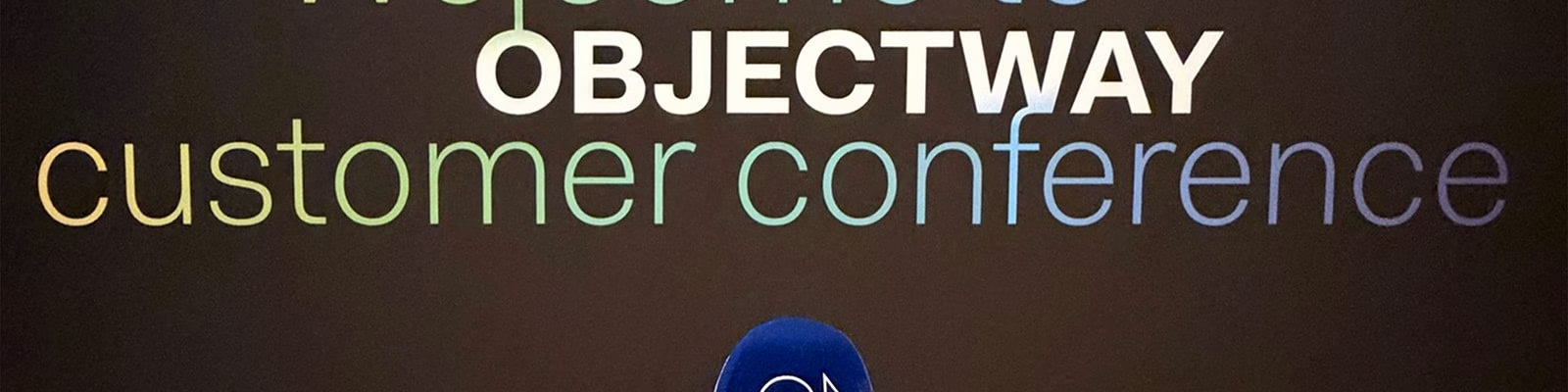
Tom: Welcome everyone to a new episode of the Leaders in Finance podcast. I am Tom van Disseldorp, Event and Stakeholder Manager at Leaders in Finance. Together with my colleague Kees, we are coming to you live from Italy, where we are attending OWIN26, a multi-day event hosted by ObjectWay.
We are here with around 200 professionals from across the financial sector, gathering to share insights, network, and inspire one another. Leaders in Finance is more than just a podcast. We organize large-scale events in partnership with industry leaders like ObjectWay, offer in-depth training through our academy, and host exclusive networking lunches throughout the year.
Whether it is through live events, digital content, or educational programs, our mission is clear: to connect and strengthen the financial community. Today, between sessions at OWIN26, we are taking a moment to sit down for a short but powerful conversation. I am honored to introduce Erik van der Deijl, Country Operating Officer at ABN AMRO, and Karel Im Brahm, CEO DAG Region at ObjectWay.
First of all, could you please introduce yourselves and your roles in one or two sentences? I will start with Karel.
Karl: My name is Karel Im Brahm, and I am responsible for the ObjectWay business in the DAG region, with Germany as our main focus. We have many clients in Germany, and I work closely with them. Today, I am here together with Erik for this podcast.
Tom: Great to have you. Thank you.
Erik: My name is Erik van der Deijl. I am the Country Operating Officer of ABN AMRO in Germany. ABN AMRO is also quite large in Germany. Of course, everyone knows us from the Netherlands, but here we are active in private banking, corporate banking, and commercial banking.
As a typical COO, I am responsible for IT operations, facility management, DFC, and more. I also act as CIO, so I am head of IT. Naturally, I have regular contact with Karel, as ObjectWay provides our core banking system.
Tom: Thank you for your introduction. It is the second day of OWIN26. Erik, what do you think so far?
Erik: I already have good memories and am making more here in Sorrento. The sessions are very inspiring, especially seeing how colleagues in the market use ObjectWay’s software in different ways. That is quite interesting.
I particularly value the networking—meeting colleagues from the market as well as providers. That is very useful. Also, the in-depth stories from various studies and projects are very interesting. Overall, it is definitely worth our while.
Tom: Karel, what is your perspective on the first two days?
Karl: I fully agree with Erik. For us, these conferences are very important because they represent our ecosystem. We also defined a headline for this conference: scalable innovation. That is our new mantra. Under this theme, we are discussing many topics in an open, transparent, and open-minded way. It gives us a lot of valuable input for our future work with our clients.
Tom: Erik, during your session you discussed efficiency and resilience. How do you translate those themes into concrete decisions?
Erik: For a bank, trust is the most important value to convey to our clients. Trust is closely linked to resilience—ensuring we can always deliver on time. At the same time, efficiency is extremely important for our clients as well.
We have focused on implementing efficiency measures over recent years. And although it is a bit of a buzzword, artificial intelligence plays a key role. We have spent a long time getting our data in order, and now we are unlocking its value. Data is a critical input for AI.
Our focus in Germany is private banking—we are the third-largest private bank here. AI mainly supports our advisors and relationship managers. The personal relationship remains the most important, but AI enhances efficiency. Resilience is also central, as reflected in regulations like DORA. Efficiency is equally essential, as we aim to support our clients in their wealth journey as effectively as possible.
Tom: Karl, I see you nodding. Is there anything you want to add?
Karl: We are aligned on this topic. One key challenge is managing complexity. We are talking about the backbone of a bank with our solutions, and that complexity is significant. There are many regulatory requirements, so it is crucial to operate within a strong ecosystem. We need to manage and scale the business model—not the complexity—and prepare banks for the future. AI is now entering a new phase, with agentic AI on the horizon. However, I fully agree that human interaction remains essential for building trust with clients. We must combine both.
Tom: Is that also where you see the biggest opportunities to improve efficiency today?
Karl: It is one of the major trends we are seeing in the market. Many banks are exploring use cases, but we need an integrated approach. It is also a cultural topic—we must prepare employees to work with and accept AI. That is the biggest challenge. At the same time, we must operate within regulatory frameworks like the AI Act and DORA.
Tom: Yesterday, during your presentation, you mentioned your joint project. Is that something you would like to elaborate on?
Erik: Happy to. It is our main program at ABN AMRO Germany, called Horizon. The goal is to establish Germany as our second home market. We acquired Hauck Aufhäuser Lampe, a fast-growing private bank with around €30 billion in assets under management. It adds strong asset servicing capabilities and investment banking expertise. The key question is how to efficiently integrate both banks. This involves not only IT, but also products, clients, and employees. Both banks use ObjectWay’s core banking system (OBS), which helps, but the program remains complex and ambitious. Our aim is to integrate wealth management clients within the next six months and truly combine the organizations to grow in Germany.
Tom: Karl, anything you would like to add?
Karl: A key success factor is our long-standing collaboration—we have worked together since the early 2000s. The banks involved have extensive experience with consolidation. Germany is seeing a major consolidation wave in private banking. Our clients are in the driver’s seat, supported by strong technology partners. With this experience, I am confident we can align our roadmaps and deliver the best solution for our clients.
Tom: What lessons have you learned from large-scale transformations?
Karl: It comes down to people management. You need a clear target operating model, strong solution design, and involvement of experts. But ultimately, aligned decision-makers with a shared goal are the key success factor.
Erik: I would add that the devil is in the details. You need to go deep into processes, products, client setups, and fee structures as early as possible. Even then, surprises will occur, so you need strong governance to deal with them efficiently. It is also critical to make strategic decisions early and stick to them. And in the end, as Karel mentioned, it is a people business. Having trusted partners like ObjectWay makes a real difference.
Tom: We have time for one final question. Looking ahead two to three years, what is one underestimated development?
Karl: AI may still be underestimated—not in awareness, but in execution. It is not just about use cases; it requires organizational transformation and strong change management. Many companies are motivated to talk about AI, but execution is the real challenge. Our focus is on using AI for execution itself.
Erik: I agree. The real impact of AI may still be underestimated, especially in the near term.
We are now focused on people using AI, but the next phase—agents interacting autonomously—raises complex ethical and operational questions. It will be interesting to see how we, as humanity, maintain control over these developments.
Tom: Thank you both for being here, and thanks to our listeners for joining us live from Italy at OWIN26. Thanks very much.
Karl: Thank you. Ciao, ciao.
Voice-over: You have been listening to Leaders in Finance. We hope you enjoyed the episode and would love to hear from you. What is on your mind? Who would you like to hear next? Let us know in a review, via email, or through our social channels. Finally, we would like to thank our partners for their ongoing support: EY, Mogelijk Real Estate Finance, and Lapaya. Do not forget to check out everything we do at leadersinfinance.nl. Thank you for listening.