
Voice-over: This is Leaders in Finance, a podcast where we find out more about the people behind a successful career. We speak with the leaders of today and tomorrow to discuss their motivations, their organizations, and their personal lives. Why? Because the financial sector could use a little more honest conversation. We would like to thank our partners for their ongoing support: EY, Mogelijk Vastgoedfinancieringen, and Lepaya
Your host is Tom van Disseldorp.
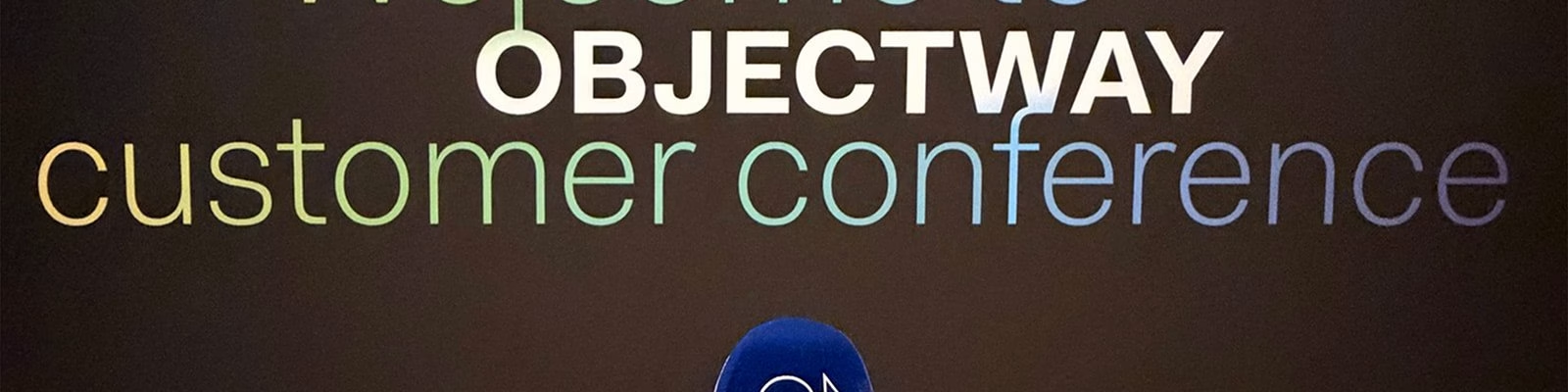
Tom: Welcome everyone to a new episode of the Leaders in Finance podcast. I am Tom van Disseldorp, Event and Stakeholder Manager at Leaders in Finance. Together with my colleague Kees, we are coming to you live from Italy, where we are attending OWIN26, a multi-day event hosted by Objectway. We are here with around 200 professionals from across the financial sector, gathering to share insights, network, and inspire one another.
Leaders in Finance is more than just a podcast. We organize large-scale events in partnership with industry leaders like Objectway, offer in-depth training through our academy, and host exclusive networking lunches throughout the year. Whether through live events, digital content, or educational programs, our mission is clear: to connect and strengthen the financial community.
Today, between sessions at OWIN26, we are taking a moment to sit down for a short but powerful conversation. I am honored to introduce Alexander Cassar, CEO UK at Objectway. Good afternoon, and thank you for joining us. Welcome, Alexander, great to have you here.
First of all, could you briefly introduce yourself and your role in a few sentences?
Alexander: Yes, of course. I am Alexander Cassar, Chief Executive Officer for Objectway in the UK, where we serve over 50 wealth management firms.
Tom: Great. The first day of OWIN26 is almost over. How has your experience been so far?
Alexander: Very powerful, with very positive energy. Of course, with artificial intelligence on everyone’s lips, it feels like being in the right place at the right time. It is a great opportunity to share our roadmap with clients—how we will enhance AI and, more importantly, help them embrace and amplify AI within their businesses.
Tom: If I understood correctly, scaling-as-a-service models and operational efficiency were emphasized during the event.
Alexander: Correct.
Tom: How do your clients translate that into practice?
Alexander: At Objectway, we manage the balance between what each client specifically needs—because every client runs their business differently—and avoiding over-customization. We do this by using a modular front-to-back approach to the Objectway platform, combining a component-based architecture. It is a bit like Lego. You might remember the original small red bricks.
Tom: Yes, just old enough—we played with them too.
Alexander: Exactly. Today, if you look at my 10-year-old son’s Lego, it is mind-blowing. But at its core, it is still the same small red brick.
This means we can take individual components and create the right architecture. We give each client something specific that allows them to be unique in how they conduct business, while avoiding the overhead of maintaining fully tailored solutions.
This concept was also discussed today by my colleague Alberto Cuccu, our Group CEO, who explained how to orchestrate this. It is not enough to have modules; you also need the right architect to put everything together.
In practice, we approach this in several ways. First, we position ourselves more as architects than just software engineers or developers. Second, we configure components through parameterization instead of full customization.
For example, imagine a Dutch wealth manager serving older clients who depend on pension income for daily living. You need to tailor services to that need, while also supporting younger clients—more digitally oriented—within the same system. This requires a strong architectural approach, which is only possible with modularity.
Third, two years ago in Venice, we introduced the Diamond Innovation Framework, our proprietary approach to guide clients away from ad hoc, overly bespoke initiatives toward a standardized yet flexible model.
With the cloud, this has become easier. Open APIs allow integration with third-party systems, avoiding technical debt from heavy customization. Through AI, we can connect our platform to virtually any system—whether modern or legacy.
Finally, it is about prioritization and balance. We focus on purpose-driven innovation—ensuring that everything delivers a clear return on investment. This applies to client-facing areas where differentiation matters, while maintaining standardized, highly automated processes from front to back.
Tom: And is this what was meant during one of the presentations with a front-to-back-to-front approach?
Alexander: Yes, I think so. But we should ask Alberto Cuccu. He was the one who introduced the term, and it was a very valuable insight.
Tom: Yes, Alberto Cuccu will also be featured on our podcast.
Alexander: Oh, great.
Tom: We will have an episode with him as well. What does operational excellence truly mean in today’s environment?
Alexander: In wealth management, operational excellence starts with putting the client first. It is all about being truly client-centric. Everything you do should deliver value to the client, because ultimately, they trust you with their money.
At Objectway, operational excellence is exactly that. We see ourselves as being in the business of problem-solving and identifying opportunities—not simply writing software for the sake of it.
To return to the Lego analogy: what fascinates me today is how Lego has extended its brand. I have a five-year-old daughter—she wears Lego shoes and Lego clothing. It shows that once you are truly client-centric, and with today’s technology, the possibilities are endless.
Tom: The sky is the limit. And what I am curious about is: what will Lego look like in five to ten years from now? We have already seen a huge leap from the simple bricks we knew to the complex starships available today.
Alexander: I think people of my generation—I am turning 60 this year—will always relate to the small red brick. But younger generations, like my children, will expect experiences on an iPad, more in a virtual environment rather than with physical bricks. It is up to Lego to evolve. In a way, Lego will have to become tokenized.
Tom: How do you balance standardization and flexibility across different client operating models?
Alexander: I think I partly addressed that earlier. Once you have a platform built from multiple modules, the key is to parameterize those modules for each client without changing the modules themselves. That is where the balance lies.
This is only possible with a composable architecture, where each module has the capabilities to meet client needs—whether solving a problem or creating an opportunity.
Tom: That is always the balance you are aiming for.
Alexander: Exactly.
Tom:I will close this episode with one final question. Looking ahead two to three years, what is one development that is still underestimated?
Alexander: A very good question. I think we should never forget that this industry exists because of one thing: trust.
Whether it is the trust between a banker or wealth manager and their client, or the trust between the wealth manager and us as a provider—there is always a responsibility. From our perspective, we have to ensure that the solutions we deliver work effectively and reliably.
So for me, the most underestimated factor remains trust.
Tom: The trust factor. That brings us to the end of this episode. Thank you, Alexander, and thank you to our listeners for tuning in to the Leaders in Finance podcast, live from OWIN26.
Thank you for listening, and have a great day.
Voice-over: Thank you for listening to Leaders in Finance. We hope you enjoyed this episode and would love to hear your thoughts. What is on your mind? Who would you like to hear next? Let us know via a review, email, or our social channels—we greatly appreciate it.
Finally, we would like to thank our partners for their ongoing support: EY, Mogelijk Real Estate Finance, and Lepaya. Do not forget to explore everything else we do at leadersinfinance.nl. Thank you for listening.