
Voice-over: Welcome to the Leaders in Finance Compliance Podcast. We talk with experts, advisors, and business leaders about navigating risk and compliance challenges within the financial sector. Because the straight and narrow path doesn’t come with GPS. We’d like to thank our partners: Cense, Deloitte, Kayak, Rabobank, en Osborne Clarke. Your host is Jeroen Broekema.
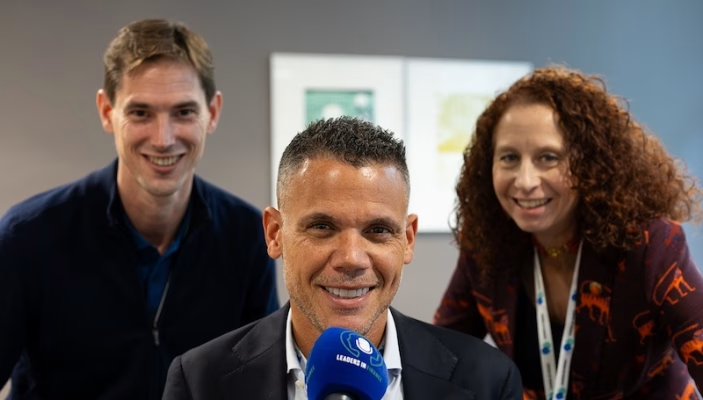
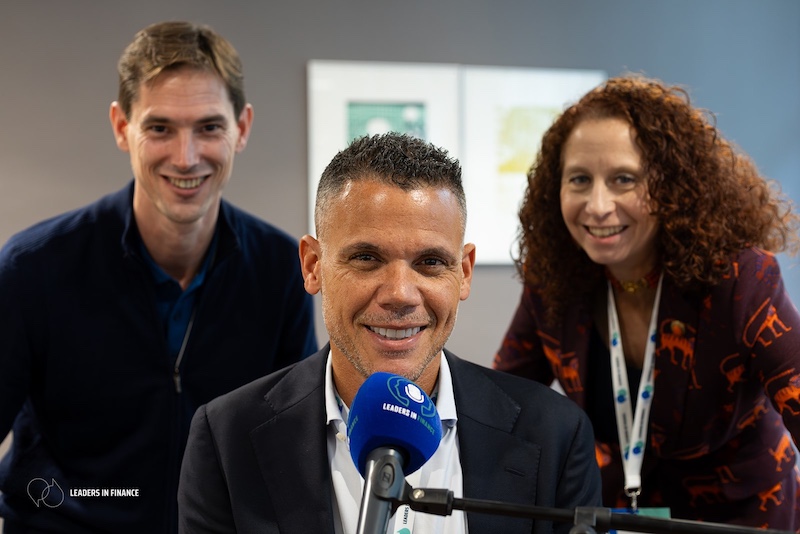
Jeroen: Welcome, listeners, to an extra episode of Leaders in Finance. I’m very happy you’re listening. I’m currently in Soesterberg, the Netherlands, right after the Leaders in Finance Compliance Event ended. And I’m here with three people who joined this conference and were also active on stage. Let me introduce them to you: Vanessa van der Does, Chief Compliance Officer at NN Group; Christiaan Visser, Partner at Deloitte; and Hugo Leijtens, Co-Founder & Chief Strategy Officer at Cense. Welcome, everyone, to this podcast.
And what we’re going to do in this extra episode is reflect a little on today’s event. We’ve seen a lot of speakers, we’ve seen a lot of panels, and I’m really curious to hear what stood out for you and what you found particularly interesting. But before we do that, I’d love for you to introduce yourselves a bit further than the short introduction I just gave. Vanessa, could you start, please?
Vanessa: Yes, of course. I’ve been in the financial industry for over 25 years in various business and IT roles. And as of last year, I joined the group compliance team again as Chief Compliance Officer.
Jeroen: That’s great. Hugo?
Hugo: So, I’m Hugo. I’m a co-founder of Cense. We build compliance software for the crypto industry. And part-time, I am the crypto and AI expert for RIEC.
Jeroen: Wonderful. Christiaan?
Christiaan: Christiaan Visser. I’m a regulatory and compliance enthusiast. I’ve been active in financial services and compliance for more than 25 years. First as a lawyer, then as a banker, and now as a professional services leader.
Jeroen: A follow-up for you. You worked for a long time in a major bank, right? Very different from being a partner in a consulting firm?
Christiaan: Yeah, definitely. When I started out, I mentioned earlier that I was part of the team of the first compliance officers at the bank I worked for, ING Bank. We were five. Now I know that number has multiplied by hundreds, day after day. And when I moved to Deloitte, I always say I made my main job out of my side job. It’s really something different.
Jeroen: Well put. Hugo, you’re an entrepreneur. And as you mentioned, you also work for RIEC, which is a government organization. Is it easy to combine the two?
Hugo: No, it’s actually quite challenging. Doing two jobs at the same time is always challenging. The fortunate thing is that I see it as one big value chain, basically connecting the dots from the private sector into the public sector. And I’m in a fortunate position to build software that allows data to be that connecting factor.
Jeroen: Vanessa, you did not always work in financial services. It’s a great world to be in.
Vanessa: Yeah, I really liked it. I joined for very practical reasons. I wanted to be a manager and work part-time because I wanted to start a family. That was already well developed 25 years ago in the financial sector. I thought I would leave as soon as I started my family. And 25 years later, I’m still here.
Jeroen: Interesting how you got there, but you’re happy to be in.
Vanessa: Very much.
Jeroen: If you look at the event today and your own role, what was your contribution?
Vanessa: I joined the panel on stage with Wibout from Triodos Bank. We had a good discussion on compliance and AI technology, with a lot of interaction with the audience. I really enjoyed it.
Jeroen: And when it comes to tech and AI adoption within your organization, would you say you’re a leader in financial services or more of a laggard?
Vanessa: Hopefully in the forefront. We have a very enthusiastic board and a lot of developments. But after Hugo’s presentation, I think we need to adjust that a little. Still, AI is at the core of our business. We have many examples and business cases where we’re adopting AI, also in compliance.
Jeroen: And in that adoption, are you more focused on risks, given you’re a compliance officer, or on opportunities?
Vanessa: I don’t think it’s a contradiction. If you want to use AI safely, that’s the only way you can use it. I see a lot of opportunities, also for compliance. For example, in our contact center, staff have to make notes after a customer call, but they’re under time pressure. The notes often fall short, so when a customer calls back, details are missing and you can’t spot trends. Now AI listens in and staff only validate the conversation. It helps us serve customers better, more efficiently, and remain compliant. So it’s not always a contradiction. But if you look at compliance itself, we can still step up. Right now, we support the business in using AI more than we use it for ourselves. That’s still to be developed.
Jeroen: To smoothly segue into Hugo’s presentation, what made you mention him?
Vanessa: I think it’s also my old profession, IT. That spark came alive again. At the same time, bringing a difficult subject like AML into the tech area, and then moving forward to crypto and all the things out there, and linking that to my day-to-day business that also incorporates a digital bank—that really connected a lot of dots in my head. I got inspired, I see opportunities, and I can’t wait to explore them even more.
Jeroen: You’re just allowed to mention one or maximum two points you wanted to get across today, Hugo. What were those?
Hugo: I think the crypto market is growing, and the whole market is getting more mature. We need to start embracing it. And now we also have the means, the methodology, and the tools to do so.
Jeroen: Excellent. Christiaan, you headed up a panel. Could you tell me more about what this panel was about and who was in there?
Christiaan: Yeah, sure. I was very happy with the opportunity to facilitate the panel on operational resilience. I had two esteemed panel members: Tom van der Laar, Global Financial Crime Head and Deputy Global Compliance Officer at Rabobank, and David Minderhoud, CEO of ICS Cards. It was a very nice conversation about the shift from managing system outage time to upholding institutional trust under distress. I really liked the conversation, especially David’s addition of a business and CEO perspective to the topic of compliance.
Jeroen: Yeah, because you suggested when we were preparing for this event to add a CEO to a chief compliance panel. I thought that was interesting, but it worked out well. What was the reason you wanted a CEO there instead of just chief compliance officers?
Christiaan: I think it really resonated today. It showed that compliance, which 15–20 years ago was more of a second-line function somewhere in the basement of the office, is now something a CEO is very involved in. If we want to further develop, it’s very important to take those insights into account. And maybe for next year, we can also invite clients or customer groups. That would be very insightful to continue the learning process.
Hugo: As a listener to your panel, I also really enjoyed it. To be honest, the CEO of ICS was very funny. It’s complex to make such a relatively boring topic like compliance and AML into something understandable and practical. It was a very nice panel.
Vanessa: And also to see that there is basically no difference between compliance and a CEO. You both have the customer at heart. And we’re in the business of trust—selling trust. I think he mentioned that as well. And that’s what compliance is all about: making sure customers trust us. For me, it was nice to see we were on the same page. That’s not always the feeling you get in day-to-day practice.
Christiaan: I think a very strong statement is about trust. The trust equation and the importance of trust from a business perspective.
Jeroen: Before we move on to the program, Vanessa, one thing I remember very vividly was you talking with concrete examples about all the complexity—on top of what we already see with politics, AI, tech, and cultural differences. You gave examples on Poland and Japan. Do you think that’s ultimately even more important than everything else?
Vanessa: I think the basis of everything we do is behavior. You can write all the policies and have all the tech solutions, but you can’t be there all the time. You have to rely on people’s behavior—that they want to do the right thing and know what the right thing is. And you have to take into account different lenses in different countries, or even within one country. If you don’t, you risk missing the point. Maybe AI will do that for us in the future, but for now, behavior is more important than translating policy or having the right controls.
Jeroen: Is it harder given people work from home so much nowadays?
Vanessa: No, not in this aspect, if I’m honest. What I do think, and it was mentioned in the panels today, is that I’m not worried about senior people. They have their network; they know what to do. But for new or junior people, they learn from others. I always say: you don’t go to the office for yourself, you go for your team. And when I’m in the office, I hear more than I do at home. At home I have to plan to call someone. At the office, I overhear a conversation and think: if you’re talking about that, I know someone else you should connect with. I’m always trying to connect people and dots, and that works better in the office.
Jeroen: I see the gentleman nodding. Very practically, how much time do you work from home? Same question to the others.
Vanessa: I’m in the office at least two days a week, often a bit more. But I also really enjoy working from home. With a busy family and being used to multitasking, I’m very effective at home as well.
Jeroen: You already have that network, as you mentioned. And you guys?
Christiaan: I used to be really an office tiger, as we say in Dutch. For 20 years, I was in the office five days a week.
Jeroen: Including nights sometimes?
Christiaan: Sometimes as well. But since COVID, I’ve also noticed the pleasure of working from home. So now it’s two days a week at home, three days at the office or client side. But it also opens a lot of opportunities for unlocking talent across the globe. That’s the big upside of working from home: access to the whole talent pool globally. And I think that’s a big, big upside.
Hugo: Yes, well, Cense is a remote-first company by definition. Basically we all work remote except for our development office in Poland. We try to center most of the developers there because that works better. Me personally, I’m very seldom at the office. I actually spend one day a week at the RIEC office, but that’s it.
Jeroen: It’s amazing we have you in person today.
Voice-over: This is the Leaders in Finance Compliance Podcast.
Jeroen: A question to all of you — whoever wants to go first, please take the microphone. What from the program did you find really interesting or what stuck with you? And why? Christiaan?
Christiaan: Yeah, the speech of Theodor Kockelkoren – Inspector General of Mines, Staatstoezicht op de Mijnen – really resonated with me. Especially his past at the AFM and his current function now. The opportunity to reflect on how the regulatory domain has developed, and also the position compliance can take in opening the discussion between public and private sectors. It’s very spot-on — moving away from being a gatekeeper to becoming more an enabler of trust. I really liked these examples.
Vanessa: Yeah, and I think also the presentation from Danske Bank…
Jeroen: Dorthe Tolborg – Chief Compliance Officer and Member of Executive Leadership Team, Danske Bank
Vanessa: She mentioned it’s not only about the rules and guardrails we build, but that we have to lead the way. That, for me, goes one step further than not being the gatekeeper — it’s leading the way. That’s very inspirational.
Jeroen: What exactly does she mean with that?
Vanessa: That it’s not only about saying, “you do something and then we, as second line, check if it’s okay or not,” but actually leading the business forward by showing what’s possible. It’s a different perspective than looking afterwards and saying, “okay, we are the gatekeeper.” Instead of “develop something and then we’ll check,” it’s leading the way and showing possibilities.
Hugo: For me, the theme across most presentations was really the strategic enablement of business through compliance. That’s very important. As a chief compliance, it’s about aligning with the business and enabling growth — because without clients, you don’t need compliance.
Jeroen: Other things? Same question again. Maybe there are other things you want to share that stood out from this day?
Christiaan: Sometimes I’m a bit of a broken record on this point. I keep mentioning it, but I also heard Mirjam Bakker – Chief Compliance Officer, ABN AMRO, David Minderhoud, and Dorthe Tolborg mention it: the importance of understanding the business you operate in, and the societal context you’re operating in. It’s very important. The better your understanding of business and society, the more added value you can deliver in leading the way. I think it was very telling that multiple people highlighted this as paramount.
Jeroen: So it’s good that we currently see quite a few chief compliance officers within Dutch financial institutions with a business background, not purely a compliance background.
Christiaan: Yes. And to be honest, during the panel it was also mentioned: what traits do you really need? You have to be strong in regulation, risk management, and business understanding. You could almost say it’s impossible to find in one person. And you’re never finished learning in this domain. It’s a role where you really need experience in different parts of the business.
Hugo: Well, next to all the beautiful words about the presentations, I also think the event was perfectly organized. Beautiful location, nice people, great talks. Oh, and lunch and breakfast were great.
Jeroen: I’m not sure we’re keeping this in the podcast, but if you hear this, then I did, because obviously I like hearing it. Anyway, just out of pure self-interest, for next year—the Compliance Event 2026—what should really be on the agenda that you haven’t seen today, or haven’t seen enough of today?
Vanessa: For me, conduct. As I said before, I think that’s at the heart of everything we do. Maybe also the combination of conduct and AI, and conduct metrics. If we can predict and profile more, that will really help us as compliance to keep our business and the industry safe. There are a lot of developments in conduct drivers. For me, that would be very interesting.
Jeroen: So not a person, but what kind of job title would you prefer? Someone from the government, oversight authorities, a chief compliance officer, a CEO, a client—who do you want to hear talk about conduct?
Vanessa: I think it’s actually at the heart of compliance, so it’s a really good topic to have on the agenda. But I think there are real experts on conduct and conduct drivers, maybe in psychology.
Jeroen: Or more academic.
Vanessa: More in that area. I think it’s interesting to see that a lot is about the theory. But if you combine that with AI, then I think you really have a hot topic for compliance.
Christiaan: Yeah, I really agree. And I think what would also be nice is maybe involving a customer group. And if you connect the dots between conduct, crypto, and a customer group, I know there’s also a lot of focus on the vulnerability of young people in the crypto domain. Having a tangible discussion about it, and how you can play a role in that domain—enabling the business but also protecting the client—that would be a great suggestion for next year.
Hugo: To be honest, I think these suggestions are great. If we could add another hour, what I would love to see is some operational demonstrations of implemented agentic AI.
Jeroen: Oh, wow. Yeah, that’s a very good one. Probably not easy to organize, but that would be great. Who knows?
Vanessa: Yeah, or an avatar.
Hugo: Jeroen AI.
Vanessa: In our company they just did training—I think it was also mentioned today actually—where they uploaded a policy, and automatically a training came out. If you think a little bit further, you can also use AI to see what needs to be trained and what people did not understand. But we already see the possibilities of making an avatar of a trainer. And because I have to do it in a lot of different languages, it just translates it. You still have to validate it, but it is really efficient, and I can have an avatar on stage. We also had a 3D hologram actually.
Hugo: That’s pretty cool.
Vanessa: It was really, really cool. Doing a presentation from a completely remote area—I would not advise doing that at a premises like this actually—but you see the possibilities emerging really fast to train in various languages without being present.
Jeroen: Thank you. This is great. All great advice for next year. Any final comments before I wrap up?
Christiaan: Looking forward to next year’s edition. Thank you.
Vanessa: Same here.
Jeroen: Wonderful. Well, thanks for taking the time, even while missing part of lunch. So it’s extraordinary that you’re doing this. Thank you so much. Vanessa van der Does, Chief Compliance Officer at NN Group. Hugo Leijtens, Co-Founder and Chief Strategy Officer at Cense. And last but not least, Christiaan Visser, Partner at Deloitte. Thank you so much for taking the time. And listeners, thanks for listening. Before I sign off, I want to mention that on the 2nd of October, if you’re interested in compliance—and particularly in the financial economic crime domain—we have the Leaders in Finance AML Event, the fifth jubilee edition. That might be of interest to you. Thank you so much for listening.
Voice-over: You’ve been listening to the Leaders in Finance Compliance Podcast. We’d like to thank our partners: Deloitte, Rabobank, Cense, Kayak, and Osborne Clarke. Would you like to know more or leave us a comment? You can do this on our LinkedIn page. If you follow us there, we’ll keep you up to date with our new episodes. We’d be grateful if you could leave a review and tell others about this podcast. Also, don’t forget to check out the other podcasts on our channel. There’s bound to be something for you.