
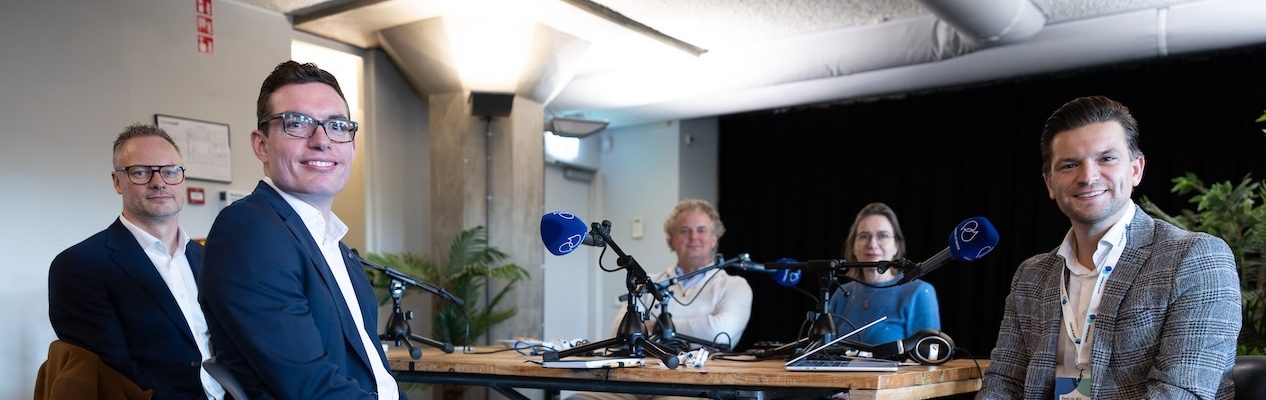
Kees: Good afternoon, listeners, and welcome to an extra episode of the Leaders in Finance podcast, live from Pakhuis de Zwijger in Amsterdam. We just had our CRO Risk Event 2026. We’re still completely vibrant, so I can’t wait to start this podcast.
I’m not alone here today. I’m joined by Owen Strijland, Managing Director at Protiviti; Michel van der Sluis, Director and Co-Founder at Fortrum Conclusion; Wendie Cornelissen, Director Risk Management at Achmea; and James Marron, Enterprise Account Executive at Protecht. Welcome, all.
Before we really dive into it, let’s do a round of introductions. Tell me a bit about your background and the company you work for. Michel, can I start with you?
Michel: I’ve been in banking, mortgages and consumer finance for over 20 years now, and I founded Fortrum in 2018. We’re a due diligence firm.
Kees: You did a talk on stage today as well. How do you reflect on it briefly?
Michel: Excellent. There was a crowd that was really interested: the right people, the right level. So I think it was really interesting all day.
Kees: Great to hear. More on that later in this podcast. Owen?
Owen: Thank you. I’ve been within the CRO domain for, I think, 20 years already. I started with a tiny project when I had just graduated. At Protiviti, we do a lot of risk, security, privacy and everything in between. Today, I had three guests on stage from fintechs.
I think the environment a fintech operates in right now—with very fast-moving technology, while trying to obtain and safeguard a licence—is a very interesting place to be as a CRO. We work a lot with them globally, on topics that were discussed today.
Kees: You had a tech panel together with Mews, Katanox and GoDutch.
Owen: Correct.
Kees: Which you moderated very nicely, I have to say. How do you reflect on the panel? Can you share one key takeaway?
Owen: I think the key takeaway is that all the CRO roles there were relatively new. Catanox is just two years old. GoDutch has just started with a CRO as it works towards a licence. Mews also has a relatively new CRO. Although the people are definitely not new to the role, the organisations are new to having someone in that role.
Having someone safeguarding a licence or trying to obtain one means so much for the technology behind it and for the people behind it. Whether it’s Mews with 1,000 employees, Catanox with just 30, or GoDutch with something similar, the challenges are the same. On one side, things move fast; on the other, there need to be boundaries, brakes and guardrails. I really enjoyed hearing how they all fulfil that role as CROs in such a technology environment.
Kees: It was a very nice panel. Wendie, could you tell me a bit more about your role and the company you work for?
Wendie: Yes, certainly. Thank you. I’ve been in banking for 30 years this year.
Kees: Thirty years. Congratulations.
Wendie: I spent 26 of those years at ABN AMRO and joined Achmea in 2023, so three and a half years ago. I’m the Director of Risk Management at Achmea Bank, to be specific. And today I was also on stage.
I did training on AI compliance over the summer, read quite a few books and kept on top of the news, as everyone will have done. I shared my insights from that. I think we should all be on a learning journey, eager to understand and learn. I touched on the legal side of it, on robustness, which is very important, but also on the human side. How can we make it human-centred and trustworthy?
Kees: You started with the question, “Should I believe everything the AI wizard says?”, which was a good reflection on the talks we had up until then. I have some questions about your presentation later on. But first, James, can you introduce yourself and your company?
James: Of course. I’ve spent the last 15 years of my career—also, coincidentally, the first 15 years of my career—in the technology and fintech landscape. In my current role at Protecht, I’m responsible for new business in the EMEA financial services industry outside the UK. I’m currently starting my fourth year there.
It’s our first time at the Leaders in Finance CRO Risk Event. We’re delighted to hear that next year’s event date has already been announced, and we’re really looking forward to coming back. The calibre of the conversations has been very high. As Michel said earlier, we’re encouraged by the people coming to this event. I think they’re right in the sweet spot of the solutions Protecht delivers.
I should probably mention those solutions. We’re a SaaS software provider offering solutions in the GRC space. We promote a very risk-centred view of the world to our customers. We’re excited to have Owen and the wider Protiviti team alongside us. We also have a partnership agreement in place, and we’re looking forward to what that can do for us in the Netherlands and across Europe.
Kees: Thank you very much. Great to hear that you’ll be returning. It’s on tape now.
Gary Lynam, Managing Director EMEA at Protecht, gave a presentation called “AI and Risk Management: From Control to Intelligence.” Why is this so important from your point of view?
James: I think it’s fair to say that AI was inescapable throughout the day. And that’s true not just within financial services, but across society. It has had a real impact on us as a firm over the past year or so.
Earlier in the spring, Protecht was acquired by a US private equity firm with a particular focus on bringing AI capabilities into SaaS software tools. As a provider of risk management solutions, we initially took a cautious approach to AI. But that has really accelerated over the last six months, and we’re excited about what the next six months hold for our AI roadmap.
From a go-to-market perspective, we’re seeing a real shift in expectations among our customers. Static, point-in-time reporting that we return to on a quarterly or semi-annual basis is no longer really acceptable. We’re seeing a shift towards continuous control monitoring and more real-time demand for data, reports and analytics, all with the goal of making better-informed decisions within organisations. AI is one of the key enablers of getting to those insights more quickly.
Kees: Thank you very much. I’ll ask Wendie more about AI later on. And if you want to respond to each other, feel free.
But I have a question for you, Michel. When we talk about datasets and insight, that really connects to your presentation as well. Could you tell us more about the presentation you gave on double pledging?
Michel: Of course. I gave a presentation about Market Financial Solutions, which allegedly committed a massive fraud. An amount of 1.8 billion was missing. Eleven months earlier, the company had clean audited accounts. Nothing appeared to be going on. Eleven months later, it was in administration.
There was an investigation into what had happened, and what they allegedly did was double pledging. They offered the same collateral—the same loan—to multiple funders, while you can only allocate it to one funder. The other money was basically gone. Of the 716 loans that should have been on the books, I think only 126 actually were.
That’s a massive fraud, and much of it has to do with collecting data and monitoring in real time. If you don’t do that, you create the possibility for this type of fraud. So we definitely think continuous monitoring, as you mentioned, is an important step. However, we also think you need to do more. You need a proper platform review, including the entire governance structure.
You need to understand how the organisation is structured. Is it one SPV? Are there multiple SPVs? Are there linked companies? Who’s the accountant? Who’s the law firm? Is it a company with 500 people where one person still makes all the decisions? You really need to understand how the company works. If you combine that with platform reviews and reviews of individual loan files, I think you get a fuller picture.
Having systems in place and monitoring continuously is the future and a really important part of it.
Kees: A very practical eye-opener: a real risk management case. How do you look at this, Owen, from your perspective? You’re in touch with a lot of CROs, of course.
Owen: I recognise this. And I also recognise the challenge CROs face these days. It’s not just financial risks and fraud, which are easier to carry out because of the tools fraudsters have. We all know the stories about bank accounts being opened and mortgages being given to fake accounts, driven purely by AI.
I think you’re completely right that you have to monitor more constantly. The big question at CRO level is: what exactly is that monitoring going to tell you? What value is there in looking at 200 controls continuously if their outcomes don’t tell you much about the decisions you have to take or the actions you need to take?
In the age of AI and more tooling, we can get on top of what’s happening in the data more quickly. But then what do you do? I sometimes see older GRC tools and compliance policy tools that are more administrative and don’t really bring value at board level, where the CRO needs to operate.
Going forward, the value will lie in meaningful insights: what will happen in the next two, three or four days—or two or three weeks—if I don’t react to certain signals we’re seeing? I really like the interconnectedness, but it’s a big challenge. GRC tooling may be catching up, and fraud tooling may be catching up, but what about IT incidents? Are they still registered somewhere else down the line?
You need to create a full picture for the CRO to be able to make decisions. That means bringing together compliance, risk and IT risk. At board level, we’re looking at how to get meaningful signals out of all the new tools that exist. Then how do we make the right decisions, who makes those decisions, and who is accountable for the path we follow?
Wendie: Maybe to add to that, Owen: sometimes you don’t have the time to respond in a considered way. Sometimes you have to act immediately, like we saw last week with the PHP vulnerability that could have been exploited at scale. The time you have to react is decreasing.
Owen: I fully agree. We do a lot of crisis simulations, sometimes with the help of AI. We run them at board level, but also one or two levels below.
In the end, the board is accountable, but you have to enable your people to make decisions. With a PHP vulnerability, you shouldn’t wait until it reaches the board and the board has to decide. People in IT and in your product teams should be able to make those decisions themselves.
If the board takes that decision-making ability away from them, then I fully agree with you, Wendie: time is of the essence. People need to be able to react and take responsibility. That’s a matter of trust. You have to trust that they’ll do the right thing, that the company has trained them to do so, and that they’re empowered to act. That’s important if you want to move quickly when immediate action is needed. So thank you for that addition.
Kees: AI can, of course, also be used to counter these threats. That brings me to your presentation, Wendie. You talked about the need to know where AI is being used and who is accountable, which connects to the AI Act. Could you tell us more about the message of your presentation? Putting AI on the agenda is perhaps an obvious choice, but your talk was really insightful.
Wendie: My presentation covered what it means to have human-centred and trustworthy AI. The European AI Act addresses the need for AI to be lawful, robust, human-centred and ethical. I think what resonated most with people was the ethical and human side of it.
We need to make sure we stay in charge of AI. Michel, you just mentioned platform checks, but I also heard you say that you need to understand the content. You need to protect your domain knowledge. That’s very important. And you really need to know and understand the AI tools themselves. I’m eager to learn how they work. You mentioned a training course you took, and I was already thinking about taking it myself.
The third aspect is critical thinking. Train yourself to keep questioning the output, but also teach the colleagues around you to assess it critically. I think the human aspect also came through in Ron Keller’s excellent presentation. My own perspective was quite European, but it seemed to resonate well with the audience.
Michel: If I may add to that, I fully agree. Critical thinking is a major part of it. But there’s a second part as well. We bring junior colleagues into our organisations, and they immediately start using AI. When we were starting out, we had to do the work hands-on. We had to get our hands dirty and understand how the work was done.
It’s difficult to develop critical thinking if you don’t fully understand the work itself. Junior colleagues need to build that expertise. I think that’s a challenge for the sector: don’t move too quickly towards relying only on AI. Also focus on building the expertise people need to assess its output critically.
Wendie: Exactly. You have to do the groundwork, learn the tools and train yourself not to believe everything the wizard says.
Kees: The perfect title for your presentation. James, Gary Lynam’s presentation for Protecht was called “From Control to Intelligence.” Having heard all this, how do you reflect on it?
James: I agree with what Michel and Wendie have said about the importance of continuing to exercise that ability to question things critically. Without contradicting them, we do have a slightly different perspective on some of the use cases for which we’re introducing AI functionality into our tool.
It goes back to the point about giving people the information they need to make better decisions at every level of the business. A GRC tool isn’t just a board-reporting tool. It covers a broad range of topics: risk management, compliance, business continuity, operational resilience and so on.
The quality and breadth of what we capture from the first line are critical. In many conversations today, people talked about risk culture within their organisations. One way we’re using AI is to make it easier for people across the business to report incidents and near misses immediately.
Instead of giving them template forms with fields and dropdown menus that might not quite fit what happened, we can make reporting simpler. People in the first line aren’t risk professionals in their day-to-day jobs. How do we give them tools they can easily use? That allows the second line to spend less time administering risk information and more time reviewing and challenging it, which is what they’re there to do.
In practical terms, someone might enter a couple of sentences or upload an attachment: “Here’s the incident I observed,” or “Here’s the near miss that occurred.” Behind the scenes, that information is mapped to the organisation’s risk framework and methodology. It gives the organisation more transparency about what’s happening in the business.
It works because it’s easy to use and fits into people’s normal way of working. They can put on their risk management hat, contribute to the risk culture and then return to their day job. User adoption matters across the entire platform, not just in risk management or control assurance. It reflects the risk-centred approach we want to offer our customers.
Kees: Thank you, James. We’ve talked about insights and controls. Technology was one half of today’s event, but we also talked a lot about geopolitics: about it being a question of when, rather than if, and about the different powers in the world. Some of it felt quite heavy. Ron Keller gave an excellent talk.
There was also a panel with Twan Huys, Tom van de Laar from Rabobank, Silvia Caserta from Mizuho and Daniel Munson from Visa about uncertainty and risk. An open question for the group: how does the current political situation in the world affect you? How do you look at it?
Owen: If I can answer: Protiviti is a US-centred consultancy firm. At first, we were a little afraid that we might lose some Dutch clients because we’re listed on the New York Stock Exchange and have US leadership. Luckily, we also have strong European leadership.
The decisions made about the firm in the US have been different from those made in Europe. Here, we’re still able to organise a risk event and invest in people who truly understand risk management and compliance. Our US firm is focusing more on other areas and a little less on compliance, though it does focus on AML and sanctions.
As a consultancy firm, you have to differentiate between regions because so much of our work is driven by politics and regulation. Luckily, we have a good presence in the Netherlands, so we can respond to what’s happening in the EU and to what our Dutch clients need. They sometimes benefit from our presence in the US as well, because many of them operate globally. But we have to be aware of differences in strategy and in how new regulations are introduced.
It’s an interesting market to be in at the moment. It’s vibrant. As a consultant, you’re always looking for areas where there’s a lot of change and volatility.
Kees: It’s becoming, as someone said on stage—I can’t remember exactly who—“deliciously complicated.” I noticed that Marloes from De Nederlandsche Bank seemed to embrace that. It was almost: “I was born for this. This is why we’re in risk management.”
Wendie, I think you have to leave. First of all, thank you for being here and for your insightful presentation. Could you give our listeners one piece of advice for the coming period? We don’t know what will happen, whether positive or negative. What would you say to people working in risk management, or to people in general?
Wendie: Be curious and remain eager to learn. Don’t make predictions that are too negative, because I think there’s reason to be hopeful about the future as well. Use AI at scale where you can, but do so consciously. Remain curious and keep learning.
Kees: Or, as Ron Keller said, be well prepared and take action. Those are important points. Thank you, Wendie.
Wendie: Thanks for having me.
Kees: Michel, looking at the situation in the world and at your own field of work, what advice would you give?
Michel: Definitely stay curious. But I think you also have to be sensible. Despite all the emerging risks, spreads on mortgages and consumer finance are still quite high. There’s still a lot of pressure to meet sales targets, bring in margins, grow portfolios and create multiple funding lines.
That’s fine, as long as you have the right controls in place. We should be sensible about that. I think investment banks sometimes tend to overlook geopolitics and what could happen. They’re still optimistic about the future and about growing their mortgage portfolios. Again, that’s fine, as long as the proper controls are in place.
Kees: Thank you. Over to you, James.
James: I’d borrow a couple of lines I heard on stage today. I noted down a few things that stood out. You mentioned Tom from Rabobank earlier. One thing he said was that disruption is the new normal. If we pause and reflect on the last few years, that applies not just to the industry but to society more broadly.
It was also interesting to hear Marloes from DNB talk about geopolitics less as a risk category and more as a driver of risk. I agree with that framing. Another point from the panel was that we can prepare, but we can’t predict. That’s a useful mindset to take away. Don’t become too attached to your predictions. Work through a range of plausible scenarios and prepare for them, but stay agile and flexible enough to respond when your assumptions turn out to be wrong.
Kees: Thank you. Those are great takeaways. I’m glad you mentioned them, because it’s hard to capture everything from such a full day. You really had to be here.
Owen, how do you look back on the event? This is also Protiviti’s second year as main partner. Looking ahead, how would you like to shape next year’s event?
Owen: Let me start with the event. In the first year, we already had a very good audience. There were CROs in the room and someone from a supervisory authority. This year, we surpassed that. I think we easily had more than 30 CROs in the room, including board-level CROs.
The interaction was really good as well. We had slightly fewer presentations and more conversations. I think people at C-level appreciate that. They receive a lot of information, but have less time to talk with peers. I hope they value the community we’re building.
As for today’s theme, I’m someone who likes change. That has to do with my upbringing and my history. I went to a different school roughly every two years and lived in a different village or town every two years. I think you have to embrace change and stay alert to the fact that anything can happen at any time. Not being able to do your groceries, your refrigerator turning into a microwave—I’m joking, of course, but things will change.
You’d better be prepared for change and ready to respond. As human beings, we don’t naturally like a lot of change. There are things we’d like to keep the same, but we’ll have to adapt.
I think the biggest change is that everyone will have to become a bit of a technician. You need to understand how to talk to a machine. Over the next ten years, that will be an essential skill: being able to communicate with machines and understand what they’re saying back to you. If you can do that, you’ll be ready for the next decade.
If you avoid it, you may be surprised by how quickly your role or the processes you manage change. That might sound a little dark, but my technology background helps me interact with AI every day. It also helps me have good conversations with colleagues who understand AI much better than I do.
I’m looking forward to next year. Perhaps we can bring in more of a European perspective—maybe invite the ECB, perhaps even a new president of the ECB whom we’re familiar with. That would be nice. We know a change is coming in February, so the timing could work. Let’s aim for that. Aim for the moon, and if you miss, you’ll be among the stars. That’s a famous quote. I like it.
Kees: An excellent quote to close with. Thank you very much. Looking ahead, it’s good to hear that we’re prepared—or getting prepared—although we all hope that some of the scenarios we’re preparing for won’t happen.
I’d also like to thank the event partners: Protiviti, Fortrum Conclusion, Protecht and the Nederlandse Vereniging van Banken. Thank you, Owen Strijland, Michel van der Sluis and James Marron for joining me. Wendie Cornelissen from Achmea Bank had to leave, but I want to thank her as well.
And thank you all for listening to this reflections podcast about the CRO Risk Event. More than 140 people from over 40 organisations attended today. Next year, we’ll aim even higher. It’s on tape—not a promise, but a wish.
Next year’s event will take place on 28 October 2027. We hope to see you there. Thank you for listening.
Voice-over: You’ve been listening to Leaders in Finance. We hope you’ve enjoyed the episode, and we’d love to hear from you. What’s on your mind? Who would you like to hear next? Let us know in a review, by email or through our social channels. We’d greatly appreciate it.
Finally, we’d like to thank our partners for their ongoing support. Don’t forget to check out everything else we do at leadersinfinance.nl. Thank you for listening.