
Voice-over: This is Leaders in Finance, a podcast where we find out more about the people behind a successful career. We speak with the leaders of today and tomorrow to discuss their motivations, their organizations, and their personal lives. Why? Because the financial sector could use a little more honest conversation. We would like to thank our partners for their ongoing support: Kayak, EY, Mogelijk Real Estate Finance, Roland Berger, and Lepaya. Your host is Jeroen Broekema.
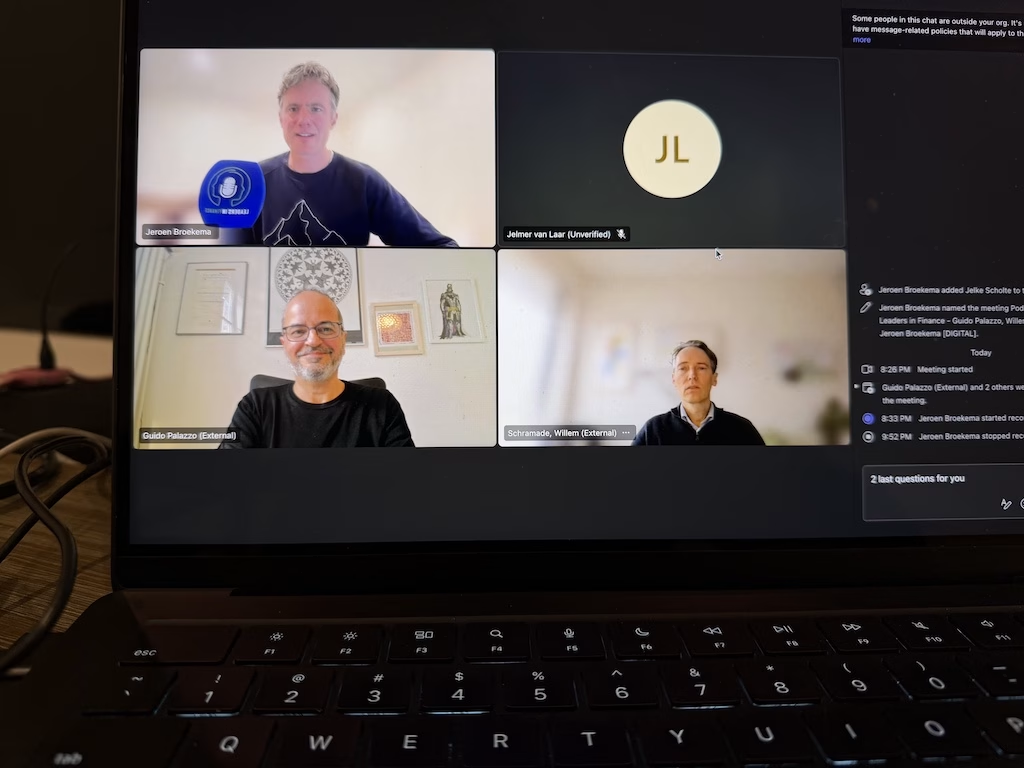
Jeroen: Welcome to a new episode of the Leaders in Finance podcast. Today, this is not a regular episode in which I interview a CEO, finance minister, or bank president, but an extra episode in which I interview a guest on a particular topic or, for example, a particular book. Today, it is both: a topic and a book.
I am very pleased to welcome Professor Guido Palazzo. He is a professor of business ethics at the University of Lausanne and co-author of the book The Dark Pattern, subtitled The Hidden Dynamics of Corporate Scandals. Welcome, Guido.
Guido: Thanks for having me, Jeroen.
Jeroen: Wonderful. I am very glad you are taking the time to speak with me and with Leaders in Finance. Although I will be interviewing Professor Palazzo, I am happy that I do not have to do this alone today, because the person who made this possible and came up with the idea will be joining me in this interview.
He is also a former guest of the Leaders in Finance podcast: Professor Willem Schramade, professor of finance at Nyenrode, with a focus on sustainable investing. Welcome to you as well, Willem.
Willem: Thanks, Jeroen. Great to be here.
Jeroen: Wonderful. I would like to start with two things before we dive into the book. The first is a short introduction from both of you, so that people who may not know you yet, or who have heard of you but would like to know a bit more, get some context. I would like to ask a very simple question. Could you tell me a little bit more about yourself, Guido, first, and then Willem?
Guido: Yes, I am Guido Palazzo. I am a professor of business ethics in Lausanne, Switzerland. I am Swiss, German, and Italian, so I always say I am a European mix. I studied business and philosophy, did a PhD in philosophy, and early on, in the late 1990s, focused on the interface between ethics and business, which at that time was something quite unusual. Today, luckily, this topic has become mainstream.
Jeroen: Willem?
Willem: I am Dutch and a professor of finance at Nyenrode. I used to be an investor, investing as a public equity investor in large corporates. When I found that their business models were often affected by sustainability issues, that got me interested and eventually led me into impact investing and back into academia. I now focus on how corporates can invest for better societal outcomes, not just maximizing shareholder value, but putting social and environmental value at the forefront as well, which in theory is not that hard, but in practice quite challenging.
Jeroen: For those who want to know more about you, as I mentioned, you were a guest on the show about half a year ago, so people can listen to that episode. Before we move over to Guido, Willem, I wanted to ask you something. You were very excited to interview Professor Palazzo. What was the main reason for that?
Willem: I read the book, and I think so many interesting things come together there, but you will find that out during the podcast.
Jeroen: That is a cliffhanger, exactly. When I started reading, the first thing that came to mind, actually even before I started reading, because I know the case quite well, was Wirecard. It is a case that is massively well known in financial services when it comes to corporate scandals. What do you think about Wirecard, Guido, before we dive into the book?
Guido: Wirecard is the typical case of how we imagine a corporate scandal. When we think about scandals, we usually think they happen because there are some evil people who do evil things to enrich themselves, or because they have character issues. Wirecard fits that image quite well.
You have a handful of top managers who, with the help of secret services, enriched themselves and ran away with a lot of money. But what interests me more is another type of scandal: normal people doing bad things.
People like you and me. When you dig deeper into scandals, you sometimes find thousands of people participating, like in the Wells Fargo case, the largest American retail bank, where around 100,000 salespeople committed fraud. You cannot explain 100,000 people committing fraud by pointing to their character, greed, or individual differences. So there must be something else going on. That is what interests me more than simply looking at bad people doing bad things. It is the banality of evil, as Hannah Arendt called it.
Jeroen: Yes, that is a name that easily comes to mind. Since I am sitting here with two academics, could you briefly walk us through some definitions? It does not have to be very theoretical, but what exactly is the dark pattern?
Guido: The dark pattern is an answer to the question of why good people do bad things in organizations. My co-author Ulrich Hoffrage and I looked at numerous large scandals and asked ourselves whether there was something they all had in common. On the surface, they all look different. You can have a harassment scandal, like at Uber. You can have a technology-driven fraud, like at Volkswagen. They are all different. But if you dig deeper, is there something they share? We went into court documents and investigative journalism reports, and we spoke with people who were there when it happened.
We identified a pattern: nine elements, or building blocks as we call them, that repeat across these scandals. They have little to do with individual character. Instead, they relate to the context in which people make decisions. Under certain circumstances, that context can become so strong, exert so much pressure, that good people’s perception of reality becomes distorted, and they do whatever it takes to survive in that context. That is the idea of the dark pattern.
Jeroen: Just to be clear, the dark pattern is ultimately something different from an actual scandal, right?
Guido: You can have all the elements of the dark pattern without a scandal occurring.
Jeroen: So what happens if all those elements are present, but no scandal emerges? Because that does not sound entirely logical to me.
Guido: You need a breaking point. You need a crisis moment. You need something that has worked for a while but no longer works, and yet you cannot say it. One of the elements of the dark pattern is the fear that toxicity creates. You cannot say that something is not working or that your success story cannot continue. You have to find a solution.
So this breaking point is necessary. You have a super-toxic, high-pressure culture. You had success until now, but then you move into a crisis, and that crisis breaks you. You continue your success story, but you do so by disregarding any kind of rules. You need a crisis moment plus the dark pattern for something bad to explode.
Jeroen: In your book, you discuss all these cases, right? Theranos, Wells Fargo, as you mentioned, Volkswagen, Boeing, Uber, Foxconn, France Telecom. Can you give another example of such a crisis moment?
Guido: Think about France Telecom. It was privatized in 1999, like many telecommunications services in Europe. The unions negotiated with the government that the people working there could not be fired because they were civil servants. France Telecom then invested a lot of money in startups, mobile telephony, and the internet, but at the wrong moment. Before the early 2000s bubble burst, their share value crashed. They appointed a new CEO in 2005, Didier Lombard, and he started calculating. First, he needed to increase the share value. He needed to save money. He needed to invest in the future, not in old fixed-line telephone technology. And he had too many people. He had the wrong people. He had technicians, the people who go into households to install telephones or fix them when something is not working. He had too many of them. He could not simply transform them into software engineers. That requires a different type of person and a different education. So he wanted to get rid of them. But he could not fire them. He had 22,000 too many. That was his crisis moment. He was under pressure to increase share value. He had to reduce costs, but he could not.
Jeroen: And of course, the listenership is mainly from financial services. Then there is the Wells Fargo case. By the way, I recently interviewed the current CEO of retail banking at Wells Fargo, who manages around 92,000 people. He also mentioned several times the massive consequences Wells Fargo has faced for many years, and will continue to face for many years to come. But anyway, what was the crisis moment there?
Guido: Wells Fargo at one point decided on a strategy to sell more products to the same customers. They calculated that every American has, on average, 16 bank products: bank accounts, credit cards, insurance products. They wanted half of that, which is eight.
They developed a strategy called “Eight is Great” and designed a sales system that pushed people to sell as many products to customers as possible, giving them quotas that at some point they could no longer realistically achieve. When they started this strategy, they were selling about three products per customer. When they were caught in the massive scandal, they were selling around 6.2 products per customer. They were almost there. These sales numbers were four times higher than what any other bank in America could achieve. No one ever asked how it was possible to sell four times more products than any other bank with more or less the same products, the same people, and the same processes. The answer was that salespeople used customers’ electronic signatures to open bank accounts, credit cards, and insurance products without the customers knowing, charging fees for each new product to their regular accounts.
They focused especially on elderly people, recent immigrants who did not speak English well, and people with financial problems. People who would either not notice or not speak up. The crisis moment here is more of a slippery slope. You tell people they have to sell more and more and more. Then there comes a moment when they cannot sell more anymore. But they have to. They see colleagues around them in the open-plan office cheating and still achieving their quotas. Their boss yells at them every day and tells them not to go home in the evening. So they start to cheat as well. There is this quote from one of the salespeople who said: “I was a soldier in the Iraq war, and life was actually easier there than in the sales room at Wells Fargo.” It becomes a pressure cooker. We think that if we increase people’s targets, they will become more motivated, achieve them, and then we increase them again. But there is a breaking point, and that breaking point is usually invisible, especially if no one dares to say, “I cannot sell more,” without being fired or humiliated.
So you have two types of crisis. One creeps in slowly. Boeing is another example: always producing more and more with fewer people. The other is a sudden blow-in-the-face crisis, like Volkswagen, which had to build a diesel filter to comply with U.S. law but could not, and also could not admit it.
So there are two paths: moving very slowly toward the breaking point, or hitting it very fast.
Willem: But they share your number four: having unrealistic, corrupting goals, right? I think it comes across very powerfully. And by the way, the quote you mentioned about the former soldier really hit me hard. He found the culture at Wells Fargo more stressful than the Gulf war. I had a similar chilling experience reading about the France Telecom case, with more than 40 people taking their own lives and the way they were terrorized. It is shocking how deeply this affected people on a personal level.
Something else you said triggered me. You mentioned that you interviewed the current manager of Wells Fargo. To what extent have they actually acknowledged this dark pattern within their own organization? And what are they doing about it? Did you get any sense of that?
Jeroen: No, we did not dive into that. It was a very personal interview about leadership. So I do not know. Legally, I know they have taken many measures, and for many years they were not allowed to do certain things in the market. But personally, I do not know.
Guido: If you follow the case in the news, it seems they keep running into similar scandals. At one point, Senator Elizabeth Warren even said that their license to operate should be revoked because they appear unable to learn. That is something you see in many of these scandals.
Jeroen: Boeing as well, right?
Guido: Exactly. They do not learn from this. And the point you made, Willem, is important. When we look at these scandals, we often focus on surface-level issues such as legal compliance. But we do not see the immense human suffering in the background.
That was one of my main motivations for writing this book: to show that these corporate cultures do not only lead to compliance problems, they break people. Either people become criminals, as at Wells Fargo, or they destroy themselves, as at France Telecom.
Willem: Yes, because you mention Hannah Arendt and totalitarianism, and even the Einsatzgruppen during the Second World War. At first sight, that comparison seems far-fetched. But when you read the cases, it is this dehumanization and the resulting enormous suffering that makes you realize it is the same mechanism at work.
Guido: There are two extreme directions human identity can take that support the dark pattern. One is when people see themselves as masters of the universe. Rules do not apply to them.
Jeroen: That was often the case in the U.S., for example.
Guido: Yes, especially among entrepreneurs in the U.S. who think they are the next Steve Jobs, a messiah, and that rules do not apply to them. There is this quote from Elon Musk’s lawyer, who once said: “Elon is sending rockets into space, he is not afraid of the regulator.”
Because he sends rockets into space, rules do not apply to him. Tesla even has its own Wikipedia page on legal violations, which is quite unique. On the other side, you have people who are told they are nobody, that they are worthless, that they should be ashamed for not leaving. They are told they are obstacles.
Their identity is stripped away to the point where they just follow orders. They do whatever it takes to survive. And if they feel that even that is no longer possible, as in the France Telecom case, they may take their own lives.
The numbers vary depending on the source, but based on what I compiled, there were around 100 suicides over three and a half years, and 41 suicide attempts among France Telecom employees under daily pressure and humiliation. People slashed their wrists during meetings with HR, jumped from company buildings, or hanged themselves at home in their France Telecom uniforms. Horrible stories. So the pressure leads either to cheating, as at Wells Fargo, or to self-destruction, as at France Telecom.
Voice-over: This is Leaders in Finance with Jeroen Broekema.
Jeroen: That is a great segue into a few other questions I would like to ask. When you look at the sheer number of people involved, sometimes hundreds of thousands, as in the Wells Fargo case, how do individuals experience this? Are they always aware that cheating is going on? Or are they mainly afraid? Or do they avoid thinking about it because they simply do not want to know? Or is it all of the above?
Guido: This connects to a theory my colleagues Ulrich Hoffrage, Franziska Krings, and I developed some years ago called ethical blindness. It describes the process through which people can slowly lose the ability to see that what they are doing is wrong.
You do it once, and it feels wrong. You do it again, and it feels less wrong. You get used to it. There is a quote from an Enron trader who said: “You do it once, it smells. You do it again, it smells less.”
At first, you experience cognitive dissonance. You think, “What I am doing is not right.” But then you start rationalizing. Everyone else is doing it. You want to go home. You are afraid. You are under pressure. You need the bonus. Whatever the reason, you rationalize, and the dissonance disappears.
Over time, it becomes routine, a habit. You also lose agency. You feel you cannot change anything. You may have raised concerns, and nothing changed, or someone else raised concerns and was fired. You learn that change is impossible. This is simply how the world is.
There is a famous email exchange between two Boeing engineers. One warned his superior about serious safety issues with the 737 MAX that could lead to crashes. His superior replied: “At Boeing, changes are only made when people die.”
That tells you everything. Change is not possible. At Volkswagen, you were not even allowed to use the word “problem.” Language itself removes ethical concerns from your radar, and you simply execute.
That is why the comparison with the Einsatzgruppen, who carried out mass killings during the Second World War, may seem strange at first. But it is the same social psychology.
Willem: And ethical blindness is really at the core of your book, if I understand correctly. Could you elaborate on that, and maybe then move to the nine building blocks?
Guido: In a way, it is inspired by what Hannah Arendt wrote about Adolf Eichmann, the chief logistics officer of the Holocaust. He fled to Argentina, was arrested, brought to Israel, put on trial, sentenced to death, and executed.
Hannah Arendt was present in the courtroom and wrote about it for The New Yorker. She said she was shocked. She expected a Nazi monster and instead saw a boring bureaucrat following his incentive scheme and pursuing his career.
Whether she was right about Eichmann has been debated, but she was right in principle. She called it the banality of evil. Evil, she wrote, grows like a fungus on the surface. It does not have to be deeply rooted. It exists in mindless behavior.
Social psychology has confirmed this again and again. You can remove ethical reflection by placing people in contexts with strong pressure: group pressure, authority pressure, time pressure. Combine them, and people lose the ability to see that what they are doing is wrong.
Afterwards, when they are arrested, they are often shocked by themselves. They say, “While I was doing it, I did not see that it was wrong. Only afterwards did I realize it.”
Take Lance Armstrong. He won the Tour de France seven times using EPO. When he finally admitted it on the Oprah Winfrey show, he said something remarkable: “I used EPO, but I never cheated.”
In his mind, he was acting morally, because he knew everyone else was doing it. Jan Ullrich, Marco Pantani, all of them. If he did not do it, he would have no chance of winning. By doing it as well, he believed he created a level playing field.
That is ethical blindness. You no longer see that what you do is wrong, or you even reinterpret it as something morally right. And you can rationalize almost anything.
Jeroen: And as Willem mentioned, these building blocks of ethical blindness, you have already covered quite a few of them during this conversation, right? We have talked about the slippery slope, which is one of them, and corrupting goals. Willem, you spoke about unrealistic targets.
I think you have also mentioned toxic leadership. So what are some other important ones? I have the nine in front of me. I mean, they are all important, but we do not necessarily need to cover all nine, and people should read the book anyway. But what are one, two, or three building blocks you really want to call out?
Guido: Maybe one that I think is particularly important, and where Willem and I, coming from a business school background, know that not us personally, but our colleagues and our history of what we have taught, has contributed a lot. We call it rigid ideology.
It is the idea that we teach students at business schools that their only responsibility is to maximize profit. And then they go out into the world and do exactly that. They maximize profit. And they are also taught that ethics is for private life, not for your job, right?
So you focus on profit maximization for one group. And mathematically, if you maximize one thing, you must focus only on that. There is no room to care about other aspects.
When Harry Stonecipher became CEO of Boeing, coming from the Jack Welch world, he did exactly that. He did what he had learned from Jack Welch. You maximize profit with two tricks.
The first is that you fire huge parts of your workforce. Jack Welch fired 25 percent of the people in his first four years at GE. Harry Stonecipher did the same at Boeing, firing 25 percent of the workforce in his first four years, especially experienced engineers, replacing them with cheaper engineers.
The second is share buybacks. You buy back your own shares. You invest in your own shares instead of in innovation. And if you do this for tens of billions of dollars, there is not much left for innovation, because you can use each dollar only once.
If it is used for buying back shares, it is not used for innovation. So share value goes up for two reasons that have nothing to do with innovation, performance, or product quality. It is simply financial engineering.
In the long run, it has a negative impact. But by the time the long run arrives, you are long gone as CEO, your bonus linked to share value has exploded, you are rich, and you leave. And then others…
Willem: It is a really nice and simple world view you have, right? Actually, one of my first jobs was at GE, in the financial management program. It was really terrible.
They lived in the spreadsheets. It was only about extrapolating past numbers. I was at the Munich headquarters of the European reinsurance business, and I was just collecting the numbers from all over Europe, and then it had to go to the U.S.
And then my boss would make some adjustments just to make them look right. It was all about the spreadsheets. And yes, the third point is manipulative language.
I would call this spreadsheet language manipulative as well. If it is not in a spreadsheet, it does not exist.
Guido: Yes, language plays a key role in the dark pattern. And spreadsheets do one thing: they frame everything you do in a neutral, cold, bureaucratic financial language.
It is supposedly objective, right? So you cannot challenge it. “This is how the world works.”
And you do not ask ethical questions when your language coats everything in something neutral. In the book, we call this euphemistic language: language that takes away the moral dimension of what you do.
If you call something “creative accounting,” that sounds much better than “tax fraud.” But in the end, it is just tax fraud, right? But who can be against creativity?
Language can be euphemistic, and language can also be aggressive. The CEO of Lehman Brothers used to tell his traders: “You must cut the throat of your enemy,” and he would give them plastic swords. And the enemy was not Goldman Sachs or JP Morgan. The enemy was the trader next door.
Because at the end of the year, 20 percent of them would be fired. Another invention of Jack Welch was using the Gauss curve in HR: high performers, average performers, low performers, and you get rid of the low performers. At the end of the year, we call them dead wood. That is what we called them at GE.
And that is another element of the dark pattern: the incentive system. You create internal Hunger Games. And if you pitch people against each other, but coat it in nice language, it does not feel like you are doing something bad.
Think about France Telecom again. You cannot fire civil servants, but you can move them across the country. They cannot refuse, because they are civil servants. So you move them far away from where they live.
They come to the new office in the morning and are told: “Wait here until we give you your mission.” They sit on a chair. There is nothing else in that room: no computer, no desk, just a chair. You sit there for eight hours. You come back the next day. The next week. You sit there for two months, three months, four months, six months. No one comes to give you something to do. If you do not show up, you give them a reason to fire you.
HR at France Telecom called this “sending someone on a mission,” or something they called a “progress interview,” which sounds so nice. A “progress interview” meant that as a team leader, you had a weekly conversation with the person you wanted to get rid of, who refused to leave. Every week it was scripted by HR, with the same sentences: “Why are you still here? We do not need you. You are an obstacle. You should feel ashamed. Please go.” Every week. “Progress interview.” “Sending someone on a mission.” So: language, incentives, toxic leadership, ideology. These are four elements of the dark pattern.
Willem: And Guido, how come they could get away with doing that to so many people? Because you can imagine, if it is about over 20,000 people at France Telecom being treated like that, of course to varying degrees. These people also form a kind of community. They know each other. So if Pierre hears about Claire receiving this kind of treatment, they should be in the same boat. But that does not seem to happen, right?
Guido: How does that work? It does not happen for various reasons. One is that it is never ten people in the same team, right? It is one person in that team, someone else in another team. So it is fragmented. Even the unions do not see what is going on until very late in the process. And the other thing is that in all of these scandals, when you are the victim, or when you speak up, there is a typical answer you get: you are the only one having the problem, right? There is this female engineer at Uber who gets sexually harassed by her boss on the first day she works there. She does the right thing. She calls HR. HR tells her, “Well, he is a high performer. We can do nothing, but you can change teams.” She changes teams. She gets harassed again. She calls HR. They tell her again, “This is a high-performing manager. We cannot do anything about it, but you can change teams.” She goes to a new team. The third manager harasses her. She goes to HR again. HR tells her, “Look, first of all, you are the only one coming to us with these things. And second, why do you provoke it?” So you start feeling ashamed, because everyone says you are the obstacle, you are not the future, you are the past. “Why are you still sticking to this job?” And “we do not have anything for you to do,” while your colleagues drown in work. So you start to blame yourself.
This is one of the group conformity effects Solomon Asch investigated in the 1960s: if I disagree with the group, or if I am an outsider in any sense, I think differently, I ask critical questions, and the others do not.
If I am the outsider, at some point I start thinking: maybe I am the problem. Not the system. I am the problem.
And then some resign themselves to fraud, like at Wells Fargo. And others say: if I am nobody, if I am nothing, if I am an obstacle, I can kill myself because there is nothing left worth living.
Jeroen: It is amazing, Willem, how much this resembles the Dutch childcare benefits scandal, right?
Willem: Yes.
Jeroen: Unbelievable how you can almost map it one-to-one onto that case. And that is not the corporate world, but it works everywhere.
Willem: That was one of the other eye-openers of the book for me: that it could happen at France Telecom, which used to be a government organization. I knew from my experience that these kinds of things happen in corporates, right? But France Telecom has this government background, and it just shows it can happen anywhere.
Guido: It happens anywhere. We have one case in the book about a hospital, the Karolinska Hospital in Stockholm. We would have loved to include an NGO case as well, but the problem is data. If there is a corporate scandal, you have thousands of pages of court documents and journalists writing about it.
An NGO scandal is not as well documented. So you cannot make all the strong claims we make if you do not have enough data to triangulate. And they would probably sue you as well. So there is no NGO case, but I would say it applies to any kind of organization.
Willem: Yes. Also here in the Netherlands: scandals in student organizations. And of course politicians, Silvio Berlusconi, Bangladesh… It all seems to be a lot of these nine elements out there. You have fraud cases in universities, right?
Guido: Absolutely.
Voice-over: This is the Leaders in Finance podcast with Jeroen Broekema.
Jeroen: From a methodology perspective, I was wondering: was it hard to decide, “These are the nine”? Because I guess you could come up with 15 as well.
You could also argue there are more structural things in societies that make this happen faster or more often in certain contexts, and maybe less in others. I do not know if that is the case. But my question is: why these nine? Why not twelve, or six? What was the methodological reasoning behind this?
Guido: Maybe the answer is that Dante’s hell has nine circles, and that is why evil naturally has nine. That is not the answer.
Actually, we wanted to call the book Inferno, following Dante’s nine circles of hell in the Divine Comedy. But our publisher said, “Dante, nobody knows Dante in the U.S.A. If you do that, you create a niche book.” So we did not call it Inferno.
But the process we followed was the following. Of course, we were not completely innocent when looking at the data. We had written the ethical blindness article. We knew there is a lot of social psychology about how people make decisions and how ethics get distorted.
What we did first was simply write down the raw story: what happened. Twenty-five, thirty pages, without interpretation. We then gave those stories to people who were there when it happened and asked them: is this what happened? Is this accurate? Is something missing?
Some of them gave additional information, data, or corrected things. Once we felt confident that “this is what happened,” we shared these cases with our students, MBA students and master’s students.
We gave them two or three cases and asked them: analyze them and tell us what you think is the pattern. What repeats across these cases? We did the same ourselves. And we came to very similar results as the students.
Not always in the same words we would use, but they would identify the share value focus, the goals, the fear, the language. That gave us confidence to say: this is what repeats. Then we looked at additional scandals, applied the pattern, and asked: is the same going on, or is something else going on?
I recently asked students who had read the book to analyze two cases we did not use, like the UK Post Office case and WeWork, to test our pattern and also look for additional elements. The pattern holds.
So we are fairly sure this is what drives scandals. And for each building block, there is lab research demonstrating the effect: unachievable goals break ethics, language breaks ethics, and so on. But nobody has looked at them together.
Willem: Yes. That is what I meant in the beginning when I said a lot of things come together in this book. I recognize many of these building blocks from other research, or even in practice, unfortunately. But combining them like this is really powerful. And Jeroen, I do not know where we are for time, because at some point we also have to start talking about solutions.
Jeroen: I have been checking boxes, so I think we have actually covered all the other nine.
Guido: No, we have not covered rules yet. We should not forget about those. Maybe a few words on the one building block we have not discussed yet: what we call ambiguous rules.
In some companies, especially those that end up in a scandal, over time people realize there are two types of rules around them: official rules and informal rules.
If you work at Wells Fargo in sales, of course you have training on the code of conduct. You have corporate values. Your company is “employer of the year” year after year. But at the same time, you observe superiors pushing colleagues into fraud, or tolerating fraud, while you are yelled at for not achieving your quota.
So at some point you realize: we have two types of rules here, official rules and informal rules. And when they are not compatible, you have to make a choice.
In psychology this is called a double bind. Gregory Bateson called it a double bind. You give people two rules, two orders, and they are contradictory.
You cannot do both. So what do you do? You look around: what do others do? What gets promoted? What gets tolerated? And then you follow those rules.
Over time, under the pressure of the dark pattern, companies open up a gray zone. In that gray zone, if you are afraid, if you cannot achieve your goals, if you might be kicked out, if you are in the bottom 20 percent at the end of the year, you start interpreting what you can do closer and closer to the darker shades of gray, until you break rules and break the law.
But you do not see the transition from very dark gray to illegal, because it is the slippery slope. If change comes in small steps, we do not see it happening.
Willem: In the book, you give a really nice example of how that might be broken, with the example of the pharmaceutical company and the new CEO. There is this salesperson being given a prize, and some compliance people say, “This is completely the wrong signal because he is cheating all the time.” Could you elaborate on that?
Guido: Yes. I was once invited to do a workshop on ethical blindness, good people doing bad things, at the annual strategy meeting of a large pharmaceutical company. The top 500 people were there.
I had the afternoon slot on day one. In the morning, they gave awards to their best salespeople. When the Salesman of the Year went on stage, the compliance people next to me got nervous. I asked what was wrong, and they said: “This guy cuts corners wherever he can. We have never caught him, but everyone knows it.” So this is the double bind. In the morning, the message is: as long as you are successful, rule breaking is fine. In the afternoon, I talk about ethics. People will have to choose.
We went to the CEO during lunch. He was new and did not know about this. I told him: you have to fire this salesperson. If you do not, that is also a message. If you want to send the right message, you have to fire him.
He fired him two weeks later, so he made the right decision. But most companies would not. Think about what I said about the Uber manager who harasses female engineers, and HR says: “He is a high performer. We can do nothing.” That is what normally happens. High performers: we do not touch them.
Jeroen: When I was reading, and also during this conversation, I still have the feeling, and you have been very clear about it, that this can happen everywhere. It can happen to you and me. You have almost literally said that.
But still, these cases seem so extreme. The cases you have chosen: are they extreme, or are they actually not extreme?
Guido: When I teach the dark pattern to my students, for example in my MBA class, and I ask them to share their own experiences, the last time I planned to do this for 15 minutes, and we did it for two hours, because they could not stop telling stories they had experienced themselves. Everyone knows the dark pattern around them.
Most organizations have some level of toxicity, and that makes the dark pattern quite normal. Again, it does not necessarily lead to a scandal, because as long as you are successful, you burn out people, replace them with others, and that is “fine.” But the breaking point makes the difference.
Willem: Suppose you are one of the CEOs or top leaders listening to this podcast, and you are thinking: I have to admit, in my organization this is happening as well. I am partly aware of it, and partly not. What can I do to break this pattern, or at least mitigate it? What would you advise them to do?
Guido: Do not be an asshole. Treat people with respect. Do not damage the dignity of your fellow human beings who happen to be your employees. Most of the things I described flow out of two building blocks. One is the ideology we are all embedded in and consider normal. The second is toxic CEOs, toxic CFOs, toxic COOs.
Top leaders then say, “Actually, I do not want all these losers.” They create this Gauss curve exercise, or they yell at people, or they give them “goals” and take another chief, because they think, “We have to be rough, otherwise people are not motivated.” We have to change that kind of thinking. We need leaders who treat others with dignity and still achieve their goals. You can have a successful company without abusing your people.
Jeroen: Are there particular contexts that are more prone to this? And yes, Willem, we keep going on your theme of how to prevent this, because you are very right. Very important. And you just made a great segue. But I really want to know: are there particular “mega-contexts”? Are capitalist societies more prone to this than other setups? Are men more prone than women? I was going to ask: men or women? And the third one: are particular industries, like financial services, just to name one, more prone because it is all the time about money? My assumption might be wrong. But when it is a lot about money, does it happen quicker? So: capitalism versus others, non-democracies versus democracies, sectors, men versus women. Is that something you can talk about, or is it very difficult?
Guido: No, ideology is key. And the ideology that surrounds pretty much everything on this planet right now is capitalism. It is this idea that markets regulate themselves, that people are homo economicus, that life is a jungle, that consumption makes us happy, that we need pressure. All these things are taken for granted, not just in business, but in any kind of organization. We need hierarchies. That is our ideology. It is the one we created in Europe and the U.S. and then rolled out globally after the fall of the Berlin Wall.
There might be dark patterns in other ideologies too, but I do not really see them on this planet right now. Maybe one could analyze the past or the future as well, but the air we breathe is capitalism, and that leads to these things.
Are some industries more prone? Certainly the financial industry. It often has no consequences, right? No one goes to prison after the financial crisis. No one goes to prison at Wells Fargo. They might reduce the bonus of the CEO by, I do not know, millions. So he “only” gets 150 million, but that is the punishment, right? And I know from a lot of banks that they calculate the fines into the budget. They know the fines are coming for legal violations. I once went to a U.S. SEC website on bank fines and picked one bank randomly, HSBC. It could have been Deutsche Bank or Credit Suisse as well. And I created a table of fines over a ten-year period.
It is year after year: millions and billions in fines for a huge variety of crimes. Very often I start my teaching by asking: what do you think is the industry with the highest level of regulation? So many compliance rules that even compliance managers sometimes struggle to understand what they have to explain to managers. And the answer is the financial industry, of course. It is the densest level of regulation. They sometimes have hundreds of people working only on anti-money laundering.
And yet: year after year, smaller scandals. Not necessarily the big ones like Wells Fargo, but smaller scandals, year after year after year. In this industry, breaking rules becomes normal. It is considered an unavoidable part of business.
Then it is not only industries, I would say, but characteristics of industries or decision moments that matter. New industries. When the Enron scandal erupted in the early 2000s, part of it was that they went online. They were one of the first internet businesses. Their core business was in pipelines, and that was highly deregulated. But then they entered a market for which there was no clear regulation, because no one knew where it was going. So in a context of highly uncertain regulation, ambiguous rules, things happen. The same today with crypto or AI. I would expect the next big scandals in crypto and AI.
Scandals very often happen in transformation moments too. Big change processes, where rules are up in the air, people are frustrated, they feel treated unfairly, you fire a lot of people, pressure grows. So transformation moments in companies are dangerous as well.
Jeroen: Very clear. People in financial services, watch out. And especially if you have financial technology, like new businesses, then watch out even more. So to go back to Willem’s point: if you are not an asshole and you are still worried the dark pattern might be happening in your organization, what else can you do?
Guido: We have a chapter in the book we call The Bright Pattern. In a way, you just do not do the things that make the pattern dark. That is the simple answer. To elaborate: maybe you do not give your people goals they cannot achieve. You can give ambitious goals, we all want ambitious goals, otherwise life is boring.
But they should not be ambitious to the breaking point, to desperation. The important thing is the combination of elements. Unachievable goals alone are not the problem.
It becomes a problem when it is combined with this idea: if I do not achieve that goal, something terrible will happen to me. I will be fired, humiliated, yelled at, my career is over, whatever.
If you can go to your superior and say, “Look, these goals are not realistic, we have to adapt them,” and you adapt them, that is fine. So it is about the intensity and the combination. What you need, and what a culture of fear cannot provide, is an atmosphere where people can go to their superior and say: what you want me to do is wrong. What we call speaking up, right? All these organizations we investigated had people speaking up. At Wells Fargo, there were three salespeople who wrote emails to the CEO and HR about the sales practices.
Willem: How do you create this culture of speaking up? Because leaders always say, “My door is always open,” blah, blah, blah. But how do you build that conversation? You talk in the book about moral vocabulary, etc. But how do you get that into people’s system, their awareness, and their actions?
Guido: One side effect of teaching shareholder value maximization is that managers believe talking about ethics is a sign of weakness. They think: if I talk about emotions, dilemmas, mistakes I made, I look weak. The opposite is true. Research is very clear: if leaders create a climate in which it is normal to talk about ethics, people feel encouraged to speak up when they observe something that is not right.
So how do you do this? You normalize ethical conversations. Why not open a meeting by discussing one corporate value? Why not talk about a dilemma situation?
Why not pick a scandal in the news and ask your team: could this happen here? If not, why are we so sure? If yes, what can we do? Or look at a decision you made a year ago and ask: would we decide the same today, knowing what we know now? Engage your team in ethical conversations so they feel safe.nThen they also feel safer to speak up when something is not right. Training people to speak up is important, because just saying “my door is open” does not work.
Martin Winterkorn, the CEO of Volkswagen, created a culture that Der Spiegel called “North Korea without concentration camps.” When he spoke about the scandal in the German Bundestag, he said: “I always had an open door.”
First, I do not think it was true. There were layers of security and secretaries. But I am sure he believed it. He believed he was a fair leader. So we should ask ourselves as leaders: when was the last time someone came to me and spoke up? If nobody ever comes, that is strange. And if someone did come: what did I do with it? Did I investigate? Did I give feedback? Did I change something? Did I thank the person? Did I share that story to create a positive example?
Speaking up does not happen just because you say the door is open. Leaders have to do the work. And then there is the issue of isolation. We know this from research on bullying in schools. If children observe a bully targeting another child, they have two options: take the side of the bully, or the side of the victim.
We tend to take the side of the bully because we do not want to be the next victim. The same happened at France Telecom. If someone breaks down in the office crying, what do the others do? They take their laptops and move away. You do not want to be seen with that person.
So organizations must train people to be each other’s ally. Support each other when someone speaks up, when someone is harassed, when someone is treated badly. We must learn to speak up for each other. Often we do not speak up not because we do not want to, but because in the moment we do not know what to say or how to do it. And that can be trained.
You can turn an organization where everyone fights for themselves into one where you have a community. But you also have to stop this stupid Gauss curve thing. Stop putting people on a curve and telling them they are low performers, losers. At GE they called them “dead wood.” McKinsey introduces the Gauss curve and calls low performers “value destroyers.” Value destroyers: such an inhuman way of talking about people. So do not use the Gauss curve. Or if you use it, do not use it to kick people out, to create a Darwinistic survival struggle. That kills collaboration.
Jeroen: You have it in academia as well, right? You have grading on a curve. It does not matter how good people are, 20 percent will still be “below” the others. So you see it everywhere.
Voice-over:
Leaders in Finance with Jeroen Broekema.
Jeroen: There are three groups, I am talking about financial services, but it applies everywhere, that are supposed to play a checks-and-balances role: compliance, regulators, and non-executive directors. In your opinion, based on what you have seen, are they playing that role well as a check on power?
Guido: No, they are not. Compliance often understands compliance too legalistically. But legal issues appear only at the end of the process we discussed, not at the beginning, not at the warning signals. You have to look at culture, but they are not trained to look at culture. They are not psychologists or ethicists. Their background is often legal. So compliance needs to understand its job much more broadly.
Regulators are part of what we call rigid ideology. It is a disaster in many of these cases: regulators do not do what they are supposed to do. Think about Boeing. The FAA, the aviation regulator, was losing resources year after year, even before deregulation trends intensified. They did not have the teams, skills, or people to investigate new products. So Boeing would self-certify large parts of the 737 MAX. Imagine that: self-certify. Volkswagen did its own emissions tests because regulators did not have the resources to do the tests themselves. So you regulate yourself and send the data to the regulator. We can imagine this does not end well. Even in cycling: for a long time, regulators could not reliably detect EPO in blood. So the rule was not “do not dope,” it became “do not dope too much.” They set thresholds, like hematocrit levels, because they could not prove the underlying practice.
Regulators fail in all these cases, because we teach that regulation is bad, regulation is against efficiency, regulation must be weak. That is part of the ideology. Part of what we teach in business schools.
Jeroen: Yes. So Willem, I wanted to give you the opportunity to ask maybe the last two questions from your end. Then I have a personal one for Guido. I am sure you have many questions.
Willem: Yes. First, you mentioned a couple of times how business schools have facilitated this. Could you expand a bit on that, and what we could do better? And second, in the financial industry, some players do better than others. For example, you could argue that Handelsbanken does a much better job than Credit Suisse or Wells Fargo. Could you elaborate on those differences to inspire our listeners?
Guido: Yes, Handelsbanken is a nice example of a bank that breaks this taken-for-grantedness of how things need to be done in a bank. They do not give their people sales quotas. They do not pay bonuses, because they think it would deviate their salespeople from serving customers. And they are still very successful. There is plenty of research showing that bonus systems do not create more performance than fair salaries. But we have designed a world in which it is almost impossible to escape bonuses and do something else. Business schools sometimes do this too. They pay bonuses for papers: the more papers you publish, the more money you earn as a professor. It creates wrong incentives. It creates incentives to maximize output and publish things that no one wants to read. But you just publish like crazy. So Handelsbanken does these things much better than other banks. I sometimes hesitate to give an example of a company that does everything better, because I do not think that exists. To some degree, all organizations have the dark pattern rising. But some have it better under control than others.
On your first question: everything we teach in business schools is based on neoclassical economics. It is based on ideas such as: governments must be small, we must produce as much as possible, there are no limits to that, and people buy stuff to be happy. Humans are opportunistic, do not trust them, therefore we control them. These ideas are behind what we teach, sometimes implicitly, sometimes explicitly. In strategy we teach Michael Porter. Porter’s basic idea is: a company is surrounded by enemies. They want to take something from you. You must create obstacles so they cannot take it from you. Life is a jungle. This “life is a jungle” metaphor is behind so much of what we teach. I have not seen many classes in my business school, or in others, that really focus on cooperation.
Willem: Yes, which is strange, because by far the most successful company in this country is ASML, which is grounded in a huge ecosystem of companies cooperating across several countries, and they are completely dependent on each other.
Guido: Yes. And you find many examples showing that humans, by default, are probably rather cooperative than constantly fighting each other. Pushing people into a fight does not bring out the best in them. Collaboration and cooperation might. A lot of the courses we teach go in the wrong direction. It is slowly changing, but it often changes as an add-on. My ethics class is an add-on to other classes. It is not integrated into the overall thinking. It has not become a new ideology centered on cooperation, planetary boundaries, and so on. Business schools resist these changes.
Willem: Yes, we have corrupting goals as well. Publish or perish. And we have to publish in journals with a very narrow focus that only rewards doing regression analysis on micro topics and forgetting about the big picture.
Guido: Yes. That is why I stopped publishing papers. I do not believe this is a useful activity, for that reason.
Willem: You are clearly ahead of me there.
Jeroen: That is hardcore for an academic professor to say.
Guido: I am tenured.
Willem: You have already published a lot. So it does not even affect your score that much.
Jeroen: Yes. In the regular episodes of this podcast, we make it very personal. I always try to do that a little bit in these extra episodes as well. So my last one is actually two questions. First: when you study this, how do you not become cynical? How do you stay optimistic, assuming you want to? And secondly: have you ever, in your career, had to speak up, or had to confront a dark pattern yourself?
Guido: I have spoken up on several occasions for students who were harassed by their superiors. Yes, that kind of situation. For me, that is very normal, because as the ethics professor, when a PhD student is desperate, they come to me. I am like the priest in the business school, right? And I have always spoken up. I remember once, when I was on tenure track, a colleague told me I should be more cautious about what I say in professor meetings, because I was on tenure track. I reacted by saying: I do not want to stay silent about what I think is right just because I am on tenure track. That is not the right thing to do.
I have seen many colleagues say: “I will be more courageous once I am tenured.” My reaction is always: no, you are a chicken now and you will be a chicken later, because we do not become courageous just because we feel safe. That is not the idea of speaking up. Speaking up requires courage sometimes. And that is what we should do. That is our moral obligation, so to speak, to speak up when something is wrong. As professors and managers, we have impact. Everyone has impact when they say something is wrong and try to stop it. And if you cannot stop it, you can still leave. You can have a plan B. You do something else. You go somewhere else.
Jeroen: And the first part of my question: how not to become cynical when you see all this, quote-unquote, shit in the world?
Guido: It is increasingly difficult not to lose hope. That is true. But Desmond Tutu once said: “I am a prisoner of hope.” I am a prisoner of hope, and I would say the same about myself. What is the alternative to hope? Cynicism. I do not want to be like that. And the good thing is that you always find courageous people who say the right things in dark contexts, who speak up, who step out, who refuse to participate. That matters. We are not machines. We can make change as individuals. And if we keep that in mind, we might be ready to do it when the moment comes.
Jeroen: Wonderful. It was absolutely fantastic to speak to you. I am sure I am speaking on behalf of Willem as well, but Willem, of course you can speak for yourself. I highly enjoyed this. And I said in our very short pre-conversation that we could speak with you at a Fidel Castro length, because there is so much interesting you have to share. But I think I was the first listener, and I really enjoyed it. My number one phrase I will take from it is maybe surprising, but it is the one where you said: “Do not be an asshole.” That is ultimately what we should all be thinking about. I would like to thank you. Normally I do this in person and hand over a present. Now I will send a small present. It is ethically okay to send a book to Lausanne, which we will do after this conversation. But thank you so much. I will leave a few sentences for Willem as well, if you like, Willem. But from my side: thank you so much.
Willem: Indeed, fully agree. I was very much looking forward to this conversation, and it certainly did not disappoint. I still have to unpack a couple of things, and I am going to listen back. Thanks a lot, and hopefully the listeners will appreciate it as well. Thank you both.
Voice-over: You have been listening to Leaders in Finance. We hope you have enjoyed the episode and would love to hear from you. What is on your mind?
Who would you like to hear next? Let us know in a review, an email, or get in touch via our social channels. We would greatly appreciate it.
Finally, we would like to thank our partners for their ongoing support. Do not forget to check out all the other things we do at leadersinfinance.nl. Thank you for listening.