
LiF Extra – Narina Mnatsakanian V3
Voice-over: This is Leaders in Finance, a podcast where we find out more about the people behind a successful career. We speak with the leaders of today and tomorrow to discuss their motivations, their organisations, and their personal lives. Why? Because the financial sector could use a little more honest conversation. We’d like to thank our partners for their ongoing support. They are EY, Mogelijk Vastgoedfinancieringen, and Lepaya. Your host is Jeroen Broekema.
Jeroen: We have a very exciting guest. It’s Narina Mnatsakanian. I’m very happy you joined me today, Narina. We’ve known each other for a while, but I’m happy that we are finally actually talking on the podcast. So, welcome to the show.
Narina: Thanks, Jeroen. Great to be here.
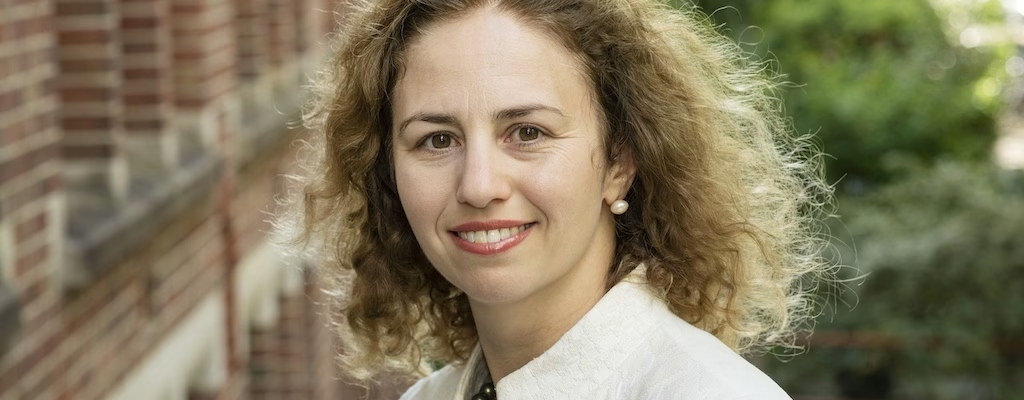
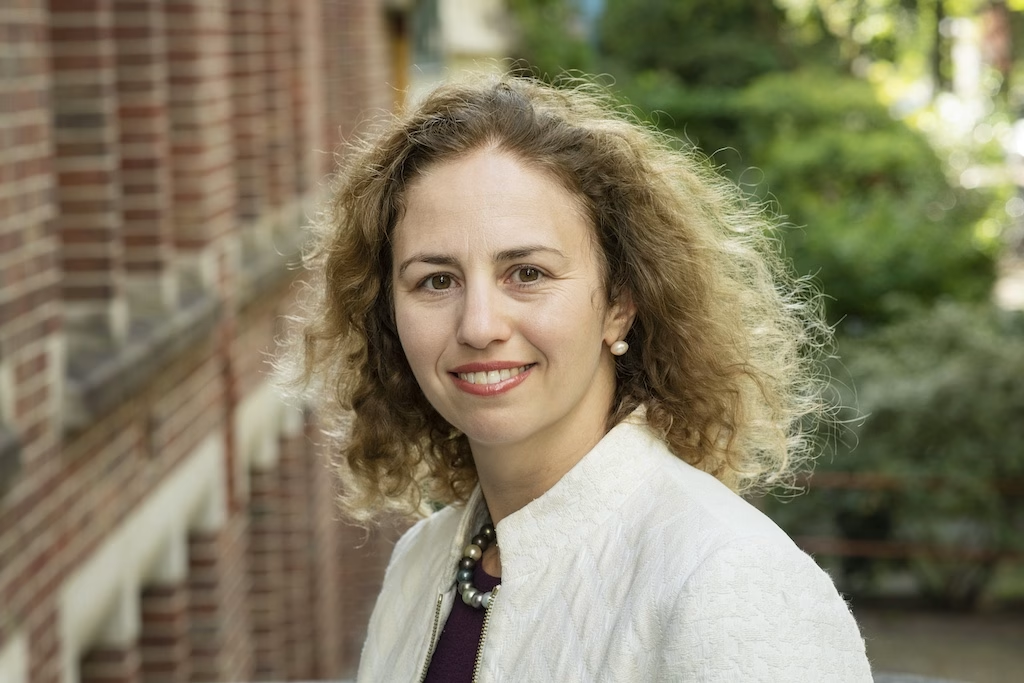
Jeroen: Wonderful. I want to introduce you a little bit, but I’m sure you can add a couple of things after that. After studying, among others, at the University of Cambridge, you’ve worked for a number of different organisations. So, for the Principles for Responsible Investment, for MN, for UBS, for Van Lanschot Kempen, the asset manager. And currently, you’re at Regeneration VC. You also hold a number of advisory positions and advisory roles. And for me, you’re really at the pinnacle of sustainable finance and everything that is related to sustainability and financial services. So, that’s also what we will be talking about over the next half hour. As I said, I’m really happy you’re here. First of all, I gave this really short introduction about you, but maybe you can add a little bit and mention the extra things that I should have included in this introduction.
Narina: No, absolutely. Indeed, my career has taken a winding path, but I’ve always focused on where I felt I could add the most value and on what I was passionate about. So, I started my career more in strategy consulting at KPMG and Ernst & Young. And I felt that I was really missing the why. Why was I doing this work? And at the time, I also felt that we really needed to shift how the financial system was working. This was back in 2005, 2006, 2007. I felt that investors were really taking a short term view without considering environmental, social and governance issues in many of their investment decisions. So that was the reason why, when UNPRI was set up, I joined it and helped lead its global expansion and the development of investor networks around the world.
And our dream was, you know, how do we make responsible investment mainstream? At the time, there was very little guidance. So I worked with large pension funds and asset managers around the world, as well as regulators and stock exchanges, to really get the movement going, get more signatories, and get asset owners especially to encourage their managers to commit and to implement.
And after that, I decided to go and actually work at one of the asset owners, at MN, for the PMT and PME pension funds, where we were really embedding sustainability across asset classes and in how we selected managers and engaged with companies. Back then, we also developed our first impact policy for PMT and PME. That must have been back in 2013 or 2014. So, very early days. But we could not actually invest in very much at the time because the impact market was not that mature. So that was when I went to work for an impact fund of funds, Sarona, in the Netherlands. It’s a bit like what FMO does, just with private capital. So, investing in African, Latin American and Asian GPs in frontier markets. I worked there for a few years, helping them raise their third fund and also leading the impact and sustainability work.
After that, I went to Kempen, Van Lanschot Kempen, to lead sustainability and impact across the asset management division and work both with the pension funds and for our own funds. This was also a great time, when there was a lot of momentum in sustainable investing. We also set up and launched an impact fund of funds, of which I was one of the portfolio managers. So, investing across asset classes.
After Kempen, I really felt that impact investing had reached a certain maturity. So, when UBS approached me to lead their impact investing work in asset management for the first time, I thought that was a great opportunity. I worked there to set up impact frameworks and to help launch new impact strategies across asset classes. But after the acquisition of Credit Suisse, some priorities changed. And yes, that was actually when we met, in the summer afterwards, when I was thinking about what I wanted to do next. Then the opportunity came to join Regeneration VC. It’s an early stage venture capital fund investing in regenerative and circular companies and business models. I joined as Partner and Chief Impact Officer just over a year ago.
And next to that, I’m also on the board of Natuurmonumenten, and I have a number of other advisory board roles for BB capital investments, Solar Impulse Foundation, and a few others.
Jeroen: Amazing, the number of things you do. And it’s always like that, right? If you want to get things done as busy people, well, you’re definitely a busy person with all those different things. So, that’s really great. I want to ask a couple of follow up questions on Regeneration VC. But before I do, I have a couple of follow up questions on your career, because you said earlier in this conversation, I was looking for the why. Did you find it? Do you feel like you’re adding a lot more to that why question?
Narina: Yes, for sure. I think that for me, it was really about how I could leverage my own time and energy. We only have one working life, and I wanted a career that was in line with my values. For me, it has really been about how we get capital, pension capital, our retirement capital, but also capital more broadly, allocated to projects that generate not only financial returns but also meaningful social and environmental outcomes. So that has been my why.
And if you look at it long term, companies are fundamentally long term. The Unilevers and Nestlés of this world want to be around in 30, 40, 50 years’ time. And our pensions are also long term. We are all investing for retirement in the years ahead. But financial markets are often very short term, quarterly or even faster in their behaviour. And I felt that it was important to bring the two closer together and make sure that investors consider environmental, social and governance factors alongside financial return, and fundamentally also shift allocation towards more meaningful projects that can make a positive contribution to people and the planet.
Jeroen: You mentioned that at some point impact investing and investing in sustainable finance became much more mainstream. Later on, you used the word maturity. Is that the case, that in general we could say that sustainable finance has become part of the mainstream and that impact investing has become mainstream in the investment world?
Narina: Yes, it’s an interesting one. I think what you’ve seen is that, in a way, it’s like a wave. If you look back to when I started in 2006 or 2007, we were working to make it mainstream. Then from around 2015, 2016, 2017 onwards, a lot of the best practices were turned into regulation in a number of markets. And in Europe, a bit later, taxonomy and SFDR came in, mandating certain disclosures and labelling of funds. And then there also came a kind of backlash. If you look at the US, there has been a kind of turning around, and in Europe a lot of the regulation is now changing. So I think, yes, it has been a bit of a pendulum.
But I think it’s fair to say that a lot of the practices became the common norm. I mean, the recognition that there are not only financial risks but also environmental risks, social risks, and opportunities, I think that is now embedded, even if people don’t call it ESG anymore. It has in a way just become normal. Certain things have simply become normal business practice, I would say. But yes, in terms of the language and terminology, there have definitely been swings.
Jeroen: Yes. Are there other big changes you’ve seen over all those years that you’ve been active in this field? I mean, obviously, you already mentioned the US backlash, the kind of backtracking a little bit by the European Commission. Are there other big things that you’ve seen change over time?
Narina: Yes, I think it’s really an evolution in how we think about these issues. Back in the day, when we had just started the PRI, the focus was really on responsible investment, on the idea that you should consider ESG factors, but not necessarily optimise for those outcomes. You considered them, you asked whether they were priced in or not. So it was really about integration, without necessarily seeking other outcomes.
Then it moved more towards sustainable investing, where you look at those outcomes in more detail and maybe seek some of them, and then to impact, where before you invest, you define certain environmental or social goals. And I would say now it is moving more towards systemic investing, where you think about the whole system, the interactions, the feedback loops, and the intervention points. So it is really about taking that holistic approach and understanding what kind of intervention is needed and how it affects the whole ecosystem. So I think that is the direction of travel. And who knows what is going to come next, but I would say there is a constant evolution.
Jeroen: I will definitely come back to what you mentioned, what I would call the geopolitical situation, and also the shifts that we have seen. But as I promised before, I wanted to talk about Regeneration VC. Tell me a little bit more about it, because for me, and probably also for people listening who do not know anything about it, how big is it, what do you do, where are you active, what are you mainly focused on, and what do you ultimately want to aim for?
Narina: Yeah, no, absolutely. So, Regeneration VC, we’re a venture capital firm originally founded by two founders, Dan and Michael. They were both serial entrepreneurs who successfully started and sold their businesses, and they felt that a lot of capital had been going to the energy transition, but not as much to the material transition. And if you think about it, everything you touch and feel is made of something, so the question is how do we make sure that this is done more sustainably?
So, that’s how Regeneration VC was born. There was a real realisation that there were a lot of interesting startups, opportunities and new technologies in this space, but very little dedicated capital. Regeneration VC has about 100 million in assets under management. We now have investments in the US, Europe, Australia and New Zealand, so we’re a small but global firm.
If you want to summarise our thesis in one sentence, it is consumption within planetary boundaries. Currently, we are consuming more than twice what the planet can sustain. As humanity, we are breaching seven of the nine planetary boundaries. In some parts of the developed world, we may even be consuming more than three times what the planet can sustain, while in less developed markets it is less, but overall we do not expect consumption to decrease. So, if we really want to live within planetary boundaries, since we only have one planet, we believe that things need to be made differently.
Our key pillars start with circular design. When people think about circularity, they often think about recycling and end of life. But by the time you get to the end of life of a product, or to waste, it is almost too late. You really need to start thinking about circularity when you design something, because that locks in about 80% of emissions. So, we look at whether things are made from more sustainable materials and whether they are biodegradable and repairable.
That is our design pillar, where we invest in very cool innovations, like companies such as Cruz Foam, which makes biodegradable Styrofoam from shrimp waste. So, for example, you can package TVs with it. Or companies like Colorifix, which makes colours that are non toxic and bio based. We have a lot of portfolio examples in that design category.
Then the second pillar is the use pillar. Instead of buying, you have more sharing business models. For example, we have a company called TULU. Imagine an apartment building where there is effectively a walk in cupboard where you can rent a vacuum cleaner, a drill, a TV beamer, karaoke equipment, or whatever else you need. So, instead of everyone in the building having to buy those products many times over, you can just go downstairs and pick them up when you need them. They have been growing very successfully. So, those are the kinds of sharing models we invest in.
Then the last pillar is reuse. How do we take waste and turn it into other types of materials? So, those are the three pillars.
Then there is another category, circular support, which runs across all three and includes more enabling technologies. For example, we have a Dutch startup, Orbisk, which tackles food waste in the hospitality sector. Globally, food waste accounts for about 30% of emissions, so that is huge. And hospitality represents somewhere between maybe 10 and 20% of that, so there is a lot of food waste there.
What Orbisk does is place devices in hotel and hospitality kitchens that take pictures of all the wasted food, analyse it, and give recommendations to kitchens on how to reduce waste. You can save up to 50% of food waste, which is huge. If you think about beef and other types of food that are thrown away, the environmental impact is massive. So, the benefit is both environmental and financial, because food is expensive. If you can save half of your food costs, that is also massive for hotels in terms of efficiency.
Jeroen: Super exciting to see all these companies from the inside. That must also be a reason to source new companies, because I guess you are also busy looking for new investments, right?
Narina: Yes, absolutely. We are investing, and we are raising our second fund while deploying it. What is also good to add is that we co invest with brands. We work with large companies like IKEA, H&M, Maersk, Scania and others, so they co invest with us and then help bring those innovations into the corporate supply chain. Because we feel that if we really want to change consumption and production and make them more sustainable, we have to work with those brands that have made bold commitments.
Jeroen: Well, that may also lead to a lot more venture capital actually coming into your fund, right? Because obviously, do not get me wrong, 100 million is a lot. By the way, you are used to much bigger numbers from Van Lanschot Kempen, let alone from UBS, for example. Is it true that you may see a much bigger inflow of money?
Narina: Yes. We are just getting started. Our first fund is fully invested, and we are in the process of raising our second fund. So yes, we do expect that. We are building the firm. And indeed, we see a lot of interest in circularity and material transition, especially as there is more focus in Europe, for example. There is more regulation coming around producer responsibility and, more generally, around circularity, end of life and making sure that products have a more sustainable design.
So, I think there is definitely a lot more regulatory focus. Big companies also have ambitious targets, including on biodiversity. A lot of institutional investors have been looking at biodiversity as an investment theme. At first you might think, well, we should invest directly in nature, which is great. But if you really start doing the research, investing through the circularity theme has a huge impact, because effectively you are removing toxics. It is not just about carbon. It is also about waste and land use. So, it is much broader than that.
Jeroen: Are the investors currently institutional, or is it still mainly the money of these founders? Roughly speaking, where does the money come from?
Narina: Yes, we do have a broad investor base. We have a number of US investors and family offices. We also have a number of institutional investors, including in the Netherlands, such as Invest-NL. And we are talking to others. So, I would say it is a mix of family offices, individuals and institutional investors.
Jeroen: Do the mandates of, for example, the big pension funds in the Netherlands or elsewhere actually fit an equity venture capital firm like yours?
Narina: Pension funds have often been quite cautious about investing in venture historically, unlike in the US, where this has been much more common. As a result, there has been more capital available in the US ecosystem from institutional investors. In Europe, I have seen that shifting a little bit. There has been more insurance capital, interestingly, than pension capital. And some of the larger pension funds have also been doing some direct investments, often combined with a mandate to invest in the Netherlands. So, it is a sort of dual agenda.
But if you think about it, it is important to diversify across asset classes. And if you really want to invest in the future, a lot of the most innovative companies have started in venture capital. If you look at, not just to talk about Elon Musk, but for example SpaceX, Tesla, and now OpenAI and Anthropic, they were all initially backed by venture capital. So, if you are not investing in that space, you are missing a key part of where innovation happens. And again, that is more of a US example, but we also have a number of European companies that have recently reached unicorn status, and a number of others as well.
So yes, I think this is definitely an area that pension funds should consider more seriously. The question is how to make more capital available for innovation. The fact that it is more risky simply means it is important to diversify more broadly, so to invest across multiple funds and vintages.
Jeroen: Yes, because you triggered me a little bit with what you said earlier about long term and long term money, right? Long term money at pension funds for long term investments. Because here, you might argue that it is actually quite high risk, right? Maybe much shorter term, and only a small part of your investments will actually become really large and profitable businesses. So, does it actually match with pension money, for example?
Narina: Yes, I mean, venture is long term. You are investing in venture funds that typically run for 10 years or more, so it is long term. And for a pension fund, it is similar to private equity in that sense. But of course, you do have higher risk because you are investing in earlier stage companies, and not all of them will make it.
The idea is that some companies will succeed, and when they do, they will generate the returns for the fund. So, it is a different mentality. I think in the pension world people are not used to the idea that some investments may not survive. But in a way, you do need that for innovation. You support a number of technologies where, at the moment, you may not yet know which ones will be successful. But over time, if you select good managers and good teams, you should get there.
I was speaking to the EIF the other day. They support the broader European ecosystem, and they do not even invest in follow up funds, they just back emerging managers and emerging funds to support the ecosystem. I think they said they had achieved something like a 10% annualised return on average over many years. And if they had invested not only in early stage but also in more established funds, they said it might have been closer to 20%. And that is in Europe alone, right? If you diversify globally as well, it becomes even more interesting.
So, it is definitely an interesting asset class if you want to support innovation and also focus on more impact driven and sustainable outcomes. Although of course not all venture capital is that, a meaningful part of it certainly is.
Jeroen: Yeah, makes sense. And diversification is actually an interesting bridge to my other question, which is: do you find enough interesting ventures to invest in? Because I guess you have quite strict rules and ideas about where you actually want to invest, to make sure it really supports all the goals you so clearly laid out earlier in this conversation. So, in other words, do you find enough?
Narina: Yeah, so we definitely have a big pipeline. There are a lot of companies that we see every month, and we track them closely. We are obviously very selective about which companies we invest in. We want to see real traction, clear milestones, and strong founders. But there is definitely no shortage of opportunities.
Jeroen: That’s great to hear, because ultimately it’s about raising money, but also about putting it to work in the right places, obviously both from a content perspective and from a financial perspective.
Voice-over: This is Leaders in Finance with Jeroen Broekema.
Jeroen: What are the average ticket sizes you do, or the average amount of money you deploy in a business?
Narina: Yeah, so we deploy between one and five million. We invest in late seed and Series A companies, and then in follow-on rounds into Series B. So, we aim for about 10% ownership. We want to see some revenue and traction already when we invest. We do not take technology risk, so the prototypes need to be working already, and then sometimes companies go on to scale. So, we invest from TRL 7 and upwards.
Jeroen: Yeah. And how many investments do you do on average annually, or over the last year?
Narina: Yeah, so it depends. On average, we do between one and five or six investments per year.
Jeroen: Yeah, so still quite selective, I would say. That’s great to hear. Well, it sounds very, very exciting. And again, I’m kind of asking the same question, but it feels like you could actually deploy a lot more money if you wanted to, even though you’re selective, given that there is enough interest and pipeline for you.
Narina: Yeah, no, absolutely. As I said, we are in the process of raising our second fund, and we definitely see a lot of interest in circularity. If you look globally, there are very few funds that are dedicated to circularity like we are, and to regenerative business models. There are a lot more generalist funds that do a little bit of circularity. But what we find is that companies really appreciate the fact that we have a lot of in-depth knowledge and also a great adviser network. So, we can help them both through our relationships with corporates and by working with them on sustainable value creation, impact measurement, storytelling, and building companies for the long term. I think it’s important at this stage to set companies up for success.
Jeroen: What I’m really interested in is that, on the one hand, you’re very much into businesses, you see what they do, what they can change in the world, how they can change a supply chain, or change the use of goods, as you said earlier, or reuse, or circular design, all those things. And on the other hand, you have this very broad view of the regulatory landscape, and of how these very large investors act. So, you have this broad view on the one hand and this very focused view on the other.
If you look at the last few years, with all the talk about backtracking when it comes to sustainable finance, is it actually only words, or have a lot of things really changed? In other words, are these transformations continuing in the right direction, or are we taking a few steps back in time?
Narina: Yeah, it’s a good question. I mean, we do see in the US that things have also been pulled back, both in terms of investor interest and in some companies. At the same time, a lot of what we do in our portfolio just makes economic sense. By saving food waste, for example, or by taking waste and turning it into something else, you are often at cost parity, or close to cost parity, while achieving similar or even better outcomes. So, we see that a lot of companies and customers still want these products, and that this is continuing, even if the rhetoric has been toned down. So yes, in the US we have seen some shifts.
In Europe, I think there is still ongoing investor interest, and we see that both from the investor side and the customer side there is even more traction. So, I would not say it is black and white, but it is definitely a dynamic picture. Obviously the whole geopolitical and economic order is evolving, so it is hard to say exactly what tomorrow will bring. It is a very dynamic environment.
Jeroen: It’s interesting what you said about Europe. Is there maybe even more interest in Europe because of the US, or is that a completely standalone trend?
Narina: Yeah, it’s a good question. I think there is also a growing realisation that if Europe wants more independence, then it needs stronger industries of its own. It needs capacity in areas like recycling, critical minerals, batteries, and other strategic sectors. So, I think it is a combination of that, together with stronger regulation and producer responsibility. But yes, it definitely seems that there has also been more external interest in Europe as a result of this geopolitical shift.
Jeroen: Let’s talk a little bit about regulation, because we’ve seen a lot of different regulation coming in, especially from Brussels. How do you look at it? Where do we stand? Can you give us a couple of thoughts on this?
Narina: Yeah, it’s a good question. In a way, I wish I knew. It feels like everything is still changing. Obviously, with Omnibus, a lot of the regulation has, in a way, been watered down. One has to say that some of it has been quite complex, especially for smaller companies, and quite burdensome. But at the same time, Europe is still moving forward, and a lot of regulation is still continuing.
There is some uncertainty, for example, around the EUDR and the due diligence directive, among others. SFDR is going to be reformed, which in a way I think will be positive. Also for impact funds like us, it could create a clearer impact category. So, I would say that European regulation is still in flux, but it has been simplified, and we need to see what survives in the end and how it develops. But a lot of it is still continuing, especially when you look at more circular, nature-related, and other forms of regulation.
Jeroen: But is it fair to say that most of it is still mainly, or entirely, focused on the big companies?
Narina: Yeah, largely, yes. So, for example, CSRD was also going to affect smaller companies, and that has been watered down. So yes, that is correct. There is less focus now on suppliers, although the big companies still have to comply. And if you look at some of these innovative solutions, they have often focused on the value chain and on creating understanding around, for example, deforestation and other issues. That is now a bit uncertain in terms of how much of it will actually still be required. Some companies are continuing to do this anyway, but others are now more on the fence, waiting to see what the regulation will do.
Jeroen: Maybe a couple of last questions from my side. This has been super interesting so far. A lot of my listeners are active in financial services, working with banks, insurance companies, and asset managers. What would you tell them when it comes to sustainable finance? What are the things you would really like them to think about when it comes to this topic?
Narina: Yeah, no, I think it’s a great audience, and I love listening to your podcast as well, it’s very useful. In my view, it is important to think about how you allocate capital more broadly and across asset classes. Of course, if you have a big institutional portfolio, there will be a large chunk that is really about doing no harm, where you try to avoid the worst things. Then you have a part that is more about doing better, where you focus on engagement and perhaps more positive selection. But I do think it is important to also have more of an impact or solutions bucket, where you allocate capital with additional environmental or social objectives.
And within that bucket, I would challenge listeners to think not only in terms of what is the safest thing we can do, for example putting money into green bonds or renewable energy projects, which is still very important, but also to take a more systemic view. Where is capital actually missing? And what transformations can be enabled by perhaps smaller investments in some of the critical parts of the ecosystem? That does not have to be in venture, of course, it can be across asset classes. But really ask yourself whether the capital you are providing is additional, and how you can use your capital, knowledge, and expertise to make a more positive contribution that can really make a big difference in that ecosystem, whether that is around food transition, energy transition, or materials transition. Whatever your focus areas are, the point is not only to invest in the obvious things, where there may be very little additionality, even if they are still clearly positive investments.
Jeroen: Yeah, when you talk, you obviously talk about investing, right? About putting capital to work. But do you also look at lending portfolios? In other words, should financial institutions, for example, be more selective in where they lend their money, who they lend to, and who their borrowers are? Because when you talk about capital, I guess it is mainly about investing, right, about the assets?
Narina: No, it’s a combination. It can also be about lending, so it could be debt portfolios as well. Yes, it can absolutely be about lending and about what kinds of instruments you use, and what you lend to. And I would say it is not only about exclusion, but also about inclusion, about thinking through innovative business models, and asking how you can deploy capital in a way that generates both financial return and specific environmental or social outcomes.
Jeroen: So, the last two very practical things from my side. One is: what is a country we should be looking at more closely, or a part of the world that we may sometimes overlook? Are there certain countries that you think are really at the forefront in terms of sustainability?
Narina: Yeah, it’s interesting that you ask that. I mean, I have actually been quite impressed recently by China and by the statistics coming out of there. If you think about it, they are now installing more solar capacity than anyone else in the world. There was also a statistic showing that more than half, I believe even 55%, of all trucks sold last year were electric. And this year it is expected to be even more. There is a huge shift going on, and China is just marching ahead while the US and maybe some other countries are pulling back.
So, I think we should definitely look at China and not underestimate how far along that path they really are. Of course, there are also many things happening there that may not be sustainable. But in a number of areas, what they have been doing is quite impressive.
Jeroen: Thanks for adding that. And the other one was: what should people read, listen to, or watch if they want to keep themselves informed? What do you love to read on this topic, for example? Is it mainstream media, the Financial Times, or very specific blogs, podcasts, or newspapers? Is there anything that comes to mind?
Narina: Yeah, so I listen to quite a broad range, and I read a broad and diverse set of materials. I am involved in the Innovative Finance Initiative and in a number of working groups, so I read a lot on systems change and food transition. In terms of podcasts, I have been listening to Ellen MacArthur circular economy podcasts. It is not necessarily only about sustainability, but I also love listening to The Knowledge Project by Shane Parrish. They have a lot of great and interesting interviews with entrepreneurs.
I also join different webinars, so I listen to a range of topics. I do not think there is one single provider, but there are often very good sustainability webinars, on topics ranging from biodiversity to circularity and measurement. I organise webinars myself as well. We recently did one with the World Business Council for Sustainable Development and the GIIN on the Global Circularity Protocol. So yes, I am really deep into the topic right now and trying to get my head around all of the measurement aspects.
Jeroen: That’s great. Maybe after this recording we can exchange a few things that I can add to the show notes, so people can click through and listen to and read what you normally read. Narina, thanks so much for your time. It’s been a pleasure. I’ve been taking a lot of notes here. People cannot see it, but I took a lot of notes. It has been really interesting to get these insights from you.
I am also very excited about what you are doing with your investing. Really exciting companies. And I am a bit jealous that you get to see all these companies from the inside. There must be so much energy in these companies to actually add value to the world. So, thank you so much, Narina, for taking the time. And maybe we can check in again in one or two years to see where we stand on this, for me at least, super important topic of sustainable finance. So, thank you so much.
Narina: Thanks a lot, Jeroen. It’s been a real pleasure. Thanks for the opportunity.
Voice-over: You’ve been listening to Leaders in Finance. We hope you’ve enjoyed the episode and would love to hear from you. What’s on your mind? Who would you like to hear next? Let us know in a review, an email, or get in touch via our social channels. We’d greatly appreciate it.
Finally, we’d like to thank our partners for their ongoing support: EY, Mogelijk Vastgoedfinancieringen, and Lepaya. Don’t forget to check out all the other things we do at leadersinfinance.nl. Thank you for listening.