
Voice-over: This is Leaders in Finance, a podcast where we find out more about the people behind a successful career. We speak with the leaders of today and tomorrow to discuss their motivations, their organizations, and their personal lives. Why?
Because the financial sector could use a little more honest conversation. We’d like to thank our partners for their ongoing support. They are EY, Mogelijk Real Estate Finance, and Lepaya. Your host is Marije Tolsma-Groen.
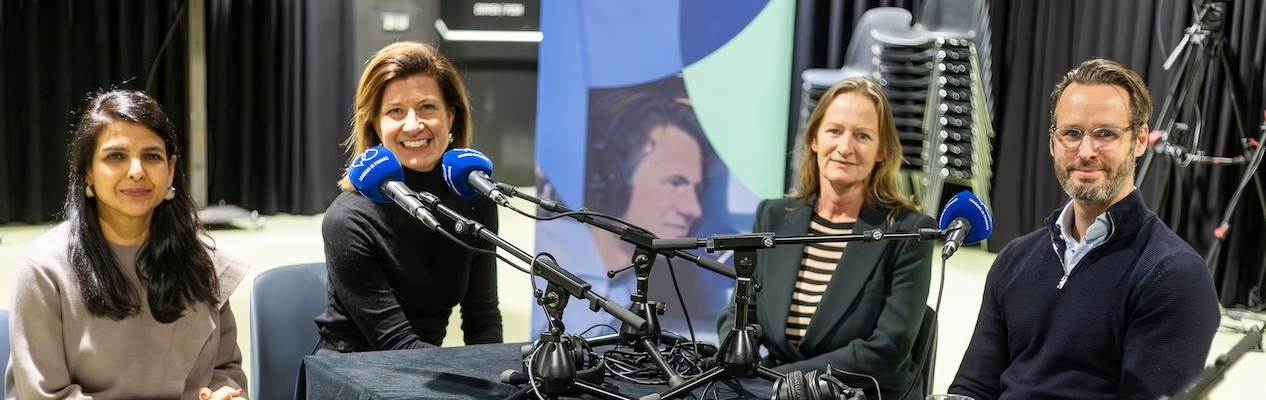
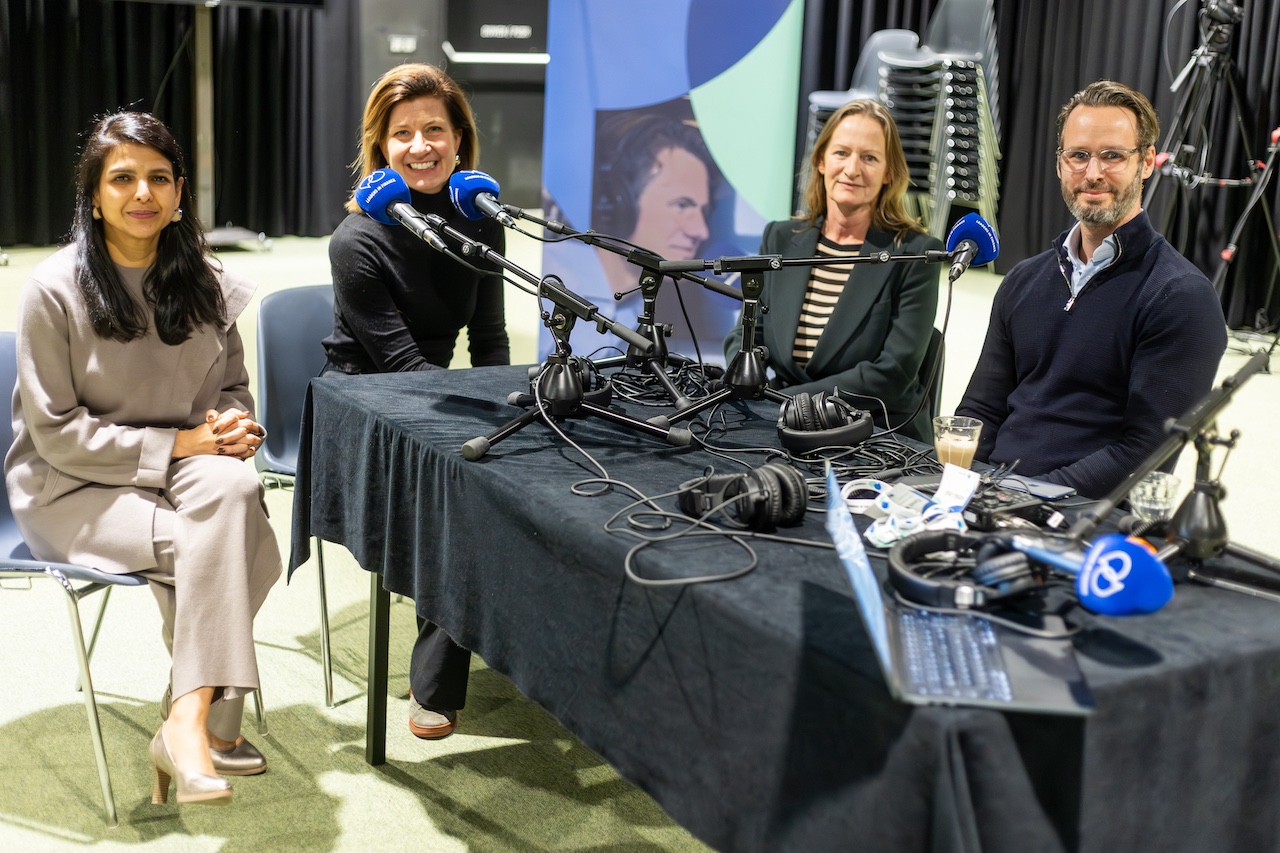
Marije: Hi everyone, and thank you so much for tuning in to this podcast. We are at Pakhuis De Zwijger in Amsterdam today, because we hosted the Leaders in Sustainable Finance event here. And I’m joined by a couple of people who played an important role today, either on stage or behind the scenes. So I’d like to kick it off with a quick introduction to see who we have at the table. Bart, over to you.
Bart: Yes, my name is Bart van Kampen. I’m a partner at KPMG within our strategy and operations practice, and also a proud sponsor of Leaders in Sustainable Finance. I think this is the third year that we’ve worked together with you guys. So thanks for that, and I’m looking back on a really great day.
Marije: Good. Good to have you here. You also had a speaker today, so I definitely want to hear how you feel about what John McCalla-Leacy did on stage. But we’ll come back to that later. On my left, I have Karen. Karen, could you please introduce yourself and tell us what you did on stage today?
Karen: Yes, hi, lovely to be here. My name is Prof. Karen Maas. I’m Professor of Accounting and Sustainability. And today I had the pleasure of doing a duo academic interview with one of my colleagues, Prof. Willem Schramade from Nyenrode University.
Marije: Thank you. And last but not least, we have Ambika Jindal. Could you also please introduce yourself, Ambika?
Ambika: Yes, thanks so much. It was a wonderful opportunity to be here today. My role was to be the final keynote speaker, after a whole range of very inspiring speakers. It was a tough job, but I enjoyed it. Thanks.
Marije: I think we’re all happy to be here at the end of a long and well-filled morning. Maybe as a first question, if you look back on the program we had today, what stood out most for you? Karen, is there anything that stood out for you?
Karen: We heard a lot of stories. We heard a lot of ambition. And if you listen to each story, it is interesting. There’s so much ambition and so much pride in it. But still the bigger question is: is this really enough? Are we doing the right things? That hasn’t been discussed that much, so that puzzles me a little bit.
Marije: Would you agree with that, Bart? Was it not discussed enough, or how do you look back?
Bart: Well, I look back quite positively. I think last year’s edition was more focused on the geopolitical sentiment and the changes in the U.S.
Marije: A normative discussion?
Bart: Exactly, and how that was impacting the sustainability ambitions within the financial sector. I think this year it was more pragmatic, also due to the topic at hand: how to accelerate sustainability by using AI and digital means. And I think the speakers were quite practical in the way they picked up this topic and accelerated it. I do agree there is still room to improve, but I liked the positive vibe in the room.
Marije: Great. Ambika, you just mentioned you were the final speaker today. You had the honor, so to speak, to wrap things up a bit. And I think you started your presentation by sharing some reflections on what was being said. Would you be willing to repeat what stood out for you?
Ambika: Absolutely. I think it was a wonderful mix of different practitioners and different experts in finance who influence how we work on sustainability. That mix is important because we all have a voice, we all have an opinion, and it’s important to keep us on our toes, I think.
Indeed, sometimes we can, in our own little bubble, feel like we are doing enough, and feel like there is nothing more to do. So sharing these best practices is great. It is difficult to be overly vulnerable in a setting like this. So I think it’s an expectation that many might have. But I’ve been in rooms where we’ve done that, and then, of course, it’s a safer space.
So I think today, for what it was, with the different parties and different kinds of stakeholders, the fact that we were transparent about several challenges, that we shared best practices, and that there was a positive outlook to it — that really came through. John McCalla-Leacy’s story from KPMG kicked that off, I think. Jeroen van Wijngaarden’s presentation, your first speaker today, and the fact that he showed a picture of his child made it personal. The stories felt very emotional and real to me. I think that was the intention, and that was good.
Marije: Yeah, maybe going to that first speech, Bart, because that was indeed mentioned. It was John McCalla-Leacy your Head of ESG at KPMG in the U.S. I assume global, as well. So tell us about it. How did you view his performance?
Bart: Yeah, of course — it’s a bit like complimenting my own organization — but I really liked the enthusiasm with which he presented. I think he highlighted three key topics in his keynote. On the one hand, he shared some perspectives, or frames, that we can apply when we look at the world and see which dynamics we currently see around sustainability.
Also the wave that is normal: from hype to realization, acceptance, and then moving into business as usual. And I think we’re in the midst of that transition — out of the hype of sustainability and into realism. So I think that brought a good perspective for the rest of the day.
And I also liked some of the highlights he shared around COP, and the dynamics he sees more on the global stage. And the fact that he had insights on which delegations were present that day, and also on misinformation that was being shared — for example about China or the U.S. not being present — and that it wasn’t fully accurate. I think that also broadened the discussion. And yeah, I liked it.
Marije: Yeah, I felt that when he managed to shuffle all those headlines and organize them for us as an audience — where do we come from, what was the ultimate low, and maybe we are slowly, slowly moving up towards an upward curve — it helped to structure it in a certain way, because it felt less overwhelming. Would you agree, Karen?
How did you look at that? Because you said it lacked ambition. Do you feel that gave a perspective?
Karen: No, absolutely. I didn’t mean to say that the talks lacked ambition. I think there is huge ambition, but it’s just not putting the real pain on the table, because it’s so hard to actually become a sustainable investor.
And John highlighted that very, very well for me. What I liked in his speech is that he translated it like this: we have worldwide ambitions that are translated into national regulatory ambitions, and that is put on the shoulders of companies or investors.
And then investors and companies try to do their best. They measure things, but it’s never related back to the national level, nor to the worldwide level. And that’s what we aim to do.
And it’s the same with… So we have this future in mind, but it doesn’t resonate, and it doesn’t feed us today on what we have to do. And I think that’s really the puzzle we should solve. So we should close the gap between ambition and what we’re doing today.
Bart: Yeah, indeed. And I think the three dimensions that he mentioned — look at what you can control, what you can influence, and what you need to monitor closely — that gives a framework you can use and apply in your everyday work, and also as a company on your ambitions.
Marije: Yeah. Which was, I feel, also re-emphasized by what Roland van der Vorst said, who went more into an example of how AI can drive sustainability. And I think one person in the audience asked, okay, but where do we start? What do we do differently? And I think he made it very, very simple: you. You need to start acting differently.
I think we can all agree that we enjoyed that kickoff by John. I’m just wondering: what other moments, or maybe a conversation, or an encounter today surprised you or stayed with you for some reason? Maybe you made some new friends or enemies.
Ambika: I can definitely say that there were many people I would want to follow up with, so that was very nice. The energy in the room — the sort of “let’s work together” part — was very, very good.
I think the moment that made an impression on me was also the speech of Dan Dorner from ABN AMRO. Yeah, I was very happy to see that he used examples that I would have used, that he pointed out problems that I would have pointed out, and that he wanted solutions for the same kinds of things.
I mean, we are different banks. We work on similar things — with ING and ABN AMRO — but it’s very reassuring, I think, if we re-emphasize those same challenges to the group, so that then we can start to solve them. So without any rehearsal, it was really, really nice to see that we are, in some ways, quite aligned, and that we ask for the same things from regulators, from public financiers, from our peers. I think that will take us far. That was very impressive.
Marije: Any encounter that stood out for you, Karen?
Karen: Well, I wrote down some quotes, so perhaps that gives some idea. I really liked what you were saying, Ambika — “hope is a strategy.” So it’s not that you should have hope and think that everything will be okay in the end. No, it’s a strategy. You have to believe in what you’re doing. And that’s so true.
And there was another quote: “Your voice matters, and your silence too.” Yeah. And that’s so true, because it’s not always easy to use your voice, and then you remain silent. But it’s so important to use your voice. So if you remain silent, then you don’t take your responsibility either.
Ambika: You’re being complicit in a way. And you’re saying something by staying silent as well.
Karen: Precisely. Precisely, yeah. So those were very nice quotes today.
Marije: Good. Thanks for those. Anything in particular that stood out for you, Bart?
Bart: Yes. Well, I really liked the presentation of Roland van der Vorst from Rabobank, and the way they are applying AI to accelerate sustainability within that bank. And also explaining the various use cases that they, as an agricultural bank, see for their farmers, their wholesale clients, and their rural clients.
Yeah, I think that made it very tangible — how AI, which is a bit of a technical concept, of course, and everybody has a view on what it could be, is made really specific for a banking environment. That really stood out.
Marije: Yeah, it makes it more tangible. I think this is one of the discussions you and I had beforehand when we were looking at the theme of today: we really wanted to emphasize acceleration. Like, okay, we know there are a lot of things that are difficult and maybe cannot be solved immediately, but can we, at least by organizing this event, show what is being done, where the challenges are in what is being done, and what our ideas might be to move forward.
And I think Roland definitely played a part in making that very tangible for us, including the three cases that followed.
Voice-over: This is Leaders in Finance with Marije Tolsma-Groen.
Marije: We said it at the beginning: this is the fourth time we’ve organized the Sustainable Finance event. It’s one of the staple events for Leaders in Finance, and it’s an important one.
We could also tell by the presence in the room: there were over 200 guests who joined us — not only from financial institutions, but also from NGOs, which was really good to see, because we like to balance the views and give everyone a voice, if we’re talking about voices. So we’re building on this topic, and we’re moving forward.
But if we say: let’s fast forward to this time next year, and imagine that we’re sitting here together again in this room recording a podcast — is there anything that you hope will have changed by then, either in the conversation, maybe in the community, or in the work itself?
Karen: Yes, well, there are a few words I heard many times today. Of course, it’s about strategy. “It’s about the client.” That’s also something I heard very often. Spreadsheets. But also partnerships, coalitions, things like that.
And I think it would be lovely if we could have some examples of partnering up next year. I think most financial institutions actually bump into the same barriers. They have to take the same hurdles. But how do they actually partner to learn from each other?
Because it also seems to me that a lot of organizations think they have to start from scratch, but there’s so much knowledge out there. There’s so much data available. There are so many tools and methods. So how do we actually use that to be able to accelerate?
Marije: Yeah, and I think there was even an example of that happening right in the room. I think it was an ING colleague who asked a question when Bianca Tetteroo from the Executive Board of Achmea was speaking, and it was indeed about creating that partnership. And I think she received an open invitation from Bianca Tetreault to make sure that both parties can align in that way.
So I agree — partnerships for next time are definitely something we’d like to hear more about, because if something became clear today, it’s that it starts with us, but we cannot do it alone. It needs movement.
Ambika: I echo that fully. I mean, I think the concept of partnerships so far has not been implemented that much. There is still this competitive sort of feeling.
I have to say it’s very complicated when you try to partner. We’ve tried. There are competition laws you have to think about. There are so many things that actually prevent true partnerships, even when people want to do it — just from a legal perspective, especially when it comes to financial institutions. So I hope that we can find a way around that.
So that we can actually see where it serves the needs we have, and move past those obstacles. I fully agree with you.
I also think bringing voices from outside finance is important. We were talking about Scope 3 a lot today, and maybe we need a bit of a reality check from those suppliers we’re talking about. If we could give them a voice as well, and engage with them the way you would on stage.
I think if we can see that dialogue has moved forward — that people have actually accomplished something together — that would be really, really promising. And that there would be new problems. I said that also in my speech: if we are still talking about the same problems we’ve been talking about for 10 years, 15 years, then we’re not doing much about them except talking about them. So at least we should have new problems by next year, I think.
Marije: Yeah, I see Bart nodding in agreement. Would those be topics for you as well next year — to talk about partnerships and see how to move the needle, where other things become more complicated? Maybe we can help each other.
Bart: Yeah, I really like the idea of also including the next step in the value chain and seeing how they perceive the efforts being made in the financial sector.
What I also would like to touch upon next time is the whole business case idea. So it’s not only doing good for good, but also doing good because it has economic value for you as a company — maybe in the short term or in the long term.
And yeah, making it not only a nice to do, but also a must do. And what is the value it can bring for a bank, an insurer, or an asset manager? I think we can make that very tangible, and I hope that next year, or in the years to come, we can make that even more explicit.
Karen: Yes, I think that was really nice in Roland’s presentation as well, where he showed the graphs — like, okay, we are more and more able to value what we have to value for the future. But now the next step is to translate that back to value now.
And can we actually take that into account in our financing models and instruments? So it would be nice if we could have some examples next year of where that has actually been implemented.
Marije: Yeah, exactly. As challenging as it might be. But I think starting with the dot on the horizon and working your way back is probably far more efficient than looking at historical data and trying to make sense of that, and not really making a step forward.
So yeah, good comments. Definitely some notes we’ll take for a next event. Like I said, we had about 200 guests in the room, but probably people listening to this podcast have either not been able to join us, or are just tuning in now to wrap up this quick reflection podcast.
Is there anything you would say is a key takeaway that you want to leave them with?
Ambika: Maybe I’ll start. Okay: don’t give up hope.
The noise is short-lived. There is noise and disruption in any new developing field. So we shouldn’t lose momentum. We shouldn’t lose hope when we really need to keep moving.
So I think we really need to make sure that people who are now suffering from climate grief, climate anxiety, and thinking that nobody is trying to do this and everybody is backtracking — that is simply not true. And I think there is enough science, enough fact to show that people are moving, that there is progress.
So I would say: if we keep that — open our hearts, open our action — then I think we can still meet all the goals that we have. So that would be the one message I would give.
Marije: Good. Karen, would you like to?
Karen: Be courageous. I would like leaders in finance to actually take steps. I think what I’ve also heard today is that we speak a lot about dilemmas — and I don’t think they are real dilemmas.
We just have to make a decision, and take a decision about what we are able and willing to take into account, and how we can value future value, how we can actually implement it, and steer on it today. And we should move beyond saying, “Oh, it’s so hard to do, it’s a dilemma.”
Yeah, it will always be a dilemma. But the more strictly you are able to put your ambition up front and make that very, very clear, the more you get rid of potential dilemmas — because then you’ve made your choice, and the dilemma is gone.
Marije: Yeah. Some final words from you, Bart — a key takeaway you would want to bring to our listeners.
Bart: Yeah, well, I think, Ambika, as you also mentioned in your presentation: let’s close the say-and-do gap. So we say a lot about our intentions, our ambitions, our commitments — but let’s turn it into action and close that gap.
Marije: I’ve heard it, I’ve understood it, and I’ve made note. We’re definitely going to be back again next year — and to our listeners, we hope to see you there.
I would like to thank you again for your role on stage, and also for joining me in this podcast. Thank you, KPMG, for being one of the partners today, and of course our other partners as well. We had eight in total today, so it was good that you all joined us, that you made this possible, and that we keep the conversation going. I think that’s one thing I’m taking away from this.
So thank you very much, and I’m looking forward to seeing you at our next event. Thank you. Thank you for the opportunity.
Voice-over: Thank you. You’ve been listening to Leaders in Finance. We hope you’ve enjoyed the episode, and we would love to hear from you.
What’s on your mind? Who would you like to hear next? Let us know in a review, an email, or get in touch via our social channels.
We’d greatly appreciate it. Finally, we’d like to thank our partners for their ongoing support. Don’t forget to check out all the other things we do at leadersinfinance.nl. Thank you for listening.