
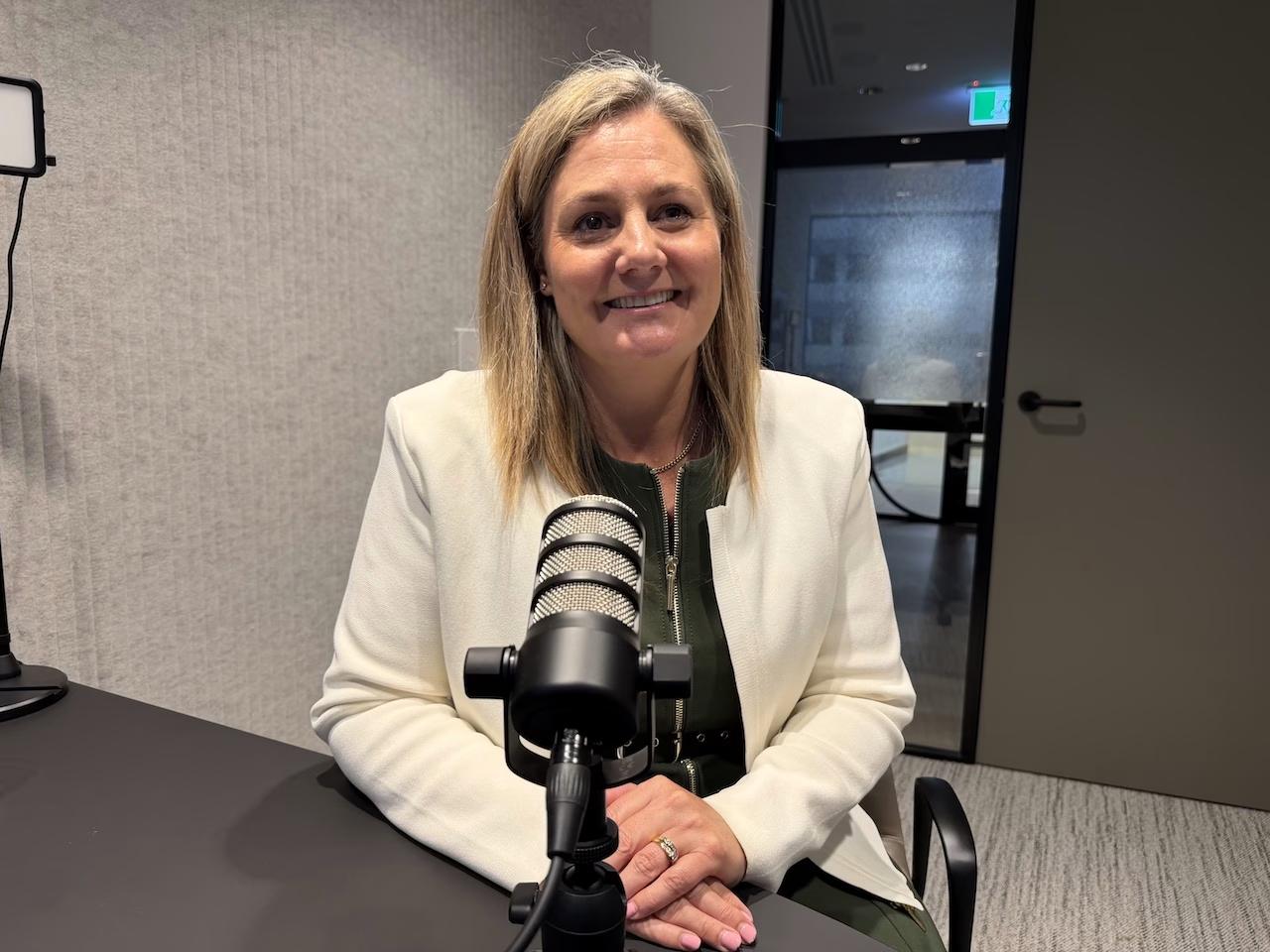
Voice-over: This is Leaders in Finance, a podcast where we find out more about the people behind a successful career. We speak with the leaders of today and tomorrow to discuss their motivations, their organisations, and their personal lives. Why? Because the financial sector could use a little more honest conversation. Our guest in this episode leads a fast-growing agricultural insurer in Australia.
Emma: We’re just getting started. While we’re 13 years into the business, we’ve still got a long way to go. There are still a lot of farmers and growers who haven’t heard of us. So when they do, we often get the opportunity to come straight onto the farm.
Voice-over: She grew up on a sheep farm in New Zealand.
Emma: So I grew up on my grandparents’ farm, and it was a great childhood, getting out and helping on the farm. My nana had a coal range where they would heat bricks, wrap them in newspaper, and we would hug them in our beds to keep warm. So it was all very basic, but it worked. And those bricks lasted all night, I have to say.
Voice-over: And if you ask her about ambition…
Emma: Sometimes we can look at a career in a straight line and think: I must get the next promotion to feel like I’m getting ahead. But actually, looking back at my career, moving sideways brought the biggest gains.
Voice-over: Our guest this week is Emma Thomas, CEO of Achmea Farm Insurance Australia. Your host is Jeroen Broekema.
Jeroen: Welcome to a new episode of the Leaders in Finance podcast. Thank you for tuning in. This week, we’re joined by Emma Thomas, the Chief Executive Officer of Achmea Australia. I am not entirely sure how they pronounce Achmea here in Sydney, Australia, but I am very happy that you’re joining us. So first of all, welcome, Emma.
Emma: Thank you. It’s wonderful to be here, and thanks for the invitation.
Jeroen: That’s great. Before we begin, I would like to thank our partners for their ongoing support. These are EY, the global consulting and auditing firm, Mogelijk Vastgoedfinancieringen, and Lepaya. Thank you to our partners.
And as is tradition, I’ll start by spelling the name of my guest: Emma, E-M-M-A, and Thomas, T-H-O-M-A-S. Before we get started, I would also like to introduce you a little to my audience.
Emma has been CEO of Achmea Farm Insurance Australia since April 2017. She leads the executive leadership team and oversees strategy, people, and culture, with a clear focus on Achmea’s mission: keeping farmers farming. Under her leadership, the specialist agricultural insurer has grown from a startup challenger into a major player in the Australian market, with consistent double-digit growth.
Emma grew up in New Zealand with strong farming roots, from her grandparents’ merino sheep farm in Central Otago to her parents’ deer and sheep farm in Riverton, Southland. She spent a lot of time helping on the farm while studying and starting her career in accounting and insurance. Before moving to Australia, she and her husband also raised their children on a small sheep and horse lifestyle farm on the Kāpiti Coast.
She studied commerce at the University of Otago and began her career in audit at a Big Four firm in New Zealand, Australia, and the US. She later held an executive role at an IT solutions company, then spent a decade in senior leadership at FMG, for those who may not know, Farmers Mutual Group, before joining Achmea. She now lives in Sydney with her husband and two children.
So that gives me, and the listeners, a little introduction to who you are. And I’d love to start by learning more about Achmea here in Australia, because a lot of my listeners will know Achmea in the Netherlands, but not in Australia. My listeners also know that I like to structure things a little, because if I ask you about Achmea here, you could probably talk for a long time. Based on my preparation, you’re clearly a very happy and proud Achmea CEO here. But let’s structure it around the stakeholders.
So maybe we can start with the clients. I think they’re super important to you, from what I’ve read. So perhaps you could tell us a bit more about the clients first.
Emma: Yes, thank you. They are incredibly important, our clients, and here in Australia they are so diverse. The exciting thing about agriculture in Australia is that it’s a growing sector, and Australia is a huge exporting nation. So it’s exciting to work alongside our clients as they face new challenges, whether that’s natural catastrophes, of which we’ve had our share here in Australia, global market uncertainty, or developments in technology and data use, literally in the field, where they have animals and crops.
With our clients, we take a partnership approach. Our strategy is based on customer intimacy. And as a specialist direct insurer here in Australia, focused solely on the agricultural sector, we really take the time to understand our clients’ businesses. That’s what really sets us apart in the local market.
Last night, for example, I was out talking to one of our clients, and they were really asking us to give them advice about what we saw around the farm. Things like where electrical equipment was located, and whether, should a disaster occur, like a fire or a storm that damages a building, essential pumps, motors, and electrical equipment would be adequately protected through those events.
So we really share what we’ve seen go wrong over our 200 years of experience coming from the Netherlands, and combine that international expertise with the knowledge of our local farm insurance specialists, who live in the regions and communities where our clients are. They have experienced those storms and fires as well, and have the opportunity to share what they’ve seen go wrong.
Jeroen: So a couple of follow-up questions before I move to the next stakeholder. First of all, when you talk about the farm insurance sector, what do you actually mean? Are we talking about very small farms all the way up to huge businesses, or is there a sweet spot somewhere in between?
Emma: Yes, good question. We focus on farmers who are owner-operators, some of whom come from multi-generational family farming backgrounds, right up to corporate farms, which may be owned by superannuation funds or have 30 farms as part of their business operations. We are seeing a lot of consolidation in the sector, with more large-scale corporate farming, and that’s certainly something we’re able to support clients with: that growth and transition, whether they are family farmers or corporate farms.
Jeroen: So is the approach very different in terms of this customer intimacy, or is it equally important for both?
Emma: It’s important that we partner with both. We want the experience to be Achmea, no matter what size the client is. But typically, with corporate farms, we are having boardroom conversations, whereas with family farms, we are sitting across the kitchen table, walking around the farm, and having those conversations face to face.
Jeroen: And when you talk about corporate, what kind of turnover should I be thinking about? How big is corporate?
Emma: Anywhere from around 50 million in turnover up to hundreds of millions.
Jeroen: So really large businesses. And with all of them, you always have this personal connection, you always go there, you never do insurance with farms just over the phone or through the internet or something like that. It’s always in person.
Emma: Yes, it’s always in person. But having said that, we are looking at developing more of an omnichannel approach to meet farmers where they are. If you think of a farmer harvesting crops at 11 o’clock at night, and the harvester breaks down, they ring their neighbour, borrow theirs, and then have a conversation about who has the insurance if something goes wrong. We want to be able to give them that peace of mind wherever they are. So we want to provide digital solutions, complemented by in-person service, either on farm or over the phone, as needed.
Jeroen: So that’s a good segue into the next stakeholder: your colleagues, the whole team. You must have quite a lot of people, then, to do all of this in such a big country.
Emma: It is a big country. We’re about 140 people strong now. About half the team are based in Sydney, in our Sydney office, and the rest are spread right across Australia. Some are home-based. We have about six offices, but many people work from home so that they can go out and visit clients at their place of work, which is typically on the farm.
Jeroen: So the other stakeholder I’m especially curious about is your shareholder, the owner of the business. Also because that cooperative element is such an important part of Achmea, but then there is obviously also the Dutch headquarters. So how does that work exactly, as a stakeholder?
Emma: The story of Achmea actually began in Achlum in 1811, with a group of 39 Dutch farmers putting money into a glass jar in case one of them needed support. Back then, in 1811, the main risk was haystack fires. So they were very conscious that they needed to help, because it had a big impact not just on the farmer’s ability to recover, but also on the communities relying on that hay.
And not only did they provide financial support, they also sat together and shared risk prevention measures. That’s really the philosophy we’ve brought to Australia. We wrote our first policy here in 2013, so we’re relatively new to the Australian market. By working with our Dutch parent, we’ve been able to bring in a lot of international expertise, alongside local knowledge. That means we’re really able to complement our service offering when we go out onto farms.
Jeroen: Because I’ve heard that glass jar story over and over again, and I think you also use it in conversations with customers, right?
Emma: Yes, we do. And I think it’s a really important part of our story, and of helping people understand that it’s not just about the financial aspect and putting money in, it’s also about how we protect and preserve what matters. So that when these large events do happen, we’re able to get clients back on their feet. They may have supermarket contracts at the other end of their business line, so it’s really important that we understand when they need to get crops back in the ground, or under glasshouses, so they can meet those contracts. So it’s not just about rebuilding, it’s about really understanding what support they need in order to keep their businesses going.
Jeroen: And one more follow-up on the relationship with the headquarters, or whatever you want to call it. Do you feel super independent here? Or do you feel like you’re part of the bigger group? How does that work exactly? Are you running your own business here, or not really?
Emma: We are running our own business here. So we get to choose and present to our board what infrastructure we need, for example IT infrastructure that really supports the local environment and ensures that regulation and compliance are built into the platforms we’re using to service our clients. But we also have the benefit of being able to reach out for international expertise.
This week, we’ve got four people over from Hagelunie in the Netherlands who are meeting with our clients and sharing what they are seeing in terms of innovation in glasshouse technology from the Netherlands.
Jeroen: Because that’s also an Achmea brand, right?
Emma: It is.
Jeroen: Yes, just to make sure.
Emma: So we’re able to tap into that, and we’ve had some cadets and also some international secondments. We’ve had the benefit of bringing people over from the Netherlands on secondment. We’ve had an IT graduate come in and support some of our business case planning, as well as people in IT security and culture.
We have kept a few of them here as well, I have to say. So we have a nice Dutch community here at Achmea Australia. And we’d really love to send some of our people, if the opportunity comes up, back to Achmea in the Netherlands.
So it really is the best of both worlds: running our own business over here and really feeling ownership of it, while also being able to tap into international expertise. And there’s a lot of expertise in the Netherlands around AI at the moment, so that’s something we’re really looking to leverage locally.
Jeroen: Right, makes sense. Do you know, by the way, approximately how many Dutch people are working here? Is it like five or ten, or even more?
Emma: Yes, it would be around five.
Jeroen: Five, yes, that’s cool. Thanks for sharing. I was going to ask about the regulator, because how are you regulated?
Emma: So we’re highly regulated in the financial services sector. We are a branch of Achmea Schadeverzekeringen, and that means we’re dual regulated: by the Dutch Central Bank, as well as locally here by APRA and ASIC.
I found that beneficial, particularly when we had the Royal Commission here in Australia. There was a significant amount of regulatory reform that came through. We already had some of those legislative changes in place, because Europe had adopted some of them earlier. So I felt that actually gave us a head start in terms of adapting to some of that regulation.
But regulatory expectations continue to increase, and it’s really important that we stay conscious of any new developments and also of how we work those into the customer journey with our clients.
Jeroen: Would you say, I don’t know if you know, that regulation is more intense here for insurers than it is back in the Netherlands?
Emma: I would say yes. My experience of working with colleagues in the Netherlands is that it is much more principles-based there, whereas it is much more rules-based here in Australia. So I think that’s probably the key difference I see.
Jeroen: So if the Dutch compliance people at Achmea are complaining about the Netherlands, then you can say: well, come here, it’s definitely not easier.
Emma: Perspective is always a good thing.
Jeroen: Exactly. That’s very true.
Voice-over: This is Leaders in Finance with Jeroen Broekema.
Jeroen: And then the other stakeholder: competition. Because you grew the business rapidly over the years that you’ve been CEO. So apparently there’s not much competition going on, or you’re just really good.
Emma: I’d like to think we’re really good. That’s certainly something we pride ourselves on. But I think the market here in Australia needs competition. It’s really important for us, and for other competitors, that there is adequate competition in the market so that products, services and offerings to clients continue to improve, and so that we can navigate the increase in volatility in natural disasters that we’re seeing.
We have experienced rapid growth, and part of my leadership in that has really focused on something my dad, who was also in insurance with a cooperative back in the 80s, always said: see the people, see the people, see the people. And whether that’s your clients, your employees or the community, it’s about being visible out there so that clients know who we are. They know they’ve got another choice when it comes to farm insurance. And as we work with them, we continue to stay relevant to them as their needs change through technology and other developments on the farm.
Jeroen: So ultimately, what you’re basically saying, in my words, is that the relationship side of all this is still extraordinarily important. And that applies to both smaller farms and large corporates. I asked something similar before, but I’m just curious: is the relationship really that important, or ultimately does it come down to pricing?
Emma: Price is important, yes. And what we like to do when working with our clients is understand what they would like insured, which risks really keep them up at night, and how to protect those, rather than being there if they drop their mobile phone. Farmers are very much jack-of-all-trades. They are very good at fixing things themselves. So it’s really those bigger risks that matter. Actually, we can work with them around what sort of package within our all-in-one farm pack insurance best suits their farm and the risks they are trying to protect against.
Jeroen: And just to make sure I really got the full answer on competition: so it’s a strength, but apparently there is still a market for you. Does that mean you can still grow five or ten times from where you are today, or is that impossible?
Emma: We’re just getting started, I feel. And while we’re 13 years into the business, we’ve still got a long way to go. There are still a lot of farmers and growers who haven’t heard of us. So when they do, we often get the opportunity to come straight onto the farm and show the difference in what we offer, and the certainty around what they’ve got covered and how we can partner with them on risk.
Jeroen: So I’m a former banker. I don’t know much about insurance, to be honest with you. But maybe you can give me a very short lecture on reinsurance, because how have you organised that? I assume insurers are not taking on all the risk themselves. You also reinsure a lot of the risk, I suppose.
Emma: We do, yes. And reinsurance is a very important part of our business. And it has changed. When I first started, we had a small pool of reinsurers supporting the business. As we’ve grown, and as our clients have grown, we’ve had to increase that pool of reinsurers so that we have support for those very large events and make sure we have that capital protection in place should multiple events occur in a short period of time, which we have seen here.
Jeroen: Yes, you’ve mentioned that a couple of times already during this conversation. It’s definitely on my list to discuss in more detail later in this episode. But just on the risk side, because the risk-sharing is still partly the glass jar idea, right? People helping each other in a risk pool. And partly it’s reinsured, and partly you’re taking on some of the risk yourselves. How does that work exactly?
Emma: Yes, that’s exactly right. So it’s about understanding what risks clients want to take on themselves, what risks they want to transfer to us, and then making sure we have adequate reinsurance protection in place for those really large events, should multiple claims occur over an extended period. So yes, you’re pretty close with your definition there.
Jeroen: Thanks for explaining. But are we missing any stakeholders here? So we have competition, regulation, the relationship with the Dutch mother, customers, colleagues. Are we missing an important one? Maybe society?
Emma: Yes, I was just going to say that. At Achmea Farm Insurance, it’s very important that we partner with our clients. And we do a lot of local sponsorships at grassroots level, whether that’s trade shows, beef expos or poultry exchanges. As I said, the diversity in agriculture in Australia is immense. We also have bananas growing here, which is something I know a lot of my Dutch colleagues weren’t aware of. There are just so many different industries that need support. The cotton industry is another one we do a lot of work with.
But for us, it’s about investing back into the communities that are supporting us. So we have a programme that we’ve been running around youth leadership in the beef sector, really investing in the next generation of leaders and making sure they have the skills and knowledge to tackle the challenges in front of them. It also helps them create a network, because it can be isolating in such a huge country. So having that network, where you can really bounce ideas off each other and support one another through relatively similar challenges, regardless of industry, is very important.
Jeroen: So how did you become CEO? I read that you were recruited.
Emma: Yes, I was.
Jeroen: Is that correct?
Emma: Yes, I remember.
Jeroen: How did it happen? Because you were in a different kind of role. You were not yet in a board or CEO-level position, right?
Emma: No. I was driving home one night and got a call from an Australian recruiter. And I thought they were quite clever, actually. They said there was a position that I had been shortlisted for, because someone had recommended me. I’ve never found out who actually recommended me, so I’m not sure whether that was just a hook. But it was compelling to hear that someone had put themselves out there to recommend me for a position at Achmea. So then I set about learning who Achmea was.
Jeroen: Did you know them?
Emma: No, no. But I did know Rabobank, and I knew there was a connection. So I questioned some friends at Rabobank to find out more about Achmea, who they were and what they were doing in Australia. And I was very excited that their growth aspirations were similar to something I had already been part of in my previous organisation. So I thought, how exciting to be able to do that again, but this time with the knowledge I had gained over ten years of growing a business.
Jeroen: So was it a no-brainer? Was it like, you know, an hour later you called back and said, I’ll do it? Or did it take a long time to think about?
Emma: Well, the recruitment process started around December and I got the job in March, so there was quite a bit of time to consider it. It was also very thorough. And that’s one thing I noticed with the Netherlands and working with the Dutch: it was all about getting to know me and who I am, as opposed to just focusing on the skills and experience I had. So I think that ability to connect was important. I probably met with about 15 people in two days in the Netherlands, just to get to know the company, the culture, the expectations and to start building those relationships early. That made the transition into the CEO role a lot easier, because I had already developed some of the relationships I would need abroad to support me here in Australia.
Jeroen: And were you here or were you in New Zealand?
Emma: I was in New Zealand.
Jeroen: So it was a big change for you. It was a step up, quote unquote, at least. I would argue it was a big step up. And it was another country, which you obviously knew, but not as well as New Zealand. So it was also a big change for you personally.
Emma: Yes, it was. And once I was offered the job, I only had four weeks to pack up the farm and move. So once the decision was made, it was all on.
Jeroen: What did the family say?
Emma: Well, my husband has been right behind me from the start. He would be my biggest supporter. And for him, it was a no-brainer. I don’t even think he hesitated. He said, I thought you’d get it. Let’s go. I’m excited.
So yes, I had to sell the sheep I had, which I probably could have sold three or four times over because they were in hot demand, my little flock of sheep. But it was also about finding homes for the horses and the chickens. It really was quite a significant move.
And then moving the family over as well, my son was four and my daughter was seven. So they were still very young. Starting over in a new country, we had to get tax numbers again. We had one cousin a couple of hours away, but otherwise we didn’t know anyone over here.
Jeroen: How different is it here compared to the west coast of Kāpiti, New Zealand?
Emma: Yes, well, I remember probably the biggest shock for me was crossing the road. In Palmerston North, where I was working, I would cross the road and be battling the wind just to get to the other side, with maybe one or two other people. Here there was a crowd of about 50 people around me as I crossed the road. So just the size of the city really surprised me, how different it was.
But a lot of the same values we have in New Zealand are also present in Australia. And the people who were already part of Achmea were very passionate about what they were doing. So it was exciting to join a company where belief in our purpose was so strong.
Jeroen: Did you get a kind of assignment from your board, or from the leadership above you? Did they tell you: this is really what we want for the next few years?
Emma: It was all about growth. As I said, we were a startup organisation when I joined. We were based in Rabobank offices, and my assignment, if you like, was to start scaling the business for growth. So how could we invest in the systems and support we needed to scale the company?
And now, even 13 years on, we’re entering a new transformative phase of our journey as an insurer. So there have been very different phases, requiring very different experiences and capabilities. And that’s the thing I love about insurance: every day is different. There’s a new claim, a new client with an idea. Our employees are currently experimenting with AI, so how can we pilot it and really use some of that knowledge in our business to support our clients ultimately?
Voice-over: This is Leaders in Finance with Jeroen Broekema.
Jeroen: I’ve asked many, many CEOs this: how different is the job from what you expected?
Emma: Yes, that’s a good question. I think my expectation was that I would need to have all the answers when I came in. Having had the experience now over the last eight or nine years, I see it very differently. It’s much more about being able to listen, understand the trends and the heartbeat of the business, see whether we’ve got momentum and where the blockers are, and then support our team around that. So my perception certainly changed along the journey.
Jeroen: And are your challenges for yourself different today from what they were in 2017 when you started?
Emma: Oh, absolutely. In 2017, it was, as I said, all about scaling, so looking at investment and IT to streamline processes for our clients. Whereas now, some of the challenges around AI are going to revolutionise the way we work. If I look at Copilot as a tool, we now have this partner, or sparring partner, that can challenge us, critique our thinking and actually elevate some of the human experiences we can offer our clients. So I feel really fortunate. I studied shorthand typing at school, which I have not used since then. And I’m sure our school leaders today, and my own kids, will not end up using some of the skills they are learning today either. But how exciting to be part of that revolution for the future. And I think insurance is a great industry for people looking to join, because the essence of what we do is helping: helping through those tough times, and helping society and the sector become more resilient.
Jeroen: Just one question in between, because I’m curious about it. We are currently recording here in what we would call downtown, but what you call the CBD, the Central Business District, in Sydney. It feels far away from the customers you serve. Why are you in this, I would call it, posh business district area? Why are you not based somewhere further out, away from the big city?
Emma: Good question, because it’s a long way to get to anywhere in Australia.
Jeroen: It’s huge. Sydney alone is large, and the country itself is massive.
Emma: That’s right. And typically, to get to most places, you need to fly. So while we do have people based in regional communities, they aren’t all in large local offices. Sometimes it’s just one or two people in a regional office. Our next biggest office, in fact, is a new one we’ve just opened in Tamworth. We see that as a regional hub, because we’re looking for people to join not just in frontline field roles with clients, but also in claims and back-office support functions in those regional communities where our clients are.
Jeroen: That makes sense. But just to phrase it differently, are there benefits to being in the big city?
Emma: Yes, there are. There is also talent here for functions such as IT, particularly in Sydney, and for some of those technical roles. The insurance industry is a relatively small industry, so we do see and attract people from other insurance companies who are looking to further their careers with us. And our regulators are based here, as are many of our strategic partners.
Jeroen: Makes sense. So if we go all the way back to the start of your career, you started at a Big Four firm, Deloitte, as an auditor, right?
Emma: Yes.
Jeroen: Yes. Why was that the path you chose at the time?
Emma: Well, I might take you back a bit further, actually.
Jeroen: Yes, that’s great. Even better.
Emma: In my accounting journey, my first job was actually working in an ice cream shop. There was a man who used to come in every Sunday after marathon training, and he would always order a strawberry ice cream with marshmallows. I still remember. It was the same every time. I got talking to him, and he was a partner in an accounting firm. I was still at school at that stage, working in the dairy. Through those conversations, we talked about what I was studying. I was studying accounting. Eventually, a graduate position came up in their firm, and I applied for it. So very much through that relationship, he was able to speak for me, having already got to know me. So after leaving school and joining an accounting firm, I actually studied part-time and worked full-time at Southland Polytech, and then later went on to the University of Otago. And I think doing it that way actually set me apart from other graduates who had gone straight from school to university and then applied to the Big Four. So I was fortunate enough to get a role with Deloitte in audit, and that gave me fantastic experience in terms of working with senior executives and businesses, understanding how they operated and looking at how they were managing their balance sheets. Through that, my focus became working internationally. I had just moved from Invercargill to Dunedin, so still very small towns in New Zealand, and I had a dream of working in America.
Jeroen: Why was that? Why did you want to go international?
Emma: That’s a good question. It was just so far away. New Zealand is a long way from everything. I’ve heard in some lectures that we’re not even on the map, which is obviously a bit disappointing. But yes, the US at that time had just had the Enron collapse, then Arthur Andersen collapsed, so the opportunity came up with Deloitte to work in Wisconsin. There, I was managing a team of Canadians and reporting to a former Arthur Andersen manager in the US. So I was in a really interesting phase of my career where I got to work with lots of different cultures in a different country. And I think that gives you a lot of confidence, just realising that you can go somewhere completely new, drive on the other side of the road, turn up at the right place, start working and start engaging with people as you normally would.
Jeroen: Super exciting at that age, right? I mean, how old were you when you went to the US approximately?
Emma: Around 25, yes.
Jeroen: Had you ever been there before?
Emma: I had been once on a university tour, but that was really more of a tourist experience than a working one. So yes, it really was life-changing.
Jeroen: And this idea of wanting to go international, wanting to see other places beyond the South Island, beyond Invercargill to Dunedin and then the wider world, was that something you already had as a child? Or did that come during your studies or later in life?
Emma: Yes, I think we obviously got a lot of American television. So I think back then it was really: what is this place like? What is it like to work there? And could I work there?
So I think I saw it as a bit of a challenge. Is this something I could do with my career? But certainly not as a child. I also studied international business at university, and I found that really interesting in terms of the different jurisdictions and ways of working.
Jeroen: You didn’t want to stay there? You didn’t want to stay internationally? You wanted to come back?
Emma: I did come back, yes. I came back, settled down, met my husband and had children. So I think that was good in terms of having that stability and not travelling around so much.
Because I actually went straight from Darwin, where I had been for four months in the Top End of Australia, had one week back in Wellington, and then went straight over to Wisconsin. So I was away for the better part of a year. And friendships change, groups change. So it was good to come back, have my children and have that lifestyle property we spoke about earlier.
Jeroen: Well, you’re international again now, and have been for quite a while. Although I would argue Australia and New Zealand are a bit more similar than the US and New Zealand. But as a student, what kind of student were you? Were you the kind of student who partied a lot, or the one who was always studying and working really hard, or somewhere in between?
Emma: Yes, good question. Well, I pretty much had to self-fund my education, so I was working in pubs, which meant I could see what was happening socially. So I wouldn’t say I partied too much, probably not as often as I might have liked. But I did feel I was part of student life and the scene. In terms of studying, I went to my classes and worked on the assignments. I actually quite enjoyed studying, but I wasn’t top of the class. I think I got better each year I was there. The more I did, the more I developed the skills that helped me achieve higher grades.
Jeroen: What kind of classes did you like most?
Emma: More practical ones, especially when we were talking about business. I do remember one class where we had to present on an accounting standard, which is pretty boring, if I may say so. But we did it with a David Letterman show theme. So we tried to bring in real-life examples and interview each other through that format, just to make it more interesting and more memorable as a presentation. I also remember there were no laptops in those days, so I literally carried the hard drive of the desktop computer to set it up in the classroom. Quite innovative back then.
Jeroen: And what would you say is the most important thing you learned during your time as a student, something you still think about or maybe even use today?
Emma: It would be developing relationships and teamwork. We did a lot of group assignments, and I think the ability to draw on that diversity of thought around a table, which is something I really value now, is so important. It is the ability to challenge each other’s thinking and to have constructive debate that actually raises the quality of the outcome or the proposal that you’re all working on together. So that is certainly something I learned at university. That is the real value. It is not always just about what you think. It is about someone else putting something on the table that makes you think differently, which then produces a better result.
Jeroen: Did you make friends for life as well, or were your friends mainly from earlier on?
Emma: They were actually from earlier. Some of my good friends from high school came on to university with me. But we were all working in pubs as well, so it was quite a busy life with study and work. We did make new friends too as part of that journey.
Jeroen: And you are still in touch with this group?
Emma: Yes, we are still in touch, but they are back in New Zealand. So I do not see them as often as I would like, but we do keep in touch.
Jeroen: Are they also in finance, or…?
Emma: Yes, actually, surprisingly.
Jeroen: I did not expect that answer.
Emma: A bit of a mix, though. Some of us stayed in finance and some did not.
Jeroen: If we go back even further, before your student years, could you share a little bit about how you grew up? I already mentioned a little in your introduction, but maybe you can elaborate on it.
Emma: Yes. So I grew up partly on my grandparents’ farm, but my parents were living in the city of Invercargill at the time. And I had a real love of horses. So most of the money I made went into supporting the horse I was given when I was 10 years old. My dad turned up with a horse and a horse float in the suburbs. He had been given this horse for free because it was such a lovely horse, but it was an ex-racehorse. So when I joined the local pony club, I was on a horse and everybody else was on little ponies. But it really did not matter because it was my passion.
And with that, I took my horse out to my grandparents’ merino farm during the school holidays. It was extremely hot in the summer and extremely cold in the winter. My nana had a coal range where they would heat bricks, wrap them in newspaper, and we would hug them in our beds to keep warm. So there was no air conditioning in those days. It was all very basic, but it worked. And those bricks lasted all night, I have to say. They really did keep us warm. But it was a great childhood, getting out and helping on the farm.
Jeroen: Yes, you did work a lot on the farm yourself.
Emma: Yes, we did. And particularly when it was shearing time, it was all hands on deck. So I was down in the shed. I was what they called rousing, so I was throwing out the wool, picking off the edges, and then rolling it up. And when I was a bit bigger, I was also pulling sheep out of the pens and passing them to the shearers. So it was quite physical work, but it was enjoyable work. And again, it was about being part of a team, part of the family. You could really see those freshly shorn sheep running out, which made it feel like you had done something worthwhile.
Jeroen: And I guess it helps you today with connecting quickly with farmers, right? Because you know the work, you have done it yourself. They are not going to say, you know, this lady, or maybe your colleagues, these people from downtown Sydney, they have no idea about farms. You actually do.
Emma: Yes, I do. Although I would say I like to call myself a third-generation sheep farmer, because I did have some sheep, but my grandparents had thousands, my parents had hundreds, and I had tens of sheep. So they are certainly getting smaller.
Jeroen: Generations of two or one.
Emma: Yes, I only need a couple more and then they are fourth generation. But yes, I think it is really important. And I live vicariously through our clients now and through seeing their farming operations and how they are growing. I do not think I was the best farmer. I was throwing out hay on the way to work and perhaps tailing the lambs a little later than I should have been. So I do see a huge amount of impressive farming practice. And farmers love telling you the story of their farm and how it has come through the generations, and what they have built. So I think it is the connection through a shared history of being on a farm, but also the curiosity you have about their business and genuinely wanting to understand their challenges.
Voice-over: This is the Leaders in Finance podcast with Jeroen Broekema.
Jeroen: So when it comes to your youth, I would like to talk about two people in particular. Obviously, we can talk about others as well. But your grandmother, I think her name was Daphne?
Emma: It is Daphne.
Jeroen: And your father, whom you already mentioned, because he was in agricultural insurance as well. So let us start with your grandmother. She was one of the so-called land girls, right, if I understand correctly? Tell me more, and tell the listeners what that actually means. I read about it, but I had never heard of it before.
Emma: Well, my nana Daphne turned 100 last year.
Jeroen: Oh really?
Emma: Really.
Jeroen: Wow. Congratulations. Three digits.
Emma: Three digits. She did get a card from the King and Queen, by the way.
Jeroen: Oh wow. Impressive.
Emma: As well as from the New Zealand Prime Minister. So that was very nice. But she has really been an inspiration. When she was 15 years old, the men went off to fight and enlist in the Second World War. And the women were really brought into agricultural jobs. I think around 4,000 women took on those roles. For her, it was dairy farming and milking cows so that the economy could keep going while the men were away.
And it is a fascinating story, because production actually went up while the women were looking after the animals.
Jeroen: Are you implying something here?
Emma: I just thought that was an interesting point.
Jeroen: Yes, absolutely.
Emma: But it was good. She had to leave school at 15 to go and do that, so she did not get the opportunity of a formal education. But she has always loved reading, and she still does crosswords today. She still lives relatively independently, which is really impressive for her age. She has just been such an inspiration in terms of her can-do attitude. It was never about whether you were male or female, or what kind of jobs you had. Jobs needed to be done, and if you were a pair of hands, you helped.
And she is very modest. She talks about just plodding along. But through her life she has done a lot of volunteer work, supporting people in aged care homes who were younger than she was. She also had that same love of horses and really taught me how to ride and how to look after a horse. So yes, it was a fantastic childhood.
And she still has a very sharp memory. She remembers times when I got locked in the bathroom or got lost on the farm as a three-year-old. She loves telling the story of how they found me.
Jeroen: Oh wow. What a wonderful story. Did she also tell you how you actually become 100, what you should do?
Emma: Yes, we have been quizzing her on that.
Jeroen: Yes, exactly, I can imagine.
Emma: Well, I think she keeps it pretty simple. It is exercise, eating real food, and keeping the brain active. That is really what has worked for her. She has never driven a car, but she reads the newspaper every morning and does the crosswords. That love of knowledge through books is something she always says matters. You just need to keep learning.
Jeroen: Wow, I love it. Exercise, healthy food, or rather real food, as you said, and reading and keeping your brain active. That is wonderful. So you use that as well in your own life, as a reminder that these three things are important?
Emma: Yes, absolutely.
Jeroen: That is great. And about your dad, because most people do not want to do what their parents did, and in the end you did.
Emma: Well, I did, but I did not want to. So let me explain that. When my father was in insurance, what I observed was that they were on commission arrangements. He had some agents who had not sold any business, and that meant they could not feed their families. I remember dad, who had access to his farming network, getting meat and vegetables and giving them to his agents. And I thought, why would I want to be part of that? That uncertainty for your family seemed really challenging.
So I actively moved away from it and started doing dad’s books on the farm as a sort of bush accountant, as they call it, and really moved forward with my accounting career. But then, later in life, I got the opportunity to go back into insurance. In terms of the people I had met and the understanding I had built up, I had a broader perspective and thought that working for a cooperative-based mutual insurer, as I did in New Zealand, was going to be different from that commission-based model I had seen back in the 80s, where people sometimes could not feed their families.
So yes, I actively tried not to. But unfortunately, my dad passed away about 13 years ago from dementia. He died at 61, which is really young. He did not really know where my career was going or what I was doing. And obviously, I would love to be able to tell him now: I am in insurance, Dad, you would not believe it.
Jeroen: I think he would still be proud, right?
Emma: Yes, I think so. But I missed the opportunity to draw more directly from his experience in terms of how he grew businesses. Still, there were things I definitely picked up from the way dad was with people. And as I said before, it is about seeing people. There is nothing quite like looking someone in the eye when they have been through a tragic situation. The question people have is: is my insurer going to be there for me? And if you can give them that assurance, and if you have already walked them through the policy so they understand what they have got, then they can sleep more easily at night too.
Jeroen: Thank you for sharing. That really is a beautiful story. And I said I would pick two important people in your life, your dad and your grandma. Are there other people we should be speaking about as well from that earlier period, say from zero to 25?
Emma: Oh, my mum. She is pretty important as well. She kept everything going at home. Mum did a lot of volunteer work, and her passion was really sport, just like Dad’s was. Dad loved rugby. Mum loved hockey. She volunteered with organisations like Kiwi Able, working with children with disabilities to give them sporting opportunities. So it was great to see how her contribution to society was enabled through Dad working, and we grew up seeing that as something important, something we should also be looking to do as adults.
Jeroen: Is there something else we should know about your youth? Something that was really important to you, or that still plays a role today?
Emma: I took the opportunities that were given to me. So when I worked for an IT company, I was the financial controller for that company, but I also took project management courses because I thought, I really want to understand this IT business I am working in, and I want to understand project management. There were a lot of projects going on, and I wanted to know what that methodology looked like. That is where I got introduced to concepts such as agile and waterfall approaches to running large-scale projects and innovation.
Looking back, it was not that I was aiming to move into IT. It was more that I needed to understand the business. But as I moved into other roles throughout my career, I had the opportunity to use those skills because I had invested in that project management knowledge while I was there.
And at FMG, I was financial controller for about three and a half years, and then I was asked if I would like to go on secondment to understand the operations and sales side of the business. I never went back. The CFO still says, you never came back. And I say, no.
But that move away from specialisation was important. I had a narrow focus then. I wanted to be a CFO, and therefore having depth in finance was important. But having breadth, being able to grow a business in terms of the top line and clients, while also balancing the books, is something I have been very fortunate to experience in my career. And if I had turned down a couple of those opportunities, I would not have had the opportunity to be here.
Jeroen: So you have kind of already answered the question I normally ask right at the end of the interview, which is about advice for people starting out. It sounds like your point is really: take the opportunities when they come, and do not be afraid to take them. Is that fair?
Emma: Yes, absolutely. And if it is a bit different, go for it. If you get the opportunity to be part of a project that makes a huge contribution to a company’s P&L, jump in and be part of it. If it fails, that is not really the problem, because you learn so much.
So when I am recruiting now, I am looking for people who have had some war wounds, people who have really taken the learning from an experience and stayed around long enough in an organisation to implement something, see how it went, realise some things should have been done differently, and then improve it for the future. I think those war wounds, and being prepared to fail sometimes, and really putting yourself into something you are not comfortable doing, matter a lot.
Jeroen: So really, do not be afraid to take some risks. That is what an insurer says, right?
Emma: Indeed. Calculate the risk.
Jeroen: You can calculate the risk, and otherwise you can always insure yourself with good education or with the opportunities you take. I want to switch gears a little. In preparation for this conversation, I read a few times, in different wording, about your love of the land, that you really love the land and everything that can be done with it.
And I would love to put that into perspective with how farming has changed over the years. From the time your grandmother was farming all the way to today. So from relatively small farms to these large conglomerates and corporate farms that you mentioned earlier. How do you look at that? Has it gone from something romantic to something very corporate, or what is your take on that?
Emma: Yes, it really is a love of the land in terms of the opportunity to make it better for the next generation. And I reflect on the Netherlands, it is such a small country. I think there is a statistic that you can fit 185 Netherlands into Australia, which is incredible.
Jeroen: But only seven into New Zealand.
Emma: Yes, we have done the maths on that. But the opportunity in a small country is to really be productive with the land. That is how I have seen land use change. It is about how much more productivity we can get, because we are not getting any more land, and not all land is productive.
More and more, though, we are seeing moves into less productive land. And with the use of water and the ability to access water, people have been able to generate returns from what would once have been very arid country in Australia. So it is really impressive how we have adapted and how a lot of international knowledge has been used locally as well.
Jeroen: So in my words, it is a huge success in terms of how many people we can feed and how much more productive the land has become. But some time ago, I read this book by a farmer who said that only two or three generations ago, not that far back, farms still had 200 different small and larger animals living on them, whereas now there might be six or seven. I do not remember the exact number. But the environmental impact is also huge, right?
So on the one hand it is a huge success in terms of how many more people we can feed and how much more productive the land is. On the other hand, a lot of people argue that it is also becoming environmentally problematic. Do you agree with that?
Emma: I think it is a balance. And as I said before, it is about making sure that the land is fit for future generations. That includes looking more critically at waste going onto the land, looking at effluent management, and restoring and regenerating soils.
Farmers are very progressive in that respect. They are conscious of the environment. They need that land for future generations, so they do take their role as custodians of the land seriously. And they are looking to put in place good land management techniques through some of the technological developments we have seen, through planting methods and crop rotations.
Jeroen: So you are not too worried about the environment? Because I kind of expected this answer. So just to challenge you a bit, I looked up a few things online. For example, the Department of Agriculture, Fisheries and Forestry here in Australia says that farming is a major contributor to environmental degradation in Australia. The industry covers over half the Australian landmass, making its impact on biodiversity, water and climate significant.
So just for the discussion here, are you concerned about that, or are you more in the camp of saying it is not that bad?
Emma: Well, from what I see, there is an active stance on it. Farmers are not just waiting. Certainly the farmers I visit are really taking proactive steps to protect the environment. There is probably far more education now than there was when I look back at my grandparents’ farm, in terms of understanding what impact their work had on the environment.
We have never had better access to knowledge and data. There is amazing technology now where you can trace cow movements around a paddock to see where they are and what impact that is having. Precision agriculture has really come in and helped identify areas that need improvement.
And, as you may have touched on in New Zealand, there is also land that has been set aside, kept separate from farming, to protect waterways and other natural areas. I think that has come through education, and I think it will evolve further.
And here in Australia it is no different. Farmers are, think of the farmer we have up on the north coast of New South Wales, they have been able to regenerate rainforest within their farming operation. It looks as though it has been there for 100 years, but they have done that in 30. So they have actually been able to work with the environment rather than just allowing waste products to spoil the land.
Jeroen: But you also mentioned these disasters a few times, these cyclones. We have seen flooding, droughts, and all kinds of issues probably related to climate change, I suppose. So your customers are really seeing this first-hand, right? They are the first to experience it, I guess.
Emma: Most certainly they do. And it’s about risk prevention and resilience. So rather than waiting for that storm to occur, there is a great opportunity to prepare, and farmers do this, particularly where farms are intergenerational. So when they are building new assets on their farms, they look at flood banks, for example, if they are in an area that floods often. They look at higher ground for stock management. They look at the positioning of electrical equipment within their enterprises. And they ask: how can we be more resilient when these events do come?
But I think there is a huge opportunity in our sector to help solve the resilience problem, because we are seeing more volatility and more significant events. So how can we get into prevention? How can we use all the data now available to give farmers real-time information so they can make decisions on the farm as a weather event is approaching? We can certainly make sure sprinklers are in place or alarms are functioning as they should in the normal course of business. But there is that extra step around immediate preparations as an event begins to unfold.
Jeroen: I don’t want to become too philosophical, but climate change is obviously in part caused by farming, while at the same time we need all the food for all the people we have. And then locally, as an insurer, you have to deal with it, as you just described. Ultimately, farms will look to you to pay out. So it is very interesting how you look at this, because on the one hand maybe farms are becoming more and more part of the solution, getting cleaner in terms of greenhouse gas emissions. But at the same time, they also need to deal with the day to day, where in this case they are facing massive climate events.
Emma: Yes, they do.
Jeroen: It’s not a question, actually.
Emma: They absolutely do. And I think it comes back to resilience and sharing knowledge so they can weather the storms. We have the capacity in Australia to feed a significant number of people, and that is just so important. If we think back to COVID, one of the things society was concerned about was whether we would still get food. And toilet paper, obviously, was a strange one, but it really was about food. And farmers just kept farming. They provided that assurance that we would not go hungry through that time, even if we were isolated and staying in our homes more often.
So I think farmers have always been able to adapt. And as the climate changes, and as they become greener and cleaner, those technology innovations are supporting them to produce food at scale without having that same detrimental impact on the environment.
Voice-over: Leaders in Finance with Jeroen Broekema.
Jeroen: This is such a great conversation. I’m almost forgetting the time, but that is why I’m now going to switch gears rather abruptly and ask you a couple, or maybe all, of the five unusual questions, because I always love asking them to my guests. So first of all: I’m giving you 200 million today, in your personal pocket. The only catch is that you have to spend it within a week or two. Where does it go?
Emma: Well, good question. 200 million is a lot of money.
Jeroen: I said maybe euros, so that is even more in Australian dollars. Around 0.6 more, right?
Emma: Yes. The first thing would be financial freedom for the family, the extended family, and really supporting everybody so they perhaps can have the same opportunity I have, which is to really work and live in something I’m passionate about. Being passionate about the agricultural sector, being out on farms and supporting clients, is something I love to do.
Jeroen: But would you still be the CEO here, or would you leave right away?
Emma: Well, I probably would not leave right away. I would be respectful in giving notice and making sure my succession plan was in order. But I might accelerate my move into more governance roles, so I could still be involved in the sector.
I would definitely be giving some money to dementia research, obviously in honour of my dad, and also investing in future leaders. I would love to see people have the same opportunities I have had when it comes to the leadership skills needed in the future.
So yes, I probably would buy a farm, although I don’t know if I would be running it. I would get some good expertise in to help support it, so I could look out the window at the animals.
Jeroen: Would you actually make your own children financially independent straight away? Or would you still want to build in an incentive for them to work hard?
Emma: Yes, I would probably build in some sort of safe landing, so they could experiment and try to find their passion. My kids are still in high school, so I would want them to finish their education. So that money would need to be tied up for a little while. But not having to worry about it, or not having to work in roles they are not passionate about, would be a pretty exciting opportunity for them. To be able to find what their passion is. I don’t think they have found it yet.
Jeroen: They will.
Emma: Yes, I would like them to.
Jeroen: I’m sure they will. What has been the scariest moment in your life?
Emma: I think it was moving to Australia.
Jeroen: Really?
Emma: Yes, with the family.
Jeroen: It’s not really life-threatening, right?
Emma: Not because of the snakes and spiders.
Jeroen: Yes, it is a scarier country than New Zealand.
Emma: There are a few life-threatening things here.
Jeroen: I think in New Zealand the only scary animal is the sandfly, right?
Emma: That’s right. Yes, they can do some damage, those sandflies. But it was a huge move for us as a family, to leave everything we knew and go into something new. And it was a challenge. We kept our farm and tried to manage it from Australia for about 18 months before we sold it, just to make sure this really was the right move for us and that the family had settled here in Australia.
So yes, that was probably the scariest moment. I just remember getting a call from Auckland Airport when I was about to leave. All my furniture had gone, and I was standing in an empty house thinking, I’m really about to go now, and there is no turning back. Everything is on its way. Is this going to be the right move? And you don’t know. You just have to go for it.
Jeroen: Yes, I mean, it’s scary for yourself, for your family, for everyone, I can imagine. But it worked out well, at least that is what I am hearing today. So do you have a somewhat unusual hobby or something you do in your personal life that people do not know, or maybe some people know, but I don’t?
Emma: I’m a hockey player.
Jeroen: Yes.
Emma: So I know the Netherlands. I’ve watched the Netherlands play hockey. They are exceptional. But I have always played hockey through my youth, and I am now playing Masters hockey. So last year I had a hockey tournament in a regional town, Bathurst, which was fantastic. It was great to play with women of my age who are still passionate about the sport. I really enjoy getting out on the field and scoring some goals.
Jeroen: Well, if you could change one decision you have made in the past, what would it be?
Emma: I probably would have broken up with an ex-boyfriend earlier.
No, seriously, I don’t really look back at decisions I’ve made and think about changing them. I look back and ask: what did I learn? And I also think a lot of the decisions you make in the past lead you to where you are today. So would I change the family situation I have now? No, not at all. The opportunities the kids have here in Australia? No. The work I’m doing? No.
So how can I use those decisions to improve all of our futures, as opposed to living in the past with past mistakes, if you like?
Jeroen: Thank you. It just sticks in my mind that if your ex-boyfriend hears this, what would he think? But anyway, I’ve asked almost 200 CEOs and C-level people whether they have a favourite book, or books, they would like to share here on the podcast.
Emma: Yes, I do. I love books and I love sharing books. So I’ve actually got two.
One that was important in the early part of my career was The Five Dysfunctions of a Team by Patrick Lencioni. It’s a leadership fable, so it’s quite an easy read, but it talks about a dysfunctional executive team and the steps that are put in place to make that team functional. And really, at the bottom of it all, is an absence of trust. It’s about getting to know people and understanding why they do not trust each other, what has happened in the past to form those judgements. And if you can get past that, then you can create a culture where people challenge constructively, where they can all focus on results and really work together as a team.
So that is certainly one I have shared and given to others in their leadership careers.
And the other one I read more recently is a book called Belonging by Owen Eastwood. He talks about the power of storytelling, particularly in building belonging. So a shared narrative that unites teams. We were at Achmea launching a change to our vision, and we really wanted our team to connect with that vision. So we turned it into a video, with pictures and footage of our clients and employees on farms, telling the story of our purpose and our vision for the future, and how we play a role in the journey of our clients.
That had a real impact on me, this sense that we all want to belong to something. And if we have a purpose as strong as keeping farmers farming, it really brings people together. We stop thinking about ourselves as individuals and start thinking about ourselves as a team, and about the contribution we make. So I found those two books very compelling. But I always have a book on the go.
Jeroen: Oh, you still have time for that. That’s great. So to summarise, trust is the big word with book one, and shared narrative is the big theme with book two. That’s great. Thank you.
Last question before we wrap up. I’ve asked a lot of questions, and you have answered all of them, for which I am about to thank you. But before I do: is there something you really wanted to share but did not share? Or a question I should have asked but didn’t? This is the moment.
Emma: Thank you. I think I have probably mentioned it already, in terms of seizing the opportunities that are presented. But sometimes we can look at a career in a straight line and think: I must get the next promotion to feel like I’m getting ahead. And actually, looking back at my career, moving sideways brought the biggest gains, in terms of perspective and in terms of accelerating my career, rather than that step-by-step feeling that I always had to be moving up.
So I think we place a lot of expectations on ourselves, that we always need to be progressing upwards. I would just say: be prepared to go sideways. And if you limit your thinking around what is possible, that will become your reality. So keep an open mind about opportunities. You never know, you could also become the CEO of an agricultural insurer, if that is what you want to do. So I would say: open your mind to opportunities, and do not be so focused on this ladder-like expectation that many of us place on ourselves at certain points.
Jeroen: Thank you. I said that was my last question, but I forgot one, which is: are you ever going to move back to New Zealand, your home country, the place where I lived for the last four months, which is beautiful. I have not seen much of Australia yet, probably also a very beautiful country. Will you ever move back, do you think?
Emma: I would never say never, but if I got that 200 million euros, I would certainly have a farm there that I would want to visit frequently. And my family is there. I’ve got two sisters back in New Zealand, as well as my mum. So I do go back quite often.
But Australia is also a beautiful country to live in and to grow up in. So I’m a bit in both camps on this one. I love Australia and the warmth, and I also love the nature and beauty of New Zealand. So yes, perhaps I’ll wait for that cheque.
Jeroen: Exactly. We’ll find out what happens then. I really enjoyed this conversation. Sorry for going on for quite a while, but it was so interesting, and that is why it went on for a long time. So thank you very much.
I really understand why people like working for you, because the two points you made about the books, around trust and shared narrative, seem to come through very clearly in the way you lead. You clearly have a vision and a narrative, but you also seem very open and transparent, and that builds trust. Those are my words, but that is what I think.
So, Emma Thomas, CEO here at Achmea Australia, thank you so much for taking the time. I brought you a present from your home country, from New Zealand, today, as well as a very small thing from the Netherlands. People can’t see it, but I’ll give it to you after we stop recording. Once again, thank you very much for taking the time.
Emma: Thank you. It’s been a pleasure.
Voice-over: You’ve been listening to Leaders in Finance. We hope you’ve enjoyed the episode and would love to hear from you. What’s on your mind? Who would you like to hear next? Let us know in a review, an email, or get in touch via our social channels. We’d greatly appreciate it.
Finally, we’d like to thank our partners for their ongoing support: EY, Mogelijk Vastgoedfinancieringen, and Lepaya. Don’t forget to check out all the other things we do at leadersinfinance.nl. Thank you for listening.