
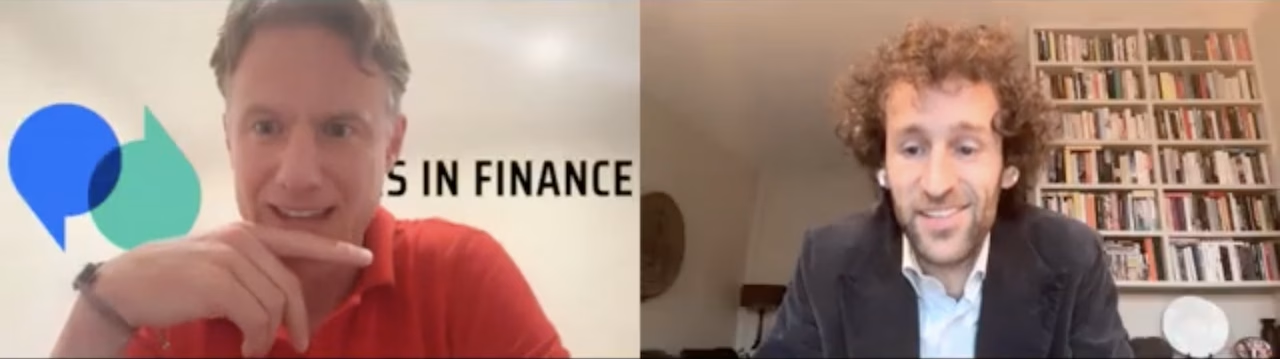
Voice-over: This is Leaders in Finance, a podcast where we find out more about the people behind successful careers. We speak with the leaders of today and tomorrow to discuss their motivations, their organizations, and their personal lives. Why? Because the financial sector could use a little more honest conversation. We’d like to thank our partners for their ongoing support: EY, Mogelijk Real Estate Finance, and Lepaya. Your host is Jeroen Broekema.
Jeroen: Welcome to an extra episode of the Leaders in Finance podcast. Today, we have an exciting guest with exciting news to share. I’d like to welcome Duco van Lanschot, the founder of Duna. Welcome, Duco.
Thank you. Great to have you with me on the Leaders in Finance podcast. And before you share the exciting news about Duna that came out this morning, I’d like to ask you a couple of questions about Duna. For people who don’t know Duna yet, could you share what you do exactly, why you started the business, and what you ultimately bring to the world?
Duco: Yeah, of course. I’d gladly do that. Duna’s mission is to build global trust infrastructure by providing digital passports for every business. Over time, we want this digital passport to evolve into a network for shareable identity and one-click onboarding. That’s the long-term vision and mission. Today, we have an AI-native platform for business identity, and it serves large banks, fintechs, platforms, and financial institutions. To give you a simple example, take Brand New Day Bank, or take bol.com, the Amazon of the Benelux. Bol also has a payment institution licence. They have 60,000 partners. When you buy something on bol, you often have an external partner fulfilling that order. So when one of these partners gets onboarded on bol.com, bol.com needs to do all types of business identity checks to avoid money laundering and fraudulent activity: KYC for businesses, CDD, AML checks. That end-to-end software is what Duna offers to customers.
Jeroen: Was it hard to build?
Duco: Yeah, it’s quite hard to build, and we’re still continuing to build. I think it’s a very hard intellectual challenge. And that also ties into the question of how we came to do this.
We encountered this problem firsthand when my co-founder and I were working at Stripe. Later on, he worked at Trade Republic, the big German neo-broker with around 7 million customers. At Stripe, we were onboarding millions of businesses.
We were known in fintech for being like, “Oh, Stripe is the best in business onboarding.” But when you look behind the curtain, you often see there’s a lot of room for improvement. There are a lot of things you’d do differently in hindsight, once you’ve seen all the edge cases.
Because we always say: in compliance and business onboarding, it isn’t hard—the edge cases are difficult. And that’s a problem rooted in code that is very specific and hard to solve. Large enterprise customers and regulated companies like banks often have hundreds of compliance and acceptance policies, with very fine-grained controls to accept customers. Doing that in a scalable, automated manner is what’s hard.
Jeroen: Two other questions before you bring your news. First, on the mission piece you described at the beginning. In a press release a year ago or something, you said identity remains one of the internet’s largest unsolved problems. So why is that the case? What’s the reason it’s still unsolved?
Duco: The reason it’s still unsolved is that identity remains tied to legacy systems. And there isn’t one portable, trustworthy identity in the world. It’s pretty puzzling to think back to 1993, when The New Yorker published that iconic cartoon featuring two dogs.
One dog sits in front of a computer and says to the other dog, “On the internet, nobody knows you’re a dog.” And ever since that moment—more than 30 years ago, when the internet was still in its infancy—little has changed. We could be sitting on a computer with my neighbor next door, and I couldn’t tell whether it’s actually my neighbor or a freaking dog.
We live in a world where information is searchable, where LLMs can digest all that information for us, where with stablecoins I can send USDC from the Netherlands to Indonesia and within a millisecond it lands in a crypto wallet there. But we still can’t tell whether our neighbor is our neighbor when he’s sitting on a computer next door. If you zoom out, it’s one of the biggest problems on the internet that we still haven’t solved.
And you see this coming to fruition, for example, in the compliance departments of large banks. Up to 10 or 20 percent of a bank’s total costs is now consumed by compliance and identity. And it leads to fraud, friction, and fines.
We’re both based in the Netherlands. My co-founder is based in Berlin, so we’re a Dutch-German company. But in the Netherlands alone, there are around 13,000 to 14,000 people in compliance, around 1.5 billion in labour spend, just for the big banks. That excludes real estate, supplier onboarding, platforms, financial technology companies, insurance companies, asset managers, etc., etc.
Jeroen: Well, on a more practical note, you can name some really big customers, right? Truly blue-chip names. Is it true that these players demand a lot from you and keep you extra sharp? Because these players, I mean, they don’t just trust you, you know. They need to fully trust you. And if they don’t, they’re gone, I guess.
Duco: Exactly. This is also one of the reasons why investors are positive, and have been positive, about our business: despite not being around for 10 years yet, we’ve been able to sign customers like bol.com, our brand new day bank that I just mentioned, but also CCV from the point solutions space. They are by far the market leader in the Benelux in point solutions, point-of-sale payments.
They’re part of Fiserv, which is a listed company worth $30, $40, $50 billion, but also customers in Spain, Plaid, a big US fintech valued at $7 billion, etc. One reason they’re so enthusiastic is that these customers trust us with their most sensitive data: the “passports” of their customers, all their customer information, and their regulatory relationships, which are at stake if you don’t do compliance well enough.
And the value proposition we bring is that business onboarding compliance is mission-critical. At the same time, it’s not your core business. And if it’s mission-critical and not your core business, you’d rather have somebody else who does this end to end, in a really great manner. Companies using us report up to 10.6x faster onboarding times, 4.8x productivity gains, and a much better user experience that allows them to onboard more customers and, as such, increase revenues.
Jeroen: And it’s amazing that these are your customers because, you know, you’re not that old as a business. So the trust bar is even higher.
Duco: Yeah. And it’s also a good thing because it pushes you forward. There’s always something in the product that isn’t perfect yet and needs to be improved. And if you have customers with a high bar for quality, you can’t get away with it. You can’t get away without shipping that quality, or getting there within a certain timeframe.
Jeroen: This morning, you came out with a press release, as I mentioned earlier. So tell me more. What’s the big news?
Duco: Yeah. So the big news is that we raised a $30 million Series A round led by CapitalG. That’s the independent growth arm of Alphabet, Google, with continued participation from our existing investors like Index Ventures and Puzzle Ventures, and also many technology leaders who have invested in Duna.
Jeroen: And you said it very quickly, but three-zero, right? Thirty million. It’s a very, very significant amount, especially now. There was a time when it was relatively easy to raise money. I wouldn’t say we’re in a time now that’s super easy. But was it easy for you to do another round?
Duco: Without wanting to come across as arrogant, because I hope that’s not the case: the honest answer is we weren’t raising. We announced the $10.7 million seed round last year in May 2025. We still had the majority—more than the majority—of those funds left. So we weren’t in need of capital anytime soon.
And then CapitalG actually proactively reached out. They had done due diligence, talked to our customers and prospects, done reference checks, all of that. They came with a very clear thesis on why, one, this is a massive problem, and why, two, they feel that building a passport and an identity network is one of the biggest unsolved challenges of the internet, and why they’re enthusiastic about funding and being part of that journey.
Then we had a quick moment of reflection: do we want this? And the reason we eventually took it is because it enables us to really continue to double down on R&D and product investments.
Right now, around 84% of the company is working on R&D and product. We still expect this round to go, at minimum, 60% to 70% to product development and R&D, because we’ve very much come to the conclusion that in a B2B world, the best product wins. So we continue to invest in product, product, product. And it will mostly allow us to expand the traction we’re seeing in big enterprises. So: accelerate enterprise capabilities, configurations, etc., and also double down on expanding Duna AI features. And with those Duna AI features, we’re seeing very promising results from our AI agents that are transforming compliance workflows into very concrete, auditable automations that also meet the quality bar of regulators.
And then, to wrap up, there’s an additional advantage. We were increasingly talking to companies worth $10 billion-plus, or listed, and they would tell us: “Hey, it’s great that you raised the $10 million seed round, and that’s a very large seed, but I’m worth $10 billion, and I don’t give a crap about your $10 million seed round.
I want you to be around in 5 to 10 years, because I’m going to build my compliance stack and my onboarding stack on you, and this is a big decision for us.” So another reason we did it is that we’re going to take these funds, put them on the bank account, put them in some very, very safe MMMs, and let them sit there as security for our customers and the rest of the business.
Jeroen: So, put very simply: a big chunk goes to product development, doubling down on product development, and the rest is what my former CEO called a fortress balance sheet.
Duco: Exactly. Exactly. I think that’s a much crisper summary than how I said it.
Jeroen: No, it’s great. You did all the groundwork. But anyway—on the product development: does this mean hiring more engineers? Is that the main thing you’re going to do? And do you need particular engineers? Or are these engineers you’re going to educate yourselves? Or are you really going to take the top docs from the big tech firms, for example in the US or anywhere else?
Duco: Yeah, so what we tend to do is hire exceptional engineers from very successful startups and scale-ups who have experience building infrastructure. We’ve hired a lot of great engineers who worked at Stripe, at Adyen, at Mollie, at Trade Republic. Very often, they also have experience working at Uber. We have multiple people who come from the Uber Payments department. We also have people who’ve been at Apple, Google, etc. I wouldn’t say it’s a goal in itself to hire from big tech, because we’ve actually interviewed a lot of people from big tech—even people with computer science degrees from Harvard and Stanford. And you’d be surprised: very often, these people aren’t builders anymore. They aren’t coders. It really depends on your Google department.
Some people are mostly aligning stakeholders and sitting in meetings, but when they come in here, we want them to build. We want them to ship, you know, and that’s a different setup. And many people in big tech don’t have that skill anymore. But we’ll definitely keep doubling down on hiring from the best fintechs around Europe. And we’re remote-first. We have offices in Amsterdam and Berlin, but we’re remote-first. And the nice thing is we can literally ask people anywhere in Europe: who is the best engineer you have ever worked on, or ever worked with? And then we go after those people. So 95% of the people we’ve hired are via our own sourcing or referrals.
Jeroen: Yeah, it sounds like a very smart strategy. So that’s one of the things you always say, right? Remote-first, so you can hire anywhere. I’ve seen this on your website and in other sources. The other thing you mention everywhere is that “transparency by default” is kind of your other line. So if you’re transparency by default, is it also about the cap table? Is that all open to everyone? Can you tell me a little bit more about how the cap table looks now after this round?
Duco: Yeah, of course. So I won’t publicly say on the podcast what the exact cap table looks like. That would be transparency by default to the next, next, next level. The cap table is one of the things that is internally completely visible to everybody who works at the company. And literally everything is visible. That’s a very deliberate decision, especially in a remote-first world.
In most organizations, you make a deliberate decision to share information. At Duna, it’s exactly the other way around: all information is public by default, unless you decide it should be confidential. So: personal feedback, PII (personally identifiable information), etc. If there’s no clear reason to hide it, we share it.
What does that mean in practice? Every email—apart from recruiting emails—is BCC’d to an archive, and everybody can see it. So literally everybody can see my email inbox. There’s an email inbox: [email protected]. Every investor I’m emailing with is BCC’d on that inbox. And a lot of people at Duna love checking that inbox to see what’s happening, what’s cooking. All meetings are recorded and shared. That includes very extensive notes from our board meetings. They’re all visible. Our financials are visible. Our monthly cash and revenue numbers are visible. In Slack, which is our shared workspace, we have a public DM channel where any work-related questions are asked in public. All our knowledge is shared in public folders. Compensation and levels are open, etc., etc.
And the cool thing is: people feel motivated and trusted. And it really helps create this entrepreneurial, high-trust, high-ownership setup. Because in other organizations, critical information is often guarded by senior leaders or managers, and it creates this knowledge gap. I always call this information asymmetry. A leader can always play the card of: “I know this has been discussed and you don’t,” or whatever. But right now, literally an intern can call out a company leader and say: “Well, I actually read in the board notes last year that this was the goal, and X and Y or Z are what we were going to build. So why did the plan change? Or why is the world different? Or why are you saying something that contradicts our strategy?” And I love that. It creates a huge melting pot of shared information and a shared understanding of the strategy. It also really helps curious minds—and we hire a lot of curious people. So I love seeing a backend engineer looking into our finance department, or into our sales decks, or those types of things. It’s great. It’s one of the things I love most about the company, and we will keep doing it.
Jeroen: So I love this answer. Back to the cap table without the next-level detail. One of the things I read in the press release from your previous round was that you have this non-profit also owning a significant part of the business.
So generally speaking, you have these venture capital players, you have these leaders, tech leaders investing as private individuals, and then you have a non-profit. Could you tell me a little bit more about that? Because that caught my attention.
Duco: Yeah, great point. By the way, I now realize I completely ditched your cap table question like a professional politician.
Jeroen: No, no. I mean, you gave a lot of interesting insight, but not the transparency I was looking for—but fine.
Duco: Of course, of course. So on the cap table—which is, by the way, quite weird—I don’t know another company where the employees can literally see how many shares the founders own, the employees own, every angel owns. It’s all public.
Then regarding your question on the foundation: when we incorporated the company, we donated one third of the company to a non-profit foundation. And the reason is that David and I always thought: we want to create a company that does good for the world, not only for ourselves. And when the company does great and we make all that money, we want to give away a lot to charities and non-profit causes anyway. David and I don’t get happiness from a fancy car, or a big boat, or all that bullshit—sitting in a nice five-star hotel with the whole family. We don’t really care about that. So we decided: if we want to give it away to charity anyway, let’s do that at the start. Because there are so many companies out there that talk the talk, but don’t walk the walk, right? Facebook starts and they say, “We want to connect people.” And guess what they’re doing? Teenage depression, addiction to algorithms. And what you end up with is a Viking in a bear suit ending up on Capitol Hill and total mass disorder in society. They talk the talk and they never walk the walk.
And that’s something where we just wanted to create a company where it’s incorporated into the governance that we are ethical by design. And by having this non-profit as one of our largest shareholders—the stake of the non-profit is exactly as big as the stake of David, my co-founder, and of myself—we have somebody sitting on the cap table who wants to align, for the long term, what’s best for everybody involved.
And it also shows our intentions to people who come to work here. It shows our intentions to our customers: yes, we want to create a very successful, very big, and ambitious business, but there’s more to life than only self-optimizing the amount of money that sits in our bank accounts.
Jeroen: Wow. I love it. I hope a lot of founders are going to follow this thought and actually do it instead of only talking about it. Before we take off—in this very short episode, really focused on this Series A round—I’m definitely going to invite you for a much longer-format interview. And all the details about the founding of your business.
But before we take off, I’d love to ask you: give me one, or two, or three, four, five—whatever you want—but point us to what Duna is going to do in the next few years, where you’ll be, and what the big challenges will be, or your big goals. Let’s say: up to the next three years.
Duco: Up to the next three years.
Jeroen: Not longer.
Duco: Usually I think more in the five- or ten-year horizon, or the next year. So let me think about the next three years.
What you’ll see us doing is really doubling down on the ROI case of Duna, because there are three angles we look at for business impact for our customers.
The first angle is increasing revenues by having higher and better conversion. So that revenue increase comes from all types of automation and front-end validation, so we can onboard customers directly, on the spot. Right now, it can take hours, or 30 or 60 days, or even three months to get onboarded for a bank account. By making that very short and rapid—with on-the-spot feedback on the right documents, clarifications, et cetera—we can usually increase conversion and make it a delightful experience again. That’s the first thing.
The second thing is completely automating all the checkbox and data collection exercises and the easy validations. Right now, in compliance departments, 99% of the time people are checking the box, collecting info, et cetera. And 1% of the time they’re actually doing the content analysis. Do I want this person as a customer? Am I combating fraud? What we want to do is automate that 99% and flip it around. So 1% of the time is focused on data collection and verifying the data, and 99% of the time is focused on the detective work of actually combating fraud.
And the third thing is that while doing so, we want to increase the quality of compliance and the security of anti-fraud efforts. This becomes even more important in the age of AI, where it becomes increasingly easy to create fake websites, fake ID documents, et cetera, et cetera. So we’re also seeing a boom in fraud and fraud cases. That’s the first thing we’ll focus on: ROI impact for customers.
The second thing we’ll focus on is that as we grow the customer base of Duna, we want to start creating this network of “passportability” for our customers. Because you can ask yourself: if you’re, say, a corporate card provider—one of our customers—would you really care if your KYC file was reused to sell things on bol.com? No, you don’t. It’s not a competitor. Or to do pension saving at brand new day bank, or to have sales payments with CCV—no, you don’t care.
And we can do that in a privacy-safe and security-safe way, where customers own all their data. Getting that network running—either in a small part of a country or in one country—would be a great milestone we’re focusing on.
And the third thing is: we just want to build an awesome company. I’m very passionate about this: what is the right culture? How do we have great talent density? How do we scale a company that people love working at? And we call it “the company as a product.” It basically means we treat building our own company as a product too. I mean, it’s never perfect—your product is never perfect either, it always has things to improve. But it’s the mentality we want to bring into building our company. And that’s also something I’m—this is more like a personal passion project.
Jeroen: Wonderful. I love all the excitement. I’m very excited as well about your business. I’m definitely going to follow it. As I said, I will also definitely interview you again in a much longer format. For now, I just want to check whether I really spoke to Duco today—because maybe this is a fake identity you put on this call. So I know, because I knew you a little bit before: have you ever done an ultramarathon?
Duco: Yes, I did.
Jeroen: You did. And I really spoke to Duco today. Duco, I want to thank you so much for your insights into Duna, but also into this round. And I want to congratulate you—I haven’t done that yet. I wanted to keep that until the end of this podcast. Congratulations on this massive round. It’s very, very impressive what you’ve built with your co-founders and your entire team. So I’m definitely going to follow it. And for now: enjoy the moment of bringing this out there to the world.
Duco: And thanks a lot for having me on the show.
Voice-over: You’ve been listening to Leaders in Finance. We hope you’ve enjoyed the episode and would love to hear from you. What’s on your mind? Who would you like to hear next? Let us know in a review, an email, or get in touch via our social channels. We’d greatly appreciate it. Finally, we’d like to thank our partners for their ongoing support: EY, Mogelijk Real Estate Finance, Roland Berger, and Lepaya. Don’t forget to check out all the other things we do at leadersinfinance.nl. Thank you for listening.