
Voice-over: This is Leaders in Finance, a podcast where we find out more about the people behind successful careers. We speak with the leaders of today and tomorrow to discuss their motivations, their organizations, and their personal lives. Why? Because the financial sector could use a little more honest conversation. We’d like to thank our partners for their ongoing support. They are EY, Mogelijk Vastgoedfinancieringen, and Lepaya. Your host is Jeroen Broekema.
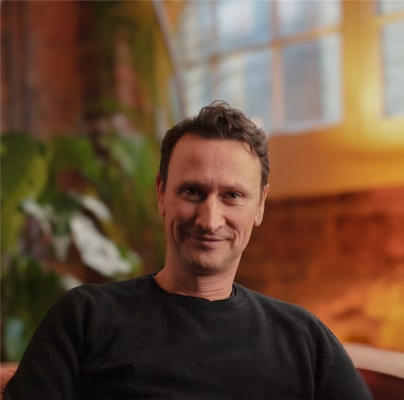
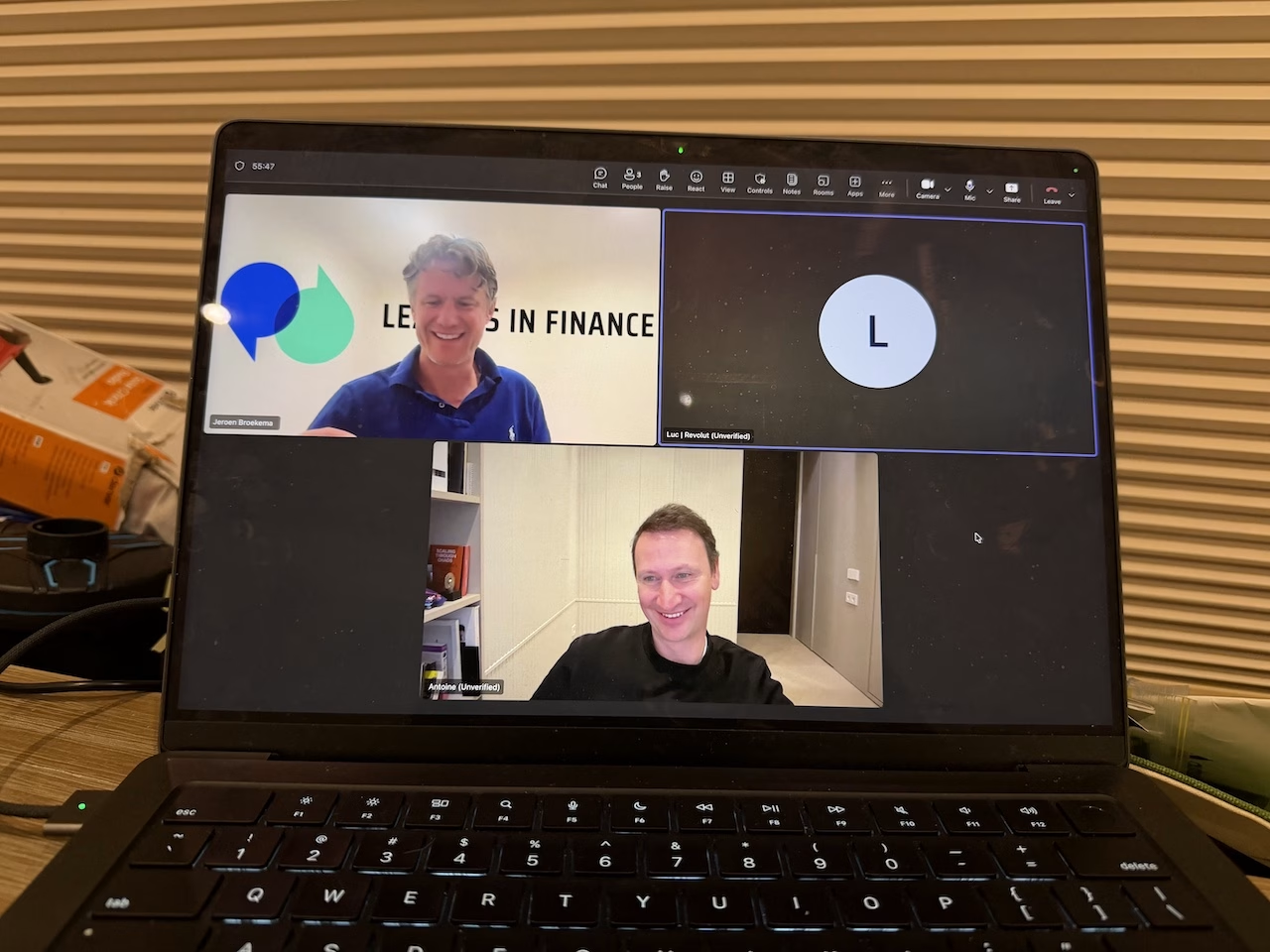
Jeroen: Welcome, listeners, to a new episode of the Leaders in Finance podcast. Today, an extra episode with Antoine Le Nel, the Chief Marketing Officer at Revolut. I’m very glad you’re here, Antoine. Thanks for joining the podcast.
Antoine: Yeah, thank you for having me. Nice meeting you.
Jeroen: For a very long time, I’ve spoken with banks, with asset managers, and with insurance, but I haven’t spoken with the top guys and ladies at Revolut before, so I’m really happy to speak to you. Before we dive into your role and into Revolut, I’d love to talk a little bit, as I always do on my podcast, about you. Because one of the first things that stood out to me is that you are, I think, if I’m not mistaken, an engineer by training. And now, as I said in the introduction, a Chief Marketing Officer. So, what happened?
Antoine: Yeah, I don’t know what happened. I mean, I did not… It was a journey to become a marketing executive. I started very much as an engineer. I started more in the data science, the analytics aspect. And then, I grew from there. So, I started more from the CRM aspect, kind of touching a little bit of marketing, then moved into performance marketing, which was very data-driven, a lot of machine learning systems, etc., etc. And then, gradually, I climbed the marketing funnel into the role that I have now, spending more and more time with brand marketing and so on, but still with a stronger data background and making sure that everything makes sense and so on. So, it was not planned. I never planned to become a marketer. It just happened organically. But I’m super happy with where I am.
I think it’s quite helpful being an engineer, especially in the world of tech. It helps me get a much better understanding of the product, of all the tech that is around, and so on, because, I mean, I’m an engineer by training, as you said. So, it helps me get a much stronger understanding of the overall ecosystem.
Jeroen: Right. And before you worked for Revolut, you were also, among other things, a strategy consultant, right? Is that still helpful in your current role?
Antoine: Well, that was a long… First of all, that was quite some time ago now. It’s been more than 10 years. I think what is helpful, but, you know, it was helpful as well with the training and the academy I did. So, when you study engineering in France, you’re actually covering a lot of different topics. Same with strategy consulting.
You do cover a lot of topics, and that is very helpful. What is helpful is the ability to jump from one topic to another in no time and still be relevant on those topics.
I think that’s probably the biggest learning that I had from consulting, because you need to jump from one thing to another super quickly. I think that’s what I still do. But it’s jumping as well and still having the depth, because it’s easy to jump if you remain shallow. Super easy. But jumping and getting deep into every topic, that’s a much harder exercise. I think that’s what engineering teaches you as well. I think engineering, your goal is to go very deep into the things that you’re studying. And I think that’s been super helpful for me.
Jeroen: And was Revolut your first time working in financial services, or did you already have a background there as well?
Antoine: No, no. I mean, I did some bits and pieces here and there, but I don’t think that would be that relevant. So yes, for me, the big moment was more or less five years ago when I joined Revolut.
Jeroen: What else do we know before we jump into Revolut? What else should we know about you as a person? I can suggest one thing. I read on your LinkedIn that you’re the founder of scubabooking.com.
Antoine: Yeah, absolutely. That was my startup time. So, I tried for some time to build a scuba diving platform. The idea was to create a kind of franchise of dive centers around the world and build some loyalty around it. Because when you’re a diver, you tend to go from one spot to another to dive and discover cool places, which means, ultimately, you can’t generate loyalty at a dive center by essence. So how can we create a network and build from that? It did not quite work as expected, as you could have imagined. I mean, it’s very hard to bring those clubs together. But it was a lot of fun. It was a lot of fun. I learned a lot.
Jeroen: Yeah. Anything else we should know about Antoine?
Antoine: Yeah, no. I mean, I’m French, living in Barcelona. I’m fundamentally European. I’m very proud of that. My partner is Swedish. So, I do live the European dream. You know, I think everyone talks about the American dream. I’m living the European dream. You know, that’s what it is.
Jeroen: That’s great. I don’t think that many people are very open about that right now, to be so super European, so pro-European, in their voice.
Antoine: Yeah, absolutely. And I think, I mean, we’ll talk more about Revolut, but Revolut is a true European success story. Because it’s not just a success story like we’ve had with other companies, let’s say Spotify. Others were very successful, but they were very successful because of the business they did in the US, you know. While Revolut became huge from Europe, within Europe. And I think that is very unique. You know, there are no other companies like this. So, I think I’m very, very proud of that. And I think this European DNA is a strength, especially at a time of European bashing, which is extremely popular. I think it’s good to remind people how lucky we are to be in Europe and the success we can get from Europe.
Jeroen: I could not agree more with you. That’s great. Great to hear that. I hope a lot of people will follow your thoughts here. So, about Revolut: I remember a long time ago, probably 10 years ago, that Revolut was a very, very different company. And for people who, you know, haven’t been watching Revolut closely, can you share a couple of numbers? Because I’m massively impressed by how fast it grew from just what I call an exchange kind of account to this full-fledged bank, a technology firm. So, can you share a couple of numbers, so people have an idea of what the size of the current operation is?
Antoine: Yeah. So, Revolut is now 10 years old, almost 11 years old. We are 13,000 employees now. So, not really a startup anymore. The numbers in 2024, which are already quite old, because we haven’t published the 2025 numbers yet: in 2024, we were already making $4 billion of revenue and $1 billion of net profit. So, I think it shows two things.
First of all, that we have the ability to scale in numbers, but also that we are highly profitable. Because, you know, there’s always been a lot of talk like, FinTechs, you know, neobanks, they’ll never get profitable, and so on.
I think making $1 billion in net profit is a pretty decent number, you know. So, I think that’s really strong. And obviously, I mean, the 2025 numbers will be much greater, as you can imagine, because the growth is quite phenomenal at the moment. And that resulted in our latest valuation, at the end of last year, of $75 billion, which makes Revolut today the highest-valued private company across Europe and in the top 10 globally. So, it’s, as I said, a unicorn within the unicorns in Europe.
Jeroen: Absolutely. And 13,000 people — where do most people work? What are the biggest chunks of people in terms of the fields they’re working in?
Antoine: Yeah. So, you can divide it into three, more or less. One important part is customer service — how we support the 70 million customers that we have. So, obviously, that takes a lot of time.
The second part is all the banking services that we have, whether it’s risk management, compliance, financial crime, and all of that. So, that represents a huge part of the company. It’s actually the biggest part of the company.
And then the last part, which is what we call more the tech core. So, it’s like the technology company part — building the product, how we sell the product, etc., etc.
So, basically, you have the tech aspect, you have the bank aspect, and then you have the service aspect. And those are the three big parts of the company.
Jeroen: So, I read a little bit about you before this podcast recording. You are busy with a lot of different things, right? So, where do you spend most of your time? Because it’s very easy to say you’re the CMO, but it’s all expansion. You do all kinds of strategic things. You do management, obviously. So, where do you spend most of your time?
Antoine: So, I split my time into four. I have four things that keep my mind busy. The first thing is to keep growing our number of customers in Europe. We still haven’t passed the inflection point, so we keep accelerating in Europe — and obviously, it’s where 90% of our business is. So, this is still where we want to keep winning. So, really, growing very fast in Europe is priority one.
Priority two is: how do we make Revolut more of the primary bank? I think we’ve grown very fast on specific features within Revolut, but we want to be a lot more holistic in the way we manage user profiles. So, becoming the primary bank is the second thing I’m spending a lot of time on.
The third thing that I spend a lot of time on is Revolut Business. Revolut is very famous for its retail offer, and I think, actually, that our business offer is the fastest-growing one. We’re growing even faster in business than we are in retail, and today it represents roughly 20% of the company. We’ve passed the $1 billion IRR last year. So, it’s a very significant business, and I think we can do a lot more in winning on the business banking aspect. So, that’s my third priority: business banking.
And then the fourth one is expansion. Expansion is about opening new markets — expanding in markets like Australia, New Zealand, Japan, Brazil, and the US. So, those we launched already a few months or a couple of years ago, but then we have the very new ones. For example, this year, we’ve launched Mexico. So, Mexico is a whole new market. We have India — we’re going to launch in the next few months — and then we have more markets like Colombia, etc., that will go live later this year.
So, those are really the four: one, grow Europe; two, primary banking; three, business banking; four, expansion. That’s where I spend most of my time.
Jeroen: Here, I still see the strategy consultant — a very clear list of four things. I love it. It’s very, very clear. If you map the four things onto me — so I’m a customer at Revolut as a consumer, but it’s not my primary bank. So, that’s number two, right? It’s not my primary bank at the moment. And with my business, I bank with a more traditional bank, if you like. I’d also bank with Revolut. I’m curious: on the primary bank stuff, out of those 70 million, I guess you’re not going to tell me how many people see Revolut as their primary bank — or are you going to?
Antoine: No, I’m not going to, but I can tell you that it’s growing faster than our base. So, the proportion is going up. It’s growing — definitely growing very fast — which we’re very pleased with.
Now, I mean, on primary banking, there are two ways of looking at it. Because we don’t yet have the full product suite. We have mortgages only in Lithuania, for example — mortgages in Lithuania — and we’re working to expand it. Same with a lot of credit products: not all of them are there yet.
And in some markets, we don’t have the fully localized product. Like in France, there are some specific savings products called Livret A, for example. You have ISAs. In the UK, you have pension plans and stuff, you know, in many different markets.
So, we still have quite a lot to build to be able to claim that we are as good as any other bank from a product perspective. But the truth is, for many customers, we are already a very strong alternative to be the primary bank.
I mean, there are a lot of people that don’t necessarily have a mortgage, and don’t necessarily need a mortgage. And we have a really excellent offer already at the moment. So, that’s the thing, you know.
So, we do have a proportion of the market that is a really good fit for our product. And for the rest, we’re developing more products in order to offer them what they need. But that’s a journey.
Jeroen: Yeah, that makes sense. Because what is the main reason that customers actually become a client with you? Or what are their one or two main reasons that they join you?
Antoine: But you see, I think this is the power of Revolut. I can’t tell you the one or two, because there isn’t one or two. At Revolut, we have so many verticals, so many products. I mean, of course, we’re known for FX, but it can also be trading, or crypto, or even our savings product, which is very strong as well. So, there are a lot of different value propositions that we offer. It can also be our loyalty program, which is very strong, called RevPoints, or access to some lifestyle products that we have.
So, the Revolut entry point is very different by customer. And that’s why we’ve managed to get such high velocity in terms of acquiring users, because we acquire users for very different needs. Everyone comes with their need.
And then the objective — what we do — is to offer the best-in-class experience so that people start adopting more products along the way. And I think that is the huge difference between banking with Revolut and banking with another bank, in the sense that with most banks, people switch banks: you make a conscious decision to move everything in one go, you shift everything, you move your salary, you move your mortgage, you just change bank.
Well, at Revolut, we say: no. How about you come, you try one product, and then you get convinced that we are actually the best product and the best place to manage your money? And therefore, for some people, it might take one or two months; for others, it might take two or three years. It all depends on the pace at which you adopt the product.
Jeroen: I thought you were going to say to my question: people join us for one reason — because it’s just a fun experience. It’s smooth, it’s UX, it’s perfect, it’s simple, it doesn’t take you much time, you can do whatever, wherever you want. That would be the main reason why people join you. But you’re more focused on the product side.
Antoine: I think that’s the main reason why people stay with us. Because until you try Revolut, you don’t know how good the UX is. So you still need to come for a specific value proposition.
There’s something specific you’re looking for, something you’re attracted by. And then once you’re in, you realize how good the UX is on top of the product you were looking for. And that’s what makes you stick. And that’s what makes you engage with more products. And that’s why it makes you a great customer in the long run. That’s where UX is. UX — the user experience — is really for retention.
Voice-over: This is Leaders in Finance with Jeroen Broekema.
Jeroen: I’m curious: if you look at more incumbent banks, or traditional banks — I don’t know how you call them — are they copying a lot of what you do? And I guess they all have accounts with you, right? To see how you do it. Did you see that happen or not?
Antoine: Well, I mean, I don’t spend my time looking at what traditional banks are doing, so I can only guess. But I mean, they are. And you see, this is one of the reasons why we are so welcome in new markets. Because we help drive market shifts. We do see — and that’s what we hear as well from regulators, from governments, and so on, that we work closely with — that when Revolut comes into a market, the whole industry suddenly changes, because it’s a shift in the industry.
It’s a shift in the quality of the experience users have. It’s a shift in how expensive banking is, because obviously we reduce costs significantly. And we have a direct impact on what competition is doing and how the whole banking sector reacts to us being in the market. And at the end of the day, who wins? The end consumer — whether it’s with Revolut or not with Revolut — because we make the whole sector much more efficient, much better, much more cost-efficient, and we bring a novel, better experience for everyone.
Jeroen: And the question you’ve probably been asked a thousand times. But I think the reason is because it’s such an interesting question, which is: there are quite a lot of neobanks, right? Or fintech businesses that wanted to become — or are still trying to become — as large as you are.
And some are actually quite big. But what are the main reasons that you are as big as you are, and that you’ve grown so fast, and that you haven’t reached that inflection point you alluded to earlier? What are your thoughts on that?
Antoine: I think we have — I mean, first of all, I think there are many players in the market that are doing a great job as well. I think whether it’s in Europe or outside Europe, it’s bringing the whole neobank fintech ecosystem to another level. So we all participate in that.
Now, I think the main difference between Revolut and the others, and why Revolut is so much ahead of everyone else in the sector, is the velocity at which we develop products and the velocity at which we open new markets. And the fact that we have this ability to not prioritize things, but run things in parallel.
I mean, while a lot of other companies need to prioritize, they need to say, “Hey, we start with that, and then we do that,” etc., etc. While at Revolut, we do everything at the same time. We expand in product, we expand in countries, and we do everything at the same time, at the best quality. I think that’s the real differentiator.
For example, we launched Mexico and at the same time we launched our mobile plans in Poland and in the UK. So how do you expand in the market in Mexico and launch a telecom offer at the same time? A lot of companies would pick one or the other. We just do both at the same time, in the same way. Now we’re working on a private bank and working on acquiring businesses to go against Stripe and Square.
Jeroen: How do you do it?
Antoine: So the way we do this — I think Revolut is an amazing engine in terms of compartmentalizing our priorities and giving a lot of autonomy and accountability to the teams delivering those products. So what you do is you define a very clear framework. You say, “Hey, this is your swim lane. You can go from here to there, but then you do whatever you have to do within those limits.” And then they go, they go, they go, and then they launch, and then we see how that goes, and then we adjust.
For example, same thing: we just launched mortgages in Lithuania. So there’s a whole team that was focused on mortgages, etc. They launched it in Lithuania. Then we’re going to adjust the product, making sure it’s the best product that we can offer. And then once we’re good, we roll it out in other markets. Same with mobile plans: we launched that in Poland and in the UK, we make sure it’s the best experience, the best product, the best service. And then once we’re happy, we roll it out in all the other markets. And then we keep going like this.
Jeroen: I guess when the founders started Revolut, compared to today — 13,000 people — does it become a little bit harder to be as fast as you were in the beginning?
Antoine: No, I think the truth is, we’re all split into very small teams. Everyone operates as a very small team. Now we have a lot of those, but they’re all very small teams, and the organization remains very flat. And I think that helps a lot, because what makes a company slow down is all those mid-management layers, and always this thing where you want to coordinate, you want to align things, you want to… I think that’s what kills companies.
Jeroen: So you are at the top of the organization — are you constantly fighting that? Because there are always new people coming in that try to set up new meetings, new structures, etc. I’m sure they will. Are you constantly fighting that?
Antoine: Yeah, I don’t need to fight it that much, to be honest. In the sense that naturally people can’t generate more meetings. I mean, at some point, there’s a limit of… I mean, I spend a lot of time in meetings, because basically I manage — what, like 20 direct reports? I manage 20 different teams directly that I meet every single week, etc. Because I am the coordinator, ultimately, but no one else does it. And I think that’s very important. The fact that we minimize the number of people who have the holistic view, because I think a lot of organizations, they say, “Oh, we don’t want silos.” But I don’t think people understand what a silo is. And I think they’re confused between what a silo is and what focus is. I think people need a certain amount of information to do their work. They don’t need to know everything about everything. I think you just need to know exactly how much information you need to do your job at your best. More is actually a waste of time.
Jeroen: But I guess people are always trying to get more, to have a broader view of the whole business.
Antoine: Yeah, but we manage the company on KPIs, so we’re very KPI-focused. So at the end of the day, it’s not about what you do, it’s about what you deliver. So I don’t really care whether you do an amazing job, you develop something great — or at least that you think is great — but if it’s not delivering, then it doesn’t matter. It really doesn’t matter. The journey doesn’t matter. The end goal matters more. And then if you think that you need this and that, but at the end of the day you create a lot of friction in the company, and then you’re not delivering, it’s not going to work out.
Jeroen: Crystal clear. In terms of tech versus the financial part: you have become a full-fledged bank everywhere. You’re dealing with regulators — sometimes with success, sometimes not that much. We can all read the newspapers. Like most financial institutions, you’ve had troubles around AML. But I’m wondering, from a regulatory perspective, do regulators always understand how you work? Or do you need to do a lot of explanation about how you work — and that you may work differently from what they are used to with traditional finance companies?
Antoine: I mean, I think we are definitely very different from any other players. I think there’s no bank that has such a global footprint as us. I think there are some banks that are quite global, but not as global as we are. We’re in 39 markets. And it’s not like — because you see, you have a lot of banks that say, “Oh, we are in 50 markets.” But when you look at it, they’re actually tiny. Because when I say we’re in 39 markets, we have a significant share in every single one of those 39 markets. So it’s not like we just have a postbox in those markets. We are really there. We’re across all 27 markets in the European Union. And there, we are always in the top five in every single market. So it’s not about being big globally. It’s about being big everywhere. And that is very interesting for regulators, because they suddenly work with a player that is very global, that can deliver a lot of insights, and that is working with more technology. And that is helping to also reshape what financial services are going to be in the next few decades. So I think there is a learning curve on both sides, in the sense that we need to learn working with a large number of regulators, and in how they work with someone like us, that is probably leading the way in what financial services are going to be in the future. So I think it’s a really interesting journey. I think we’ve developed a great platform at Revolut for working with so many regulators around the world. Getting a banking license in places where we operate is the most important thing for us. I think it’s a win-win situation. Yeah.
Jeroen: So you’ve, as you alluded to earlier, got a very high valuation. You actually make profit. Do you keep raising money? Is that needed, or is it actually not needed?
Antoine: No, we stopped raising money a long time ago. We do have high capital requirements, obviously, because we keep collecting more deposits, and the balance sheet is growing. But we’re lucky that we are profitable, which means we use our profit to keep building our capital. And that helps us absorb all the requirements from different regulators. So we are in a very lucky position that we don’t need to raise. And we haven’t had to raise during 2022, when things were going quite down, I think, because we were already profitable by then. I think that helped us a lot during a time when some fintechs were suffering a little bit. I think that gave us a big edge. So right now, no — we don’t have any capital plans there.
Jeroen: Right. And then a couple of questions around your CMO role, because I think a lot of CMOs in the world would love to work in a business that’s growing so rapidly, right? So could you tell us a couple of things about maybe things you see that you think are very different from other CMOs?
I’ve heard a couple of things from you in preparation for this podcast around, for example, that you don’t always believe in A-B testing. Or maybe there are completely other things that you think you do differently, so they can learn from you?
Antoine: Yeah, I think a few things. I think I’ve evolved my approach quite a bit from being very A-B-test-engineered. I think A-B testing is great when you try to optimize. I don’t think A-B testing is so good when you try to do 10x.
When you need bold ideas and you need to make a big step forward, you don’t really need A-B testing. I think you need to be very careful not to slow down your go-to-market, because that is a major, major challenge. I think that’s where, at Revolut, we’re very good. Our time to market is really short, and I think that helps a lot. Sometimes it’s better to be first and not totally right than being second or third and being right. I think it might already be too late by then. So I think time is of the essence on many occasions. And in that sense, A-B testing can slow you down. Now, A-B testing is still great, and I do a lot of A-B testing, but that’s more in an optimization phase. When you need to run, I mean, I run many, many A-B tests in parallel, especially on performance marketing, and set out to optimize my funnel. But you need to be a little bit careful with that. I think that’s the first thing.
The second thing is you need to be careful not to focus too much on CAC, on your cost of acquisition, because if you focus on that, you tend to acquire the worst customers. Because usually, I mean, you get what you pay for. Which doesn’t mean that a lower CAC necessarily brings you a better ROI. So you need to move away as much as possible from pure CAC thinking and focus more on ROI, and think about where your best cohorts are. And even if you have to pay more, or a lot more, then it’s fine. So I think that’s quite an important thing.
The last aspect is thinking about brand awareness. I think there are a lot of companies, a lot of CMOs, that think brand awareness is the thing to unlock growth. I don’t think that’s the case. I don’t think brand awareness is a limitation for growth, at least in the relatively early stage. If your product is not able to grow by itself in the early days, it’s not because of brand awareness — it’s just because your product is not good. It’s as simple as that. A good product should be able to grow by itself. And then you put some marketing or growth on top to fuel the growth, to make it faster. But there has to be something without marketing. If you can’t grow without marketing, then honestly, it’s not going to look very good.
But then when you reach a later stage — and in some markets we’re at the later stage of our growth plan — building brand marketing and building the brand is very important. It’s very important because that’s how you build trust and reputation. It’s very important because that’s how you build engagement. It’s very important because that’s how you help people trust you more in discovering more products. And I think this part is becoming more and more important for us at Revolut. And that’s why you probably start seeing more branding, more brand marketing from Revolut than you’ve seen in the past. It’s because we are currently doing that shift.
Jeroen: Yeah, and that last piece — just one follow-up — is that focused also mainly on existing customers? Because they need to be aware. For example, as I said earlier, I’m a Revolut customer in retail and business, but for example, I’m not aware that I can do, I don’t know, a certain product in business, or I can do a mortgage in my retail relationship.
Antoine: I mean, it can help. Now, I think that’s another thing you need to be very careful of, and some companies make this mistake: they use marketing to build product awareness for existing users. Well, that is a very expensive way to run CRM. If you start running CRM through media, that is highly inefficient. So the discoverability of new products, etc., still needs to be driven by the product and not by marketing.
Jeroen: So it should just be in-app. I should just see that the product is in my app now.
Antoine: Exactly. It’s in-app. I mean, it can be some emailing or push or whatever, but preferably you should always focus on those owned channels that should be more efficient and basically free.
Jeroen: Maybe a couple of last questions. I mean, I have hundreds, but a couple of last questions I prepared. One is the Netherlands, as this podcast is based in Amsterdam. Any thoughts on the Dutch market? I mean, you deal with a lot of markets — I think you said 39 or something earlier, if I’m not mistaken — but any particulars you want to share about the Dutch market? Or maybe is that too specific?
Antoine: No, no, no. The Dutch market is a great market. I mean, I really like it. We have a lot of fun there. We should get to 1.5 million customers very soon, which would be a great milestone for us.
It’s quite a concentrated market with the three big banks. It’s a very dematerialized market. It’s one of the markets with the fewest physical branches. I think there’s a player, ING, that has been very much at the forefront of building that digital experience in the Netherlands — but more broadly within Europe — which I think is great and shows how the country is ahead.
I think, you know, for Revolut, we’re seeing really big growth. And actually, the Netherlands is one of the countries where usage is the highest. So we do see, not only that we’re getting a lot of users in, but also that the level of subscription is high, the level of product usage is high, and so on.
So I think that’s really interesting for us. We will keep pushing. And the Netherlands, I think, from a growth perspective, is in the top 10 markets for us globally. So it’s a really important market for us that we will keep investing in.
Jeroen: Great. You’re very well aware of what’s going on in the Netherlands. That’s great.
Voice-over: This is the Leaders in Finance podcast with Jeroen Broekema.
Jeroen: Before we wrap up, one last question. Maybe I can get some thoughts from you about where this will all go with Revolut, and also with Antoine — both. And you can pick the timeframe. It could be five years, 10 years, 20 years down the line.
Antoine: Yeah, sure. So, I mean, on Revolut: if I look really 10, 20 years from now, I think the objective is — a lot of people sometimes take JPMorgan as the target for Revolut, like, “Can we get like JPMorgan?” But I don’t think that’s the right target.
I don’t think that’s really where we want to be. I think the right target is probably more Amazon, in the sense that Revolut should become the global platform for all financial services. And I think that’s really where the opportunity is: being truly global, not only being number one globally, but being number one everywhere, across all financial services.
And that should be both for retail and for business. Because then you end up in a fascinating place, where we will get hundreds of millions of users. I mean, probably — if we look at 10, 20 years — it’s going to be 500 million customers. That should be relatively easy, because we will get to 100 million customers in Europe next year.
So in 2027, we’ll have 100 million customers in Europe, and Europe is 20% of the population. So if you start doing some math, you’re like, okay, we give ourselves another 10 years, and so on. But that’s probably the range we would be in.
So you have those hundreds of millions of customers. We’re going to get millions of businesses. And then we get the acquiring and the payment gateways in between, which is Revolut Pay, and all the terminal POS that we have. And you end up in a world where you have the retail customers, the business customers, and then you connect them in the middle.
So you create a whole ecosystem that ultimately — what does it bring? It brings things that are much faster, much safer, because ultimately you don’t work with any third parties around, everything is connected within the same system, and much cheaper for everyone. Cheaper for the businesses, the merchants, and so on, and cheaper for all the customers — and a much better experience. So I think that would be a really great goal for us.
And then by then, we would be in 100 countries or more, and yeah, be truly global. So I think that’s really where Revolut will be in the next 10, 20 years, and it’s going to be fascinating. And for me — I don’t know. It’s hard to say. It’s really hard to say. I know what I’m doing this week and next week, and then we’ll see what comes next. But that’s not very important.
Jeroen: Before I’m going to thank you, Antoine, for this really interesting conversation, is there anything that we should definitely have mentioned, or should have spoken about, that you’d love to bring to the table at this point?
Antoine: No, no. I mean, just to look back on Europe, you know — I think Europe is incredibly powerful. I think it has its strengths and its weaknesses. If I look at it: Revolut would not have been there without Europe, okay? Because the first banking license we ever had was the one in Lithuania, and that helped us operate through the European passport across all the countries. So that is thumbs up. This is very strong.
Now, the challenge you have is: while this is good, I think we can do even better. In the sense that we still have to open branches in every single market in order to offer a local IBAN. To get a NL IBAN, you’ve got to have a branch in the Netherlands — same in Sweden, same in Ireland, etc., etc. Why is that? That is very strange. Why can’t we do an EU IBAN? I mean, our main regulator, main supervisor, is the ECB in Frankfurt. This is our main supervisor. So why don’t we have an EU IBAN and then we fix everything? Why don’t we think that, for example, managing AML from Sweden is good enough for Denmark? Apparently, it’s not. I don’t know why. I don’t know why. But you see, I think there are great things that Europe has done, but I think Europe can do even more, which I think would be incredibly powerful and could make us, as a continent, super strong for the future. So I’m looking forward to it.
Jeroen: Great, great addition. And yeah — in other words, Europe could be much, much stronger than it already is. Antoine, I want to thank you a lot for all your time — for speaking to Leaders in Finance, for speaking to me. I find it really insightful. Listeners cannot see it, but I wrote a lot of things down here — a lot of quotes from you. You’re crystal clear. There’s no, you know, fake stories. It’s just very clear what you mean. Thank you. Thank you very much for that, and again, for talking to us. And we will keep following both Revolut and you. So once again, thanks for your time.
Voice-over: You’ve been listening to Leaders in Finance. We hope you’ve enjoyed the episode and would love to hear from you. What’s on your mind? Who would you like to hear next? Let us know in a review, an email, or get in touch via our social channels. We’d greatly appreciate it. Finally, we’d like to thank our partners for their ongoing support: EY, Mogelijk Real Estate Finance, and Lepaya. Don’t forget to check out all the other things we do at leadersinfinance.nl. Thank you for listening.