
Voice-over: This episode is made possible with the help of EY, Mogelijk Real Estate Finance, Duna, and Lepaya.
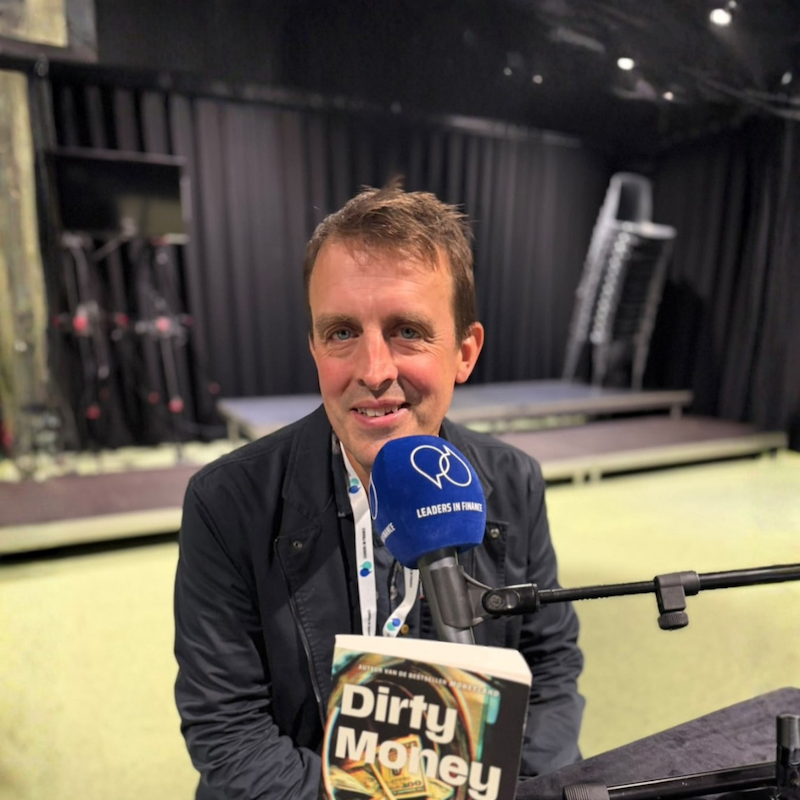
Jeroen: Welcome, listeners, to an extra episode of the Leaders in Finance podcast. I’m very happy you’re tuning in again, and today with me here in Amsterdam is Oliver Bullough, the author of multiple books. And if people know him already, they know his books are called Moneyland, Butler to the World, and his newest book is called Everybody Loves Our Dollars, which was translated into Dutch, called Dirty Money, and just came out in the Netherlands, I think a few months ago, right, Oliver?
Oliver: No, a few weeks ago.
Jeroen: A few weeks ago, right. You’re here in Amsterdam with Leaders in Finance. You gave this amazing speech this morning at the Leaders in Finance AML Event. And I would like to ask you the very simple but very important question: why this book, after Moneyland and Butler to the World, another book on AML?
Oliver: Yeah, it was never, I mean, I only ever intended to do one book on financial crime, Moneyland, and then here I am, I’ve written three. I probably will write a fourth. It doesn’t seem to be a problem that I’ve managed to solve just yet. So this book arose from the fact that after my first two books came out, I’d get messages from people asking why I was criticizing them. They were people who work for bank compliance departments, or police agencies, or in government, or regulators, or wherever. It doesn’t happen a lot, but it happened quite a few times. And they would say, “Look, we’re working really hard, and we’re really committed, and why are you so mean about us? It’s not nice to have someone throwing stones from the outside.” And I understand it probably is a bit dispiriting to be criticised. I found that really interesting, because if they are working really hard, and they are motivated, intelligent, committed people, why are they failing, right?
Because normally, if governments really set their mind to achieve something, they’re pretty good at achieving it, to be honest. Particularly if you’ve got a lot of money to spend, you can pass laws, you can deploy police agencies, you can do all sorts of things and achieve the goals that you want. But as far as we can tell from what statistics we have, and the statistics we have are, it should be said, not very good, because no one’s really done the work, but the amount of the world economy that is criminal now is precisely the same proportion to what it was in the 1990s. As the world economy has grown, so the criminal economy has grown. Despite the fact that we are throwing hundreds of billions of dollars every year at this problem, we have a gigantic, incredibly intrusive global compliance system in financial institutions. We have police agencies and law enforcement agencies with really very significant powers to tackle this issue. Leaving aside the questions around terrorist financing, which of course are equally significant, and yet nothing’s working. Why? That’s the question I set out to answer in the book. I was basically saying, if we have an AML system, why isn’t it stopping ML?
Jeroen: So this very, very important, crucial question. But if I would have a question like that in my mind, I would ask myself, where do I start? So where did you start?
Oliver: Well, I always work in the same way. I am someone who’s very interested in history. I love digging into things. And so it’s like if you look at a house that’s falling down, where do you look? Well, a good place to start is at the foundation. So if there’s a system that doesn’t work, look at the foundations of the system. So I went back in time to tell the story of the beginning of anti-money laundering, which is a story about a Texan congressman called Wright Patman, who passed the world’s first anti-money laundering legislation in 1970 in the United States. And then the foundation of international cooperation against money laundering, which is largely a question about the Financial Action Task Force, which was created at the G7 summit in Paris in 1989. And I mean, amazingly, neither of those stories had been told before, as far as I could tell.
Why did the FATF appear in Paris in 1989? I had to kind of dig that up. And why was that piece of legislation passed? I ended up in an archive in Texas that, as far as I could tell, no one had spent any time in, because I had to get special people to untie the bits of string around all these bundles of documents because no one had untied them before. So it was kind of fascinating to realise that despite the fact that we have this gigantic anti-money laundering industry, no one had researched its history. No one had figured out where it comes from. And to be honest, I genuinely think if you don’t know where you’re from, you don’t know where you are. And if you don’t know where you are, you don’t know where you’re going, to quote the author Terry Pratchett.
Jeroen: So I bought your book, I think about six months ago or something, in New Zealand, and I started reading it on the plane. I finished it right away. So before I got back to Amsterdam, I finished it. I loved it, by the way, for people that are listening and that are, I think, broadly interested in the whole concept of money laundering and how it works globally. It’s very interesting. And especially if you work in finance, it’s even more interesting. But if there’s one thing I could pick, only one thing that I will always remember from the book, is it your visit to the factories, probably it’s the right term, the American factories where they print money. So why did you go there, and what was so interesting about it?
Oliver: Well, it’s one thing that’s fascinating about money laundering. We talk a lot about the new shiny things, about crypto, AI, blockchain, whatever will be the new shiny thing next year. But really, it continues to be, the most useful tool for a common-or-garden money launderer is just cash, cash money. And it’s a really fascinating statistic that even though cash is being used less and less by ordinary people, in the UK now it’s just 8% of transactions involve cash, in the Netherlands it’s around 20%. And in other European countries, it’s a higher proportion, but still that proportion is falling all the time. Fewer and fewer people are using cash. And yet more and more cash is being printed. Central banks are printing record quantities of cash all the time. So I wanted to see what that looks like. That’s what I like doing. So I figured out that if you go to America, you can go and see the factories where they print the cash.
Jeroen: Can everyone…?
Oliver: Anyone, yeah. It’s a tourist attraction. I mean, not a very popular tourist attraction. It was just me and, like, one family with a mother and two really annoyed toddlers. But yeah, you can just go in, and they’ll let you poke around and see the big printing presses, which are incredible. But the amazing thing about it is, so the first printing presses for the Federal Reserve were in Washington, and those ones still function, but they’re quite small. And then in the eighties, they built a new factory in Fort Worth, Texas, which is extraordinary and incredibly efficient and has been recently expanded. But even that isn’t enough to keep up with demand. They’re building a whole new factory in Maryland to print ever more dollar banknotes, despite the fact that only 13% of transactions in the U.S. now use cash, and that proportion is falling all the time. Where are the dollars going? And that’s the kind of question, like, totally foundational questions about financial crime, that just doesn’t get asked.
Jeroen: And apparently the hundred-dollar note is the one that gets printed most. Yeah, this is awesome. Which is amazing, right? Because who uses a hundred-dollar note on a daily basis?
Oliver: I mean, this is genuinely fascinating. So 20 years ago, the most popular bill was the dollar bill, and then $20, and then $100, which makes perfect sense. But then over the last 20 years, the hundred-dollar first overtook the $20 bill around 2008, and then around 2014 overtook the dollar bill. So now 80% of the dollars that get printed are in the form of hundred-dollar bills. Where are they?
Jeroen: So it’s all illegal, or is that not true? It’s only a part of that illegal?
Oliver: Well, I mean, obviously it’s not all illegal. I mean, I’ve used hundred-dollar bills. I’m not a criminal, but it’s certainly incredibly helpful for criminals. I mean, who is it that really, really wants to be able to pack the most value into the smallest possible space? Why would you want to have a big-denomination banknote? The cartels, by the U.S. government’s own estimate, smuggle $25 billion worth of cash over the border into Mexico every year. If you have $25 billion in hundred-dollar bills, it is just pure mathematics. You will require half as many lorries to move them in as if it’s in $50 bills. And that is just an obvious calculation.
And it’s very frustrating to me that governments that profess themselves committed to fighting financial crime and make very onerous demands of the rest of society, that the rest of society puts up with some pretty serious consequences to tackle financial crime, are themselves not prepared to take the very minor step of no longer printing big-denomination banknotes. It would make no difference at all to the vast majority of ordinary people’s lives if the biggest euro-denominated banknote was a 50-euro bill. But if you didn’t have a 100-euro or 200-euro bill, it would make a big difference to criminals. And the same is true of hundred-dollar bills or 50-pound notes in the UK.
Jeroen: Right. So everyone should read the book. But just one follow-up question that I really need to know, which is: why are these governments printing and printing and printing? Because they all know it’s not used for their own people in their own country.
Oliver: Yeah. I mean, I think you can be conspiratorial about this. Printing banknotes is very, very profitable. There’s a reason why people refer to something profitable as a license to print money. Having a license to print money is about as profitable as a business can get. There’s two and a half billion dollars outstanding now. That’s a two-and-a-half-billion-dollar interest-free loan to the United States government. That’s a nice thing to have. But it’s obvious that the harm being caused to the world is of significantly greater proportion than the saving that the U.S. government is making by not paying interest on that loan. So in general, we are net far worse off than we would be if the cash didn’t exist.
Really, we have a collective action problem, which is that the Americans know very well that if they stop issuing 100-dollar bills, the criminals will just use 100-euro bills. And the Europeans know if they stop issuing 100-euro bills, the criminals will just use 100-dollar bills. Everyone needs to act together. And that is something that is always difficult. And frankly, with the world in the state that it is at the moment, it looks even far off than it normally does.
Jeroen: You’re a journalist as well. So you speak to a lot of people. You also speak a lot to politicians. When the book came out and in the whole period after, you obviously spoke to politicians as well. Are they aware of this, of the harm that it does in the world? Are they aware that this is a business model?
Oliver: Yeah, they are aware, I think. I suppose what I find very frustrating, there are many things I find frustrating, but particularly when I talk to policymakers, politicians and so on, is that they seem to regard all of this, it’s like it’s the weather. It just happens. And yeah, you’ve got to put a better coat on, rather than something that they can control. I think that there is a genuinely, collectively, across most Western societies at the moment, if not all Western societies, and perhaps even broader, a sense that governments are out of control, that we’re all drifting, and the world is becoming a dangerous and unpredictable place. But this is controllable. You can deal with this. It’s completely within their gift to sort this out. It’s straightforward. And I find it very frustrating that they’ll all be, like, nod and go, “Oh yeah, that does sound…”
Jeroen: So you didn’t find any politician that was, after they read this book, that they wanted to put this point on the, higher on the agenda, on the political agenda?
Oliver: No, to be honest, I would have been amazed if I had. When I was working on my first book, Moneyland, I was so appalled by what I was writing about that I genuinely thought that the problems in the book would be solved before I got the book out. And yet here we are, three books later, and I’ve stopped thinking that. So no, it is, I’m aware of the fact that this isn’t a priority for politicians. It should be. It is, they have…
Jeroen: Those voters don’t care. It’s not in my backyard, so I don’t care.
Oliver: Yeah, I think that’s probably right. I think voters don’t care. Politicians don’t care. But I think everyone has a responsibility who does understand the question, whether that’s people who work in financial crime in banks or journalists who write about this, politicians who understand this, to communicate that it matters. This is, money laundering is not like this abstract thing. Money laundering is what supports all acquisitive crime, fraud, kleptocracy, people trafficking, the cartels, all the really, the terrorism, all the really awful things that are happening in the world are made much, much, much worse by the incredible ease of laundering money. And if we made it more difficult, there will be less bad things. And having less bad things is good. So I think that’s what we should be doing.
Jeroen: This morning, you were the keynote speaker at the event. So you do this, I mean, obviously, very practical things, that you like people to read your book. It’s easy to be cynical about it. But do you think it does have impact? Or what’s, in other words, what’s the reason why you do this, these talks, you give these talks to, and in this case, to people that work in money laundering every day, I mean, anti-money laundering?
Oliver: I mean, I have a very simple personal philosophy, which is that stuff leads to stuff. And the only way not to achieve, the only thing you can be sure of is if you don’t do anything, you won’t achieve anything. So I don’t know, who knows, there might be one person in the room who listens, and then that achieves something. Occasionally, you get these lovely things. I was doing an event the other day, and someone came up to me and said that they’d seen me speak five years previously. And as a result, they’d gone to work for the National Crime Agency and working in financial crime. And I was like, “That is brilliant. Really cool. All right, that’s worthwhile. That made that talk worthwhile.” So who knows, maybe someone today will think, “All right, maybe we should stop printing big banknotes.” And they’ve got the power to make that happen. And then, wow, wouldn’t that be cool?
Jeroen: And ultimately, it all starts with awareness, right? I wasn’t aware how big this was after reading your book. And now I understand how it works. I talk about it. I also talk to regulators, to central banks, and also within these central banks. They’re often not aware. There will be people within those organizations that are, but many people are not.
Oliver: Yeah, I mean, listen, I don’t know which conversations will make a difference, and maybe no conversations will make a difference. But you miss 100% of the goals you don’t take. So, I mean, you’ve got to shoot, and maybe you’ll miss, but maybe you won’t.
Jeroen: I’m going to say thank you, Oliver Bullough, for taking the time to speak to Leaders in Finance. I just want to say one last thing from my side, which is, I’ve read all your books so far, and they’re all really good for multiple reasons. I mean, definitely not the most important one. Let me start with not the most important one, which is, they are really good. They’re very accessible. It’s very easy to read. You immediately understand what this is about. I love the fact that you go from the very abstract to very concrete examples. You’ve been traveling a lot for the books to do all the research. You’ve been speaking to a lot of people. You did quote Leaders in Finance, which is great.
And much more important, why I like the books, because they are about really, really, really big and important problems that I would say are not getting enough attention. Definitely not in the political realm, but in general, not getting much attention. We all know all the sadness that’s behind money laundering, with all the criminal activity that’s behind it. So, anyway, I would encourage everyone to buy the book and read the story. It’s a very well-written story. So, thanks so much, Oliver Bullough, to be with us. And I will link to the book in the show notes, as well as link to the previous interview I did with you a few years ago in Brussels about your previous book. Thanks again.
Oliver: Thanks for having me on.
Voice-over: You’ve been listening to Leaders in Finance. We hope you’ve enjoyed the episode and would love to hear from you. What’s on your mind? Who would you like to hear next? Let us know in a review, an email, or get in touch via our social channels. We’d greatly appreciate it. Finally, we’d like to thank our partners for their ongoing support. Don’t forget to check out all the other things we do at leadersinfinance.nl. Thank you for listening.