
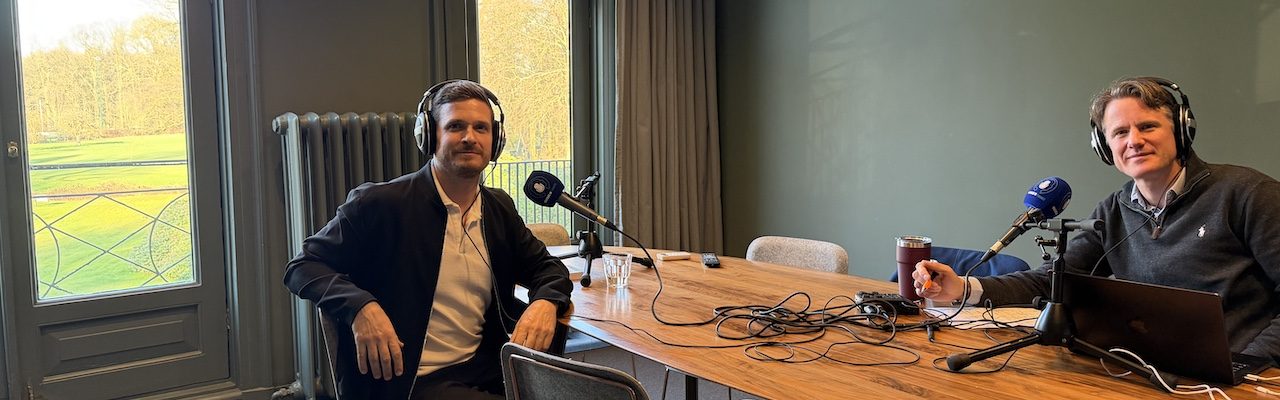
Voice-over: This is Leaders in Finance, a podcast where we find out more about the people behind a successful career. We speak with the leaders of today and tomorrow to discuss their motivations, their organisations, and their personal lives. Why? Because the financial sector could use a little more honest conversation. Our guest in this episode is a serial entrepreneur who, in less than two years, attracted nearly 20,000 business customers without a marketing budget.
Thomas: From, let’s say, the first one and a half years, I think about 70 percent of our growth has been organic. So it’s just been word of mouth, people telling other people.
Voice-over: He built his company on one simple belief: that traditional banks aren’t being straight with their customers.
Thomas: Banks, traditional banks, make money on everything that you do, you just don’t know it. You think a bank makes money on the 20 euros you pay per month, but actually, in fact, they’re making 100 euros. And 80 euros is sort of hidden.
Voice-over: And if anyone knows how to climb back from rock bottom, it’s him.
Thomas: Be kind to yourself. Because for me, I was sort of punishing myself for it. So rather than saying, like, it’s hard, I was sort of, let’s say, hating myself for it. I felt I was not successful. I felt it wasn’t good. So I think that’s maybe what you can do. And then, yeah, only forward and upwards, that’s the saying. So yeah, keep going.
Voice-over: Our guest in this episode is Thomas Vles, founder and CEO of GoDutch. Your host is Jeroen Broekema.
Jeroen: Welcome to a new episode of the Leaders in Finance podcast. Thanks for tuning in. This week, we’re joined by our guest Thomas Vles, the Chief Executive Officer at GoDutch. Welcome, Thomas. Thank you. Great to have you. Yeah, I’m very happy you are here. And before we begin, I’d like to thank the partners of this podcast for their ongoing support. These are EY, Mogelijk Real Estate Finance, and Lepaya. Thank you very much, partners, because without you, this podcast would be really hard to run. And as is a good tradition at Leaders in Finance, I’ll start by spelling the name of my guest. Thomas, Thomas in Dutch, is T-H-O-M-A-S, and his last name, Vles, is V-L-E-S. And before we get started, I’d like to introduce you a little bit. I mean, I’m sure you will do much more, but let me do the beginning of it. Thomas is a serial entrepreneur with a background in e-commerce and startups. He first gained international attention in 2013 with Poopycat, a company built around sustainable, disposable cardboard litter boxes and modular cat products. In 2015, to mark the launch of the UK business, he cycled from Amsterdam to London with his two cats in a cargo bike, a stunt that drew media attention around the world. We’re definitely going to ask about that later. After selling Poopycat in 2017, he started investing in and advising startups through Blue Bottle Ventures. He later spent a year as managing director of the Dutch Startup Association before moving into fintech in 2021 as CEO of Tellow. From 2023 onwards, he served as Chief Revenue Officer at Shine, formerly known as Ageras. Since May 2024, he has been building GoDutch. It’s not a traditional bank, I would say, but a fintech platform that aims to make business banking fairer by sharing part of its income with entrepreneurs while also taking away much of the administrative hassle. Thomas first studied physics and astrophysics at the University of Amsterdam before switching to psychology at Vrije Universiteit Amsterdam, where he completed two master’s degrees. He’s 41 years old, lives in Amsterdam, is married, and has two kids. Once again, Thomas, I’m really glad you’re here. It’s great to talk to you, and I’m sure we’re going to cover a lot of ground because there are so many questions I have. But let’s start with GoDutch, because we are here together speaking English. Your company name is GoDutch. Where does the name come from? I mean, it’s really, really easy to say GoDutch, but how did you come up with it?
Thomas: Yeah, so the original idea of GoDutch was to create, let’s say, a banking app that was a bit more focused on transparency and sharing, and also on being, let’s say, more focused on climate and social initiatives, so let’s say giving back more. And GoDutch in the US and UK, as you might know, is slang for splitting the bill. So GoDutch was actually originally intended for us, meaning to split the bill with the end user, meaning that we would give you, let’s say, a revenue share, and also make sure that while you, let’s say, have your finances with us, we’ll also take care of the planet for you. Of course, like any startup, we pivoted a lot. So at the current moment, we’re still GoDutch, we’re still doing cashbacks, and we’re still, let’s say, giving back to the world. So for every active account, every month, we regreen five square metres of dried-up savanna in Kenya. The only thing is, if you go to our website, where it was, let’s say, in the beginning, the H1, the prime headline for the website, we learned quite quickly that, yeah, people really liked us, but not for the reasons that were related to that GoDutch sharing and being climate positive, but mainly for us being a really good B2B product, super fast, and having great service. Those are the things that make us excel right now.
Jeroen: Was the domain name available at the time?
Thomas: The domain name was not available at the time. So this is, of course, the real entrepreneurial story. So I think also for, let’s say, if you’re starting a business, the first thing you do, or should do at least, is to look up the domain name and see if it’s available. I think it’s more important than a trademark, more important than anything. And I did the same. So yeah, GoDutch.com wasn’t there, but then you have some tools that you can use to sort of figure out who the owner is. And typically that sets you back a lot in terms of finance. So I went up and did my research and figured out there was a former Dutch person who had moved to Canada. So I thought, okay, former Dutch guy, Canadian, so probably a very nice guy. And then I also found out that he had a Christian bookstore. So I was like, this guy is going to give it to me for free. So unfortunately, the reality was that it was very difficult to get hold of this man. So I WhatsApped him, I texted him, I emailed him, I called him, and didn’t get any response. And suddenly, at the weekend, late at night, I got a message. And the message said, if you really want it, pony up the real amount. Apparently my offer was not high enough. And eventually we got it. And yeah, I think that was the real start of the name GoDutch.
Jeroen: Do you remember what the alternative was? I mean, in case you wouldn’t have gotten the domain name?
Thomas: Yeah. So we had GoDutch.co. We also had GoDutch with a hyphen in the middle, a little dash. Obviously, those things are really not great. So we’re very happy that we got the .com. And it’s actually really remarkable because there is a very, let’s say, relatively big startup in the field that was also called GoDutch and was actually supported by Y Combinator, so a really famous accelerator from San Francisco. And they didn’t manage to get the domain name. So I pride myself on that.
Jeroen: Yeah, you should. Well done. So without going into all the things you’ve done in the past, because there are many really, really interesting things we’ll definitely go into later, I would like to ask: the thing you’re doing now with GoDutch, being the founder and CEO, where is that different from all the things you’ve done?
Thomas: Wow. That’s a good question. Yeah. So for me, I think what’s different this time around, I mean, it’s company number seven, I think, maybe eight. So what’s different for me now is that I started this company when I had my first kid. Now I have two kids, as your beautiful intro already mentioned. And that actually changed quite a lot, because as an entrepreneur, you need to take a lot of risks. That’s actually really, let’s say, the part of the job that you do. And I’ve noticed that my risk profile is a little bit different since I have the kids. So maybe for a lot of people, I’m still very risk-taking in general. But for me, that has been something different. So I place, let’s say, more focused bets, a bit more specific, a bit more careful. And that can be a burden, but I think it’s also a strength. And in this case, instead of, let’s say, when you’re young, 21, and you eat noodles all day, you can lose everything and it doesn’t matter. Now, you know, you can’t afford to lose your house or lose your daycare or anything else. You need to really focus on building something that is, let’s say, in Dutch you would say, sustainable is the word, like bestendig in Nederland. So I think it’s also something that can become your strength, like with many things, right? Your weakness is also your strength.
Jeroen: And it makes your partner happy as well, or doesn’t that matter?
Thomas: I think my partner cares most about me being happy. She has always been great in that part. And yeah, in the previous job that I had, where it was, let’s say, of course, Tellow was integrated into a new brand, I moved to the new company, which on paper was an amazing role, right? A lot of people, big company, super high market cap. So let’s say for the outside world, nobody understood why I left. But for me and for my wife particularly, it was very clear why I left, because this is my path. And this is what I always have been: an entrepreneur.
Jeroen: I’d love to learn more about GoDutch. The way I like to structure that, what I often do, is use the different stakeholders. Because if I ask you to tell me more about GoDutch, it’s probably like two hours later when I get a lot of information. But structuring it is a great way to look at it, in my view. So first of all, who are your customers, the stakeholder customers?
Thomas: Yeah, good. Now, the customers are SMEs. And we serve, let’s say, companies from the Netherlands and even in the European Economic Area, but we mainly focus on being local here in the Netherlands. We serve freelancers, we serve BVs. BVs from, let’s say, one to 200 employees are the best fit for us. We also have a few that are a little bit bigger than that. We have, I think, now four publicly listed companies also at GoDutch, mainly for the climate reasons that I mentioned. And outside of that, we are also serving foundations, charities, associations, and then the more exotic forms as well, which we’ll do on a case-by-case basis. But yeah, we, let’s say, started GoDutch, and I’m sorry to take over a little bit, but we started GoDutch to help people. This is what we really are here for. And it just turns out that there are a lot of segments in the B2B world that are unbankable for many, and we’re just trying to help as many people as possible.
Jeroen: Okay. A couple of follow-up questions here. First of all, you mentioned a couple of listed companies, so they are really big companies then, or not necessarily?
Thomas: Not necessarily. And I wouldn’t say, in this case, that it’s like Philips, for example. And of course, I cannot mention who it is, but no, it was a nice compliment for us and actually a funny lesson, because I thought a big business like that, KYC is going to be hell, but actually, for publicly listed companies, it’s simpler.
Jeroen: It has a lot of information available.
Thomas: Yeah, exactly. So it actually goes quite quickly. So this was a good lesson for us.
Jeroen: And the other thing about the company, so generally speaking, for the bulk of your customers, what’s the size of their business?
Thomas: Yeah. So about 70% of our user base are BVs. Now, mostly we believe they have between one and 20 employees. We do want to grow a bit more, let’s say, higher up in the market. We have a few outliers now, but that’s also something that we need to develop our product for. So let’s say we’ll get better and better at serving larger companies. Freelancers are a very small portion of our market, which of course is also interesting, because there is already a lot of good tooling that exists for freelancers. And actually, VVEs are our second biggest group after the BVs. And it’s funny because we never built a product for VVEs, but when we launched, we saw that we had a lot of traction in that segment. And that was all due to the fact that we built a product that was serving a business with multiple partners, with employees. So we built a lot of things on top of team management. And for VVEs with a board that often changes every year, you have to go with your passport to the bank and then you have to wait five months to do that online. It was a huge pain that we resolved accidentally. And that’s also why we see that there’s a lot of growth now. So 70% BVs, let’s say about 15 or 18% VVEs. And then we have, I think, about 9% freelancers, and then the rest is foundations, associations, charities. Charities bank for free with us. So yeah.
Jeroen: Well, that’s really interesting. So how do most customers find you? How do you find them?
Thomas: It’s, well, indeed, we do a lot of gigs like this, right? We’re trying to get the word out. For, let’s say, the first one and a half years, I think about 70% of our growth has been organic. So it’s just been word of mouth, people telling other people. And now, for the last month or two, we’re really ramping up our social media and Google marketing budget. So we’re really trying to get more customers in and trying to also find other people with intent, rather than just waiting for people to tell each other. So we’re trying to accelerate. That’s been paying off quite well. So that’s where you’re going to see us a lot more now. But in the beginning, it was really just people being a fan of your product and then telling other people.
Jeroen: What kind of numbers are you allowed or willing to share in terms of how many customers you’re serving, or some general comment on how much growth you have seen?
Thomas: Yeah. So the public numbers that are out there are, well, I haven’t checked today, I should have, but I think we’re about 19,000 now, close to 20,000 business users. And that amount is growing quite fast. And let me see what else is good to share. Yeah. It’s always a bit hard.
Jeroen: No, but I mean, in terms of this number, are these all paying customers, or customers that came to you in the last year and a half or something?
Thomas: Yeah. We’re now, I think, probably around 20 or 21 months in. So in June, beginning of June, we’ll celebrate our birthday. Yeah. I think the other numbers that we can share are, let’s say, that our NPS is very good. So I think last time we measured it, it was around 84, I think, or something like that. So pretty good. Ratings are pretty good too, usually between 4.6 and 4.8. So we’re making people happy. And it’s also what we really, really stand for. I think another number that’s good to mention is that, for most accounts, we can open them in three hours, which is of course something that’s really groundbreaking in the Netherlands. But it’s something that we really pride ourselves on, to really get people through as soon as possible, and ideally also with as few little steps up and down in the KYC as possible.
Jeroen: And are there options where customers can do something for free, or is everyone paying right away from the beginning?
Thomas: Yeah, that’s actually the beauty of being in finance. So for banking, of course, and I think this is also one of the reasons why I mentioned transparency before, right? So we have a free package. We have paid subscriptions. Even on free, every user is a paying user by default, because it’s as long as they use your product. Because banks, traditional banks, make money on everything that you do. You just don’t know it. So you think a bank makes money on the €20 you pay per month, but actually, in fact, they’re making €100 and €80 is sort of hidden. And this is something that we started with and we really valued. So we put it in our app so people could actually see how much revenue your account was generating for us and how much you were getting back. We learned that people are not really getting excited about that. So, so far for the transparency and honesty route, but we still think it’s very important. So obviously, when people have money in the bank, there’s interest being generated. Every time you use your cards, interchange is generated. All that money flows to the bank and people aren’t really aware of that. So we’re trying to give a piece of it back, depending on your subscription. But I’ll at least be honest about how we make money.
Jeroen: So one more question on the customers before we move on to, I said I was going to structure it, not really, but in terms of the customers, I’m really curious because as a former banker at one of the major banks in the Netherlands, the first thing that came to mind is, like, how do these guys, and you already mentioned the word, do KYC so quickly and apparently well, because I didn’t hear anything about regulators complaining about you.
Thomas: Yeah. So what we’re trying to do is, first of all, just really listen to your customers and look at the customer journey. So every day, we’re trying to improve the processes and make things better. And I think that mindset already opens up a lot of improvement by itself. And our onboarding is automated for most customers. It means that you’re coming in, you’re signing up, you click on the website button, like open an account. Hopefully a lot of people will do that when hearing this. And when they do that, then they start an onboarding, and onboarding will change depending on what kind of company you are. And for example, if you are a BV, how many shareholders you have. So if you have a BV that’s a holding for yourself, your onboarding will be much shorter. If you have shareholders, your onboarding will be longer and more questions will be asked. It sounds super simple, but that little difference is not something that other players are offering right now. And it’s crazy, actually. We also made the choice that we’re trying to get as much information as possible during onboarding itself. So there are other players doing tricks like getting somebody in and then starting to ask questions afterwards. We prefer to get as much information in as possible, with the ground rule for everything being that if we can do something or find something on behalf of the user, we will always do it ourselves. So we’re not going to ask someone to upload a summary of the KvK that we can figure out ourselves. So that’s the way to do it. And I think that’s something that we saw as well. Then we also have a lot of partnerships for the different company types. And there, we also created an API, where if you, for example, have a huge database with companies or VVEs or whatever, you can link your own data with our data. And then with an API, you can actually open accounts in bulk. I mean, of course, the end user still has to show their passport and do ID verification, but all the other details about the business can already be fetched automatically. Meaning that for the end user, instead of spending, you know, five or 10 minutes on onboarding, they can do it in 30 seconds. And that’s a huge win.
Jeroen: So many of the incumbent financial institutions are complaining about the burden, the administrative burden, that comes from everything related to KYC and AML. Do you also see that this is a big cost part of your business?
Thomas: Actually, this is funny, because when we launched, we spoke to one of the biggest banks in Europe. And I had to speak at a conference at the ING headquarters, as they are a competitor to some extent. And afterwards, I was talking to one of the guys there, and he asked me the same question. And he was like, okay, and I asked him, like, how much does it cost for you to onboard a simple BV? And he told me it was €700. And I was like, how is that possible? I cannot share exactly what we’re paying, but it’s less than one twentieth of that, right? It’s a lot less. It’s crazy. I was like, what do you do? Are you printing the stuff out, collecting signatures, are you charging a coffee on the same bill? I don’t know. But I think their processes are so rigid and outdated that they’re either focusing on the wrong things or not looking at how to improve. And it’s also very hard. If you’re super young, super agile, and super quick to change, the older you get as a company, and we already see that now, the more rigid you get and the longer things will take. But the reality is, unfortunately, at least in the markets that we’re looking at in Europe, that a lot of these big banks, they don’t really, either they don’t know how to do it, but they can look at us and copy it, right? So that’s not it. So the fear is that they just don’t care. I don’t think they really want to improve, because maybe these customers are not as valuable to them as they are to us. Because for us, it’s our bread and butter. And for, say, a big traditional bank, maybe it’s just a burden. So maybe this is their way of saying, go somewhere else.
Jeroen: Next stakeholder, your team, your colleagues. Can you tell me more about the number of colleagues you have, where most people work, etc.?
Thomas: Yeah, so now we are close to 30 people. Some are part-timers. I really like to work with specialists, for example in marketing. We have a bit of a hybrid setup. So in the office in Amsterdam, there is mainly the operational team, management, and then some people fly in and out. Our developers are scattered. So we have them in Spain, Portugal, the Netherlands, Bali, like, everywhere. Yeah, it’s also nice. And yeah, so for now it’s just our setup. It’s been very interesting for me, because I’m always the person who really wanted everybody in the office, right? This is the best way to build culture. It also gives the right energy. You can really be quick. So for me, it’s the first time, and I’m really happy with the progress and how it works with the team. But yeah, it’s a lot of infrastructure you need to set up in the right way to make it work. And for development teams, engineers, product designers, those kinds of people, they are already sort of used to working online in any case. But for operations, I’m very happy that they are in our office in Amsterdam, because that’s the quickest way you’re going to get feedback back from your users.
Jeroen: Hard to find talented people? Easy?
Thomas: Yeah, for us, we’ve been blessed. So we started hiring people after our previous funding round. And I think we put, I don’t know how many, but I think 10 or 12 roles online. And we got over 1,500 applications, and not fake ones from India, but really proper ones. So even for roles that typically you need to hire a recruiter for, and pay a lot of money for, like Chief Compliance Officer, that kind of stuff, we got great people who just knocked on our door and said, hey, I want to work for you. That’s amazing. And that’s also part of the momentum that we currently have.
Jeroen: Stakeholder regulator. How are you regulated?
Thomas: Well, at the moment, we are in an interesting setup. So we’re, let’s say, piggybacking. So piggy banking, pun intended. So basically, what we do is work together with a partner institution and a partner bank. So we work together with Swan in Paris, which is an EMI. That’s basically our core banking provider. And then we work with BNP Paribas as a safeguarding bank. So let’s say if you’re…
Jeroen: What does that mean, a safeguarding bank?
Thomas: So as an EMI, you’re not allowed to have your own account, so you need a sort of bank that has a really big Stichting Derdengelden, you can call it like that, a big account where you can hold your money in. Typically, that’s a large institution. In our case, BNP Paribas, the biggest bank in Europe. And yeah, in fact, the money that you are depositing with GoDutch is actually in a really big account at BNP Paribas, which is of course also great for us because it gives an extra sense of safety, right? So BNP Paribas is one of the biggest banks in Europe, also a systemic bank. So let’s say it’s a little bit safer than ABN AMRO, and we know what happened there. So when things go south, then the government will start printing money. So it’s a good option for us to have that as a backup. So we’re actually blessed with that.
Jeroen: And ultimately, if you do really well, this is a competitor as well. So in other words, would you like at some point in the future to be a bank yourself? A regulated bank?
Thomas: Actually, let me quote my chairman, who is one of the founders of Knab, Mike de Boer. So he’s really been great for our business. He always told me, EMI, great. The day you become a bank, you lose me. So he of course did it for 14 years at Knab. It’s very hard, and the capital requirements are very strict. So for us, we can do everything that we need to do with an EMI. We’re also already in the process of applying for our own EMI. So this is something that we’re really focusing on. We want to provide our users with the best service that we can. Therefore, it’s great if we are also in control and it is our own licence. When we activate it, we will see. But that’s how we operate. The difference between an EMI and a full credit institution is basically providing interest and providing loans from your own balance sheet. And those are two things that we can also find other ways to offer.
Jeroen: Well, you don’t want to lose Mike. So let’s never become a bank. Hello, Mike. Great to hear from you again through the conversation with Thomas. I haven’t talked to you for a long time. I was just curious because there are a lot of fintechs that said we’re never going to be a bank, and some of them now are banks, right? So if you do really well, you may at some point still become a bank.
Thomas: Yeah.
Jeroen: I mean, it’s probably also a sign that you’ve become really big.
Thomas: Yeah, I agree. So I’m not saying it will never happen. I’m just saying that for us now, for the foreseeable future, it’s not of interest.
Voice-over: This is Leaders in Finance with Jeroen Broekema.
Jeroen: So what about competition? What do you see as your main competitors? And also, maybe two questions in one, do the banks, the SME banks, actually see you already as a competitor? Because you have an amazing number of clients in a very short time, but still, it’s a very small part of the total population of SMEs in the country, right?
Thomas: Actually, for the target group that we’re in, like BVs, there aren’t that many. It’s 400,000-ish. So I think we’re doing really well. And I think, indeed, when you say SME banks, I think in the Netherlands, the problem is that they’re sort of a vacuum, right? There aren’t really those kinds of players. But maybe to break it down, the most obvious competitors are, of course, traditional banks. And as I mentioned before, I’m not sure why they’re not focusing more on this beautiful segment. But the fact is, they’re not helping them correctly. They’re not helping them. So we’re not really seeing them as big competition. Then, of course, you have neobanks. In the Netherlands, you have a few that are available. What we see is that most of these neobanks are actually consumer apps that also serve a little bit of business. For us, that’s completely different from how we built our product. We designed our product for companies. We designed our product for teams. We designed our product to help entrepreneurs, to help finance teams. It’s a completely different mentality from building a product for a consumer who can also have a business account. So if you have the same app for your business as for your private account, it’s already a big red flag. So in terms of neobanks, I think we’re good. One side note is, of course, Revolut, which is one of the most, let’s say, beautiful companies out there. We really respect them a lot. They have a bit more of a dedicated business app as well. And yeah, we do keep a good eye on them. And we would consider them to be a real competitor, unlike the traditional banks. And then you have the B2B players, as you briefly mentioned. So you have Finom, which is actually a Dutch company, very small in the Netherlands. You have Qonto, which is also a bit more of an integrated finance platform. Also a beautiful company. But I think these kinds of companies are not really succeeding in understanding the mentality in the Netherlands, or at least in serving a lot of people. So I think that’s where we still are very strong.
Jeroen: Yep. Clear. I mean, it’s great if you see Revolut ultimately as your great competitor. I think that’s not a bad thing, to be a competitor for them.
Thomas: No, no.
Jeroen: Maybe it’s ultimately the one that will buy you at some point.
Thomas: Maybe, maybe. And we already had some offers in. So let’s say that’s definitely interesting. Now, I think the one thing that I really respect a lot about Revolut is the fact that they’re so big. I mean, now they’re trying to get to a 100 billion valuation, which is insane and maybe justified. But still, they operate pretty much as a startup. So they can actually ship really fast. I mean, I mentioned that most companies, when they become bigger or more rigid, slow down. Revolut doesn’t. So they’re really still expanding like crazy, but also in terms of product, they’re moving quite quickly. And that’s actually remarkable for any tech company.
Jeroen: No, I totally agree. I recently interviewed one of their board members, for people who want to listen and learn more about Revolut. They can go to that extra episode at Leaders in Finance. So let’s move on to your owners, your investors. You’re the founder, so I assume you’re also still a serious shareholder. Who are the others?
Thomas: A very serious one. So the others are, I need to think. We launched, and then I’ll try to do it per round, because that’s how my brain works best. So I started with my own investments. I did most of it myself. There was one partner of ours that has a business incorporation platform that also said, if you want to sign the contract with me, you also need to let me invest a little bit. That was a no-brainer. Then we did the first funding round in April 2025, and that round was led by Mike de Boer. So the former, let’s say, one of the, we have both founders of Knab, by the way, but let’s say, well, he’s the founder CFO, but we also have the founder CEO who joined in. We also have some other people. So we have the former CFO and COO of bunq. We have a managing director from Morgan Stanley. We have quite a few people out there. And also, more or less without any expectation, we offered our own users from the first seven or eight months the opportunity to also invest in GoDutch. So we sent one newsletter, with the expectation that it was also like the third subject, right, very low priority. And we thought, let’s just see. And they actually did more than, well, more than the target amount that we wanted to raise in total already within two weeks.
Jeroen: So yeah, they were complete ambassadors for your business, right?
Thomas: Yeah, it’s super nice that people are, let’s say, because at that moment in time, the product was still, well, I mean, I’m an entrepreneur, so I hate my own products in any case after two weeks. And if you don’t, you’re not going fast enough. But indeed, for me, there was still a lot of stuff that we had to fix and everything else. So for people to already have that confidence and love for your product, that they’re going to put their own heart and money into it, it’s a huge compliment.
Jeroen: The last stakeholder I’d like to discuss is society at large. You already mentioned a couple of times in your introduction that society is important, sustainability is important. Could you speak a little bit to that? What are the different things you do? So you’re pledging money for people who are with you, you’re giving money back to your customers. So two questions: what are all the things you do, and why?
Thomas: Yeah. So again, when we started GoDutch in 2024, I don’t think in this day and age you can start a company without having any thoughts about either the climate or even the communities that you operate in. So you always need to do something in that area. We work together with Justdiggit, as I mentioned before. So we green dried-up savanna, we restore it. And by doing that, I think we’re now over 400,000 square metres that we already restored. So it’s really like saying you can go there and visit it. That’s not like one of those tree projects where they never actually existed. We’re really proud of that.
Jeroen: Did you go there yourself already, by the way? Or will you?
Thomas: At some point I will, I hope, when I have time for a holiday. But I don’t think I’ve been on holiday since I started this company. So that’s just the entrepreneurial life. So I think that’s the first thing. Again, we see it every day, right? Some days we have 18 degrees in December, and then suddenly it’s freezing again in April. There is stuff going on. Not everybody has the same priority there, but we feel it’s our responsibility to do the minimum there. And that’s offsetting the footprint that we have for our users with the banking part. In terms of social impact, we work together with some NGOs. So we work together with War Child, we work together with the Dutch Cancer Society, KWF. And yeah, those are just things that we like to support. And we also try to motivate our users to, let’s say, instead of getting the earnings back yourself, donate it in-app to charities. Those kinds of things, we see that in the B2B world, the donations didn’t really work. Climate, as I mentioned before, we started really heavily on that. And we actually learned from our first customers that people do not really care about it, and we’re still a commercial company. So we’re still doing it because we think it’s important. But for our users, it’s not the reason why they come to us. So it’s the sad truth that when Trump got re-elected, the priority on the agenda was lowered again. And yeah, so that’s what keeps us going. And in terms of giving back, we have cashback. So depending on your subscription, you can get up to 1%, maybe soon even more, a little spoiler alert. So you can get cashback of 1%, which means every time you use your card, you get 1% back on whatever you spent on your card.
Jeroen: So let’s take a hard turn. Thanks for introducing GoDutch. I’m sure we’ll come back to it at some point during this conversation. But let’s take the hard turn and go all the way back to when you were born. So tell me more. Yeah, sorry.
Thomas: Tell me more. I don’t really remember.
Jeroen: No, not literally that moment. But where were you born? And it would be lovely if you could share something about how you grew up.
Thomas: Yeah. I was born in the suburbs of Amsterdam, I like to say. It was Bussum. So it’s a little broad definition.
Jeroen: Yeah, it’s a broad definition. I would have gotten away with it, this not being a primarily Dutch podcast.
Thomas: So I grew up there, I had a good youth. And yeah, what was the follow-up question there? How far did I get?
Jeroen: No, I mean, just tell me more about how you grew up. I’m really curious about your parents, whether you have siblings, whether there was already this entrepreneurial feeling or not at all, those kinds of things.
Thomas: Yeah. So for me, I have two brothers and my parents are still together. My dad was never really, well, he’s a lawyer and he had his own firms and that kind of stuff. And my mum had her own company. So she had her own event organisation company. So I think there was something there as well that already got me into it. But I don’t think I really was that entrepreneurial at that age. So I don’t think I started anything during high school. Yeah, the mathematical club in the beginning, because I was a bit of a nerd, but that kind of stuff. But I wasn’t really working on companies. I think the first actual concept of a company was together with my brother, when we used this old American car that we had to drive weddings. It was called Wedding Wagon.
Jeroen: What age was that?
Thomas: Don’t remember, probably 19, 20, something like that. But it never, I mean, we had a website, but I think we did one ride and that was it. It wasn’t really a huge success, but I think it was the first time I actually thought, okay, we need to create a website, we need to buy a domain, and start doing that.
Jeroen: So two brothers, you said? Are you the oldest, youngest, middle one?
Thomas: I’m the youngest.
Jeroen: The youngest one. Has that impacted you in terms of competition, for example? I’m just suggesting something.
Thomas: Yeah, yeah. I mean, the suggestion is real. Yeah, obviously, I think so, but I think it’s also to do with a lot of things, right? So I always had a sort of need to prove myself, and that always has been there. And I think that uncertainty, or that wanting for more, wanting to prove yourself, is also a really good driver. So I think that has always been part of my personality.
Jeroen: Given that you did psychology, can you allude to where the drive comes from?
Thomas: Yeah, I mean, it’s a little bit different for everybody, but I think everybody has patterns. So when you’re very young and you’re living in a certain dynamic, then there are always things that can happen. And for me, it was the same. So I had, let’s say, some, I wouldn’t call it daddy issues, but there were always these things. So I always wanted to make sure that I would be good enough for him and those kinds of things. And I think those patterns, everybody has their own variations of them. And that’s something that you can really turn into your strength as well.
Jeroen: Yeah, you can get a lot of energy from it and drive, as long as you don’t push it too far, probably.
Thomas: Yeah. And I think that’s it. And I’m very open because I’m pretty, I wouldn’t say, maybe call it a little bit OCD. So I’m very structured. I have a lot of rituals and I basically wear the same clothes every day. I do almost exactly, Monday to Friday for me are almost carbon copies of each other because waking up, going to the gym, spending time with the kids, it’s all very structured for me. It’s always the same.
Jeroen: Is your dad proud of what you do now?
Thomas: I think so. I hope so.
Jeroen: When he’s listening, we should ask. But maybe tell me, if you want, a little bit more about your upbringing, because what were typical things in your family when you were between, let’s say, zero and, I don’t know, 18 or something?
Thomas: Yeah, I think we had a pretty standard family. So yeah, I think we were not always the nicest, easiest boys. So of course, that happens to kids from Bussum, right? You think you understand the whole world, and actually you don’t understand anything. So I don’t think we were necessarily easy children. I also had some issues in high school. So yeah.
Jeroen: What does that mean?
Thomas: I had to, let’s say, go for my HAVO to a different school. And that school was like a special school, basically a school for parents who could afford it, and a school where, let’s say, it was more like a prison than a school. So it was a very hard year for me. But my mum was super sweet. So I wasn’t in my most social period. My mum was very sweet, brought my dinner to my room and supported me, and we pulled through. But yeah, those kinds of things are, of course, part of it. When you’re young, for me, it took quite a while to grow up. I think, let’s say, for me, when I became the version of myself that I am today, I think I was 25 or 26.
Jeroen: Yeah, it took some time. So was, for example, sport or other things important to you in your youth?
Thomas: Yeah, I played some hockey, some other stuff. I broke my leg playing football. So that was my biggest achievement, I think.
Jeroen: But the reason I’m asking is because, you know, correct me if I’m wrong, but it says in my notes that at some point you were a coach to a hockey team. That’s correct. So you didn’t play yourself that…
Thomas: I did also play myself, yeah, but I wasn’t necessarily that good. But the coaching is more or less that. So we were indeed, it’s actually quite a funny story, me and a friend were asked to give training to these young girls’ teams. And we thought, oh, that could be fun. And let’s say we were completely unhinged in our approach. So we made all kinds of jokes. So when we were doing the pre-match sessions, we would grab a pen, and then if everybody wasn’t inside the room fast enough, we dropped the pen. And if you couldn’t hear the pen drop, then people were not silent enough, all those kinds of jokes, in Ajax shirts the whole time, right? And the parents loved it. So it was sort of a joke for us that we just did, and we kept doing the coaching and the training sessions and got paid for it. So we were like, okay, this is a nice little side gig. And then at some point, Amsterdam Hockey Club heard about it and said, oh, do you want to become a trainer here? And then I became, like, actually a trainer at a really high level. But quite quickly, I also had to do all kinds of courses and stuff. So it was a very interesting period. And also you can see how sort of a joke sometimes turns into a serious opportunity.
Jeroen: What age are you talking about here?
Thomas: Yeah, I think I was around 18, 19, 20 years old when I did this. Did it work well? I mean, I think actually with the boys as well. I don’t remember exactly, but I think we won the competition or something.
Jeroen: What was the main thing here, why it worked? Was it the energy, the enthusiasm or the structure, or what was it?
Thomas: I think it was probably, yeah. So for me, I was not a very technical hockey player. And also not the biggest mind in hockey tactics or strategy, that you have to study a little bit. But I think my strength at that stage maybe was the same as what I have today. So I think I just get energy from people. I like to help people. And I think that also counts for a hockey team like that, where you can just offer some guidance and get a group together and make that group want to fight for something. And I think that’s the same as what I do today in the company.
Jeroen: So afterwards, you just told me about your high school time and it was, you know, you had to go to another high school and the whole story you just shared with me. Why did you go on to study physics and astrophysics? It sounds like the most difficult study there is.
Thomas: Well, that’s actually also the reason why I didn’t finish it, but your researcher did well. The truth is, and still is, that I really like it. So I still read about it and I still try to educate myself in that area. And in high school, I was also really good at it. But then the difference between high school physics and university physics is huge. And I was studying with really, really brilliant people. So for me, physics was an actual full-time study, like 40 hours a week, really trying hard and then getting a six for your first maths classes. It was very horrible. And then all the people I was studying with were just like, why don’t you get it? Like, it’s not that hard. And I was like, it’s fucking hard, super hard. So this is how it sort of started. And then of course, as I got a bit further into my studies, at some point all my other friends were becoming members of student societies and doing other things, and basically everybody around me was just drinking 24/7, and I was just studying 24 hours a day. And I was just like, what am I doing? I don’t even want to become a physicist. I just want to do something in business, right? So I thought, okay, maybe I should do something else. And then psychology, compared to physics, is a really doable study. So I did that in three years.
Why did I choose that subject? Well, I think mainly because I feel that everybody should study psychology. So for me, it’s also one of the life goals I have. I want to get everybody to do psychology in high school. I think it’s very important and super good for the world. We can double-click on that later. But for me, it was also like, as you were growing up, and as I mentioned before, when you have all these things happening with, let’s say, how you view your parents, how you view your brothers, I think it’s super valuable if you can understand how those feelings work and where they come from. And I think psychology, for a very large part, felt very natural to me. So it made a lot of sense. I think that’s part of it. Also, the helping-people part was part of it. And I think it also gave me a lot more tools in the toolbox.
Voice-over: This is the Leaders in Finance podcast with Jeroen Broekema.
Jeroen: So it sounds like, unlike many other people, you actually still use your studies in your current work.
Thomas: Yes, but I think everybody is using psychology to some extent. I think social psychology is basically how to behave well with each other. And I think that’s also the reason why I think it’s important to give everybody that sort of head start.
Jeroen: Do you recall what your thesis was about?
Thomas: The master’s thesis I do, because when I was studying, I had a little driver job. So I was driving people around, and then I was driving around the CEO of a startup company that also knew my father. And he offered me an internship. And then during the internship, I could actually prove that I was worth something. So he offered me a job while I was still studying, and as I would say back in the day, a grown-up people job. So I got a real salary, which for a student is crazy, right? So I learned a lot, grew within the company there. I think I spent a total of five years there. It was a medtech startup.
Jeroen: It was a medtech company, yeah. Okay.
Thomas: I really did everything there, from product development to marketing. So basically, anywhere I could just put my mind to something, they gave me opportunities. So that was a super cool period. And because it was a medtech company with a lot of users, I could do my thesis there as well. So I had data. Everybody doing their thesis had to go around doing interviews or research, and I could just send out research to tens of thousands of people. So we could do really cool stuff with regressions and things like that. And I created a predictive algorithm to predict long-term absenteeism. So say in a company, for example a big bank, you can look at the data and then based on, let’s say, the obvious… okay, maybe to go a little bit deeper. So for companies, it’s very important to understand and predict long-term absenteeism, because it’s very expensive in the end. So companies want to do that. And the most obvious way to do it now is with a questionnaire that’s basically asking you, are you sick? So it’s a questionnaire that says, do you have both your arms, both your legs, do you currently have a chronic disease? So it’s not really helpful because you already know that those people are going to have issues, and that’s just the way it is. So maybe you want to do it for a different reason. So what I tried to do was create a predictive algorithm that would look at things like personality, lifestyle and other medical factors instead of the obvious ones. And we sort of created an algorithm that could predict it. Yeah, so with 10 questions.
Jeroen: It’s amazing that you did this as a student, right? Because when I was preparing for this interview, I read that this was a very important part in your entrepreneurial journey, right? Because you got a lot of responsibility at a very young age without any formal education being done.
Thomas: Yeah, but I think this is the greatness of what Koenraad van Kalken did with his company. And I chose to do the same. So he just gave me opportunity. He said, you’re a hard worker, just go and figure it out. And I think that’s something that I still try to do these days in my own company, because these kinds of people are the people I want to work with. And I think that’s a quality that you cannot learn. It’s just a hunger to learn and do good. And I think that’s something that he really fed well. So I could see a lot, learn a lot, and then prepare for the next step.
Jeroen: What was student life like, other than working there and doing your psychology studies?
Thomas: Yeah, I think my student life was, I had a great student life. I had good fun, I met a lot of good people. For me, I really developed later on. So more or less after that, as I started understanding and seeing the world a lot more clearly, I felt I became a new person a couple of years after my student time.
Jeroen: All right. But I’m just curious, what changed then?
Thomas: Yeah, it’s going very much into personal life.
Jeroen: Yeah, but it’s up to you. What do you want to share?
Thomas: I mean, let’s say, throw a crazy girlfriend into the mix. So I had a girlfriend who was, let’s say, borderline. And she accidentally sort of isolated me from a lot of my friends and from my family. And when you’re getting back from a really isolated state, it’s actually a good moment where you can reset and sort of start over, and really look at things differently. So she sort of freed me up by isolating me. And that was the setup for me to really start over. And I think that big reset was the moment I was referring to.
Jeroen: So really in a difficult time, in a way, probably.
Thomas: Yeah. I mean, I’m very happy that it happened. And of course, at that time, it was harder, but it made me who I am today. And that’s something that I’m really grateful for every day.
Jeroen: What was your first job after graduation? Was it still with the medtech company, or did you leave them?
Thomas: Yeah. So I stayed with the medtech company for a little bit, and then I went into strategy consulting. So this was the job I was always thinking I wanted to do. So yeah, like sitting in a suit at the top of the Zuidas tower and working. And also here, it’s a job where basically you come into an industry or a company that you don’t know, you get two weeks to become a subject matter expert, and then you’re going to advise these huge companies on all kinds of things, including product market launches, expansions, M&A. And again, for my mind, it was really great, like really great to become a specialist in all these different topics and learn a lot. So I did that for, I think, around three years.
Jeroen: Did you already know from the beginning, I’m doing this to educate, quote unquote, myself, and then I want to run my own business? Or was it really the idea, I’m going to be a partner here at some point?
Thomas: Well, this was before the big reset. So the big reset actually sort of came together with me starting my own business. And yeah, I was doing it because I thought that was what I was supposed to do. So it wasn’t really a super conscious decision. I was just doing what I thought society, my parents and my social group expected from me: to go for a high-end job and then become successful in that job. That’s what I thought was worth it. And then Poopycat happened.
Jeroen: Yeah. No, but first of all, thanks a lot for sharing this, because I think a lot of people can relate to this, that at some point you’re doing things not because you actually, ultimately, deep down, want to do it, but more because people expect you to do it. Yeah. But Poopycat, I’d love to hear this.
Thomas: And again, but this is the point. So this is why the big reset was so important, because that’s the moment where I stopped doing that and started doing stuff for myself. And indeed, it came with Poopycat. So that same crazy ex-girlfriend that I mentioned before also had cats. And yeah, in a household where you need to do a couple of things if you have cats, there are two extra things you need to do. You need to vacuum the house more, which is, let’s say, a medium-shitty job. And then you have to clean a litter box, which is five minutes, but it’s a super-shitty job. So yeah, we had the agreement that I would clean the litter box. And that’s when my eureka moment happened. So I was cleaning the litter box and one of my cats decided to take a dump in the bag of cat litter. And that was, for me, the moment where I realised, hey, the cat doesn’t associate the litter box with going to the toilet, but the litter itself. So if I put some litter on the floor here, a cat will take a poo here. So that’s where the concept of the disposable cat litter box came about. So basically it was like a pizza box. You can open it up, the cat goes in there for a week, and after a week you throw it away. And I felt like that was a great idea. So I started experimenting, putting litter in the corner and seeing where the cat would go, then trying to create prototypes, which I was really bad at. So then I got my co-founder and ex-colleague from consulting involved. He’s an industrial engineer, a very skilled guy. And I told him, I have this crazy idea, but I need to make a product out of it. So can you help? So we started making some more serious prototypes. We went to the patent office, and it didn’t exist yet. So we got a patent and we went for it. I did my first funding round. It was also very funny, because when you don’t know how things work, I think this naive approach only works once, but it was very funny because I went with this disposable litter box to small VCs and angel investors. And every time I came in with this weird contraption of a device, I showed it to them, and everybody understood it and everybody understood the problem. And then they would say, okay, we’re very interested, we’re going to come back to you. And I was just like, ah, if you’re going to come back to me, never mind. And that was sort of because I didn’t know how it worked, but it worked really well. Because if you’re acting like that, then people really think, oh my God, I’m going to miss out. So in three weeks, I closed my first funding round for a quarter of a million.
Jeroen: €250,000.
Thomas: Yeah, in three weeks, with a disposable cat litter box prototype and a very light business plan. I mean, I could make very good Excel sheets. That’s the one thing consulting gives you. So I think the financials looked very convincing and the deck looked very convincing, but yeah, that was it. And it was a fun ride. So we had that company for five years and we expanded to 18 markets, sold in way more. And yeah, super cool ride.
Jeroen: How big did it become? I mean, it sounds really big, but I don’t know how big this market really is.
Thomas: No, the market itself is huge. We never grew that big. So we were actually more like an e-commerce company than anything else. So we developed our own products and we created our own products. We started with the disposable cat litter boxes, but we were more successful with the products after that. So we created all kinds of cardboard playhouses. So one of them is the modular one, which you mentioned in your intro as well, where it’s sort of like Lego blocks and you can create your own cat towers. But later on, we also had the White House and other wonders of the world where your cat could sleep in. And those were way more successful than the other products. Yeah, I think in terms of size, I don’t even remember, but it was never super big. So it’s not the same level as we’re operating at today, but still, I think it was a brand that a lot of people knew because cat videos on the internet obviously go crazy. So every time we made a video, we had like a million views, and that was actually the more fun part of the job. The reason why eventually we sold it, which is a whole story in itself, is also the fact that our growth came from B2B sales, where we were not good at all and which was not fun at all. And at some point you also have to realise that maybe you’re not the right guy anymore for the company, or maybe your purpose is gone or your energy is gone. And that’s a little bit what happened. And then eventually…
Jeroen: Did you run it with a couple of people, or…?
Thomas: I think we had a team of about 10 people in the end, but yeah, it was still quite small.
Jeroen: Yeah. And you ran it with your co-founder, the guy you talked to me about?
Thomas: Yeah, Rick. We’re still great friends. So that’s a beautiful founding story. But yeah, we did it together.
Jeroen: And much of all the different things, because you’re a very diverse person, it’s amazing how many things you’ve done in such a relatively short time, but much of what you do seems to come from frustration about something, right? You were frustrated about the cat doing these things and the cleaning around it, because also the next venture you started was also born out of frustration, correct?
Thomas: Every venture I do is born out of frustration. I think that’s also my personality. When you ask my wife, every time there’s a problem, I try to fix it. This is not always the best way to talk to your wife. But no, so indeed, the next step in my life was getting married. And then yeah, I was trying to organise it with my wife and trying to figure out, okay, we have in our minds how this wedding should look and work. And it was so hard to find the right place, right? Because what you call a farm, I maybe call a castle, and what you call a castle, maybe you think is a country house. So we were struggling. And yeah, this was pre-AI. So now all these things are vastly easier to do. But we created an image-classifying algorithm. So basically, you could come to us, create a mood board for how you wanted your wedding to look, and then we would find vendors based on the pictures you selected that matched the picture you had in your head. So that was the idea. It was called WeDoIDo. And yeah, it was a company where we learned two very important lessons. First of all, I mean, you only get married once, I think. Most people still do in the Netherlands. So yeah, it’s a one-off product that you’re selling, and recurring business is much more attractive. But the second thing is that when people are feeling the problem, so the reason they start using your product, that moment is actually already quite far along. So people are already quite far into the planning process. So we were sort of late in the sales cycle all the time. So it was also very hard to really get the customers in. On top of that, COVID came. Obviously, we could sort of blame it on COVID and say that’s the reason why it didn’t work, but it was already not really working before. And that’s when we turned the company around. Well, I wrote a blog called WeDo, I Don’t. Yeah, it was actually in the time of COVID where we made a statement saying that you can stop your company without making it a burden to other people, your staff, or even the tax office. You can actually close down shop in a more neat way. And that was picked up really well, even on the Sunday night eight o’clock news for some reason. So during COVID, they came to my living room to film me there and talk about my story.
Jeroen: What came after that?
Thomas: After that, the Dutch Startup Association came. So for one year, I was doing lobbying for startups and scale-ups in the Netherlands and in Europe.
Jeroen: So you got to know a lot of startups then?
Thomas: Yeah, and I think I already did because, of course, it’s a small world. And it was a super cool year to learn a lot more. I still think that the stuff we were fighting for back then is still a lot of the same topics we’re fighting for today. I mean, over the last month, there’s been a little bit of movement, but it’s still hard to see that when you talk to certain people in very high positions in the Netherlands about startups, and then they say, oh yeah, ASML, Philips. People still think Philips is one of the big startup names in the Netherlands, while we have so many great companies that were started here. And I think the ecosystem is not great. And I think we’re going to lose more and more people to other countries in Europe, but also to the UK and the US.
Jeroen: The main reasons being the policies?
Thomas: Maybe it’s that we’re highly regulated here. So it’s very hard for, let’s say, even for us, we’re in a regulated industry, but say you want to do something in food or whatever, relatively speaking, the amount of rules in the Netherlands is crazy high. So it’s very difficult to innovate. Then of course, in staffing, it’s hard to hire people. We were talking about absenteeism before. If you’re a startup and somebody in your team drops out, you have to pay for two years. It’s hard to fire people. So that’s also an issue. There is in the Netherlands a sort of risk aversion. So yeah, I feel that the VCs in the Netherlands, with maybe a few exceptions, are all a little bit late-stage in terms of startup life, right? So let’s say early-stage VC funds in the Netherlands will start looking at you when you’re doing 2 million in revenue. You’re not small anymore, right? The risk is already gone. In the US, there are companies getting over a billion in funding without even having a product, right? So it’s way more advanced there. I think that’s also an issue. And of course tax is something that we see. Tax on ESOPs for your employees, tax for entrepreneurs themselves.
Jeroen: For people who don’t know ESOPs?
Thomas: Yeah. ESOPs are, let’s say, employee share option plans. So basically you can give key personnel in your company a little stake in the company, so that they can also enjoy the full upside. And to give you an idea, the people who were at Adyen early on all became millionaires just because Adyen grew that well. And that’s something that’s really good in the beginning because you can attract very talented people, you can pay them less, and they’re also highly motivated because they’re also part-owner of the company. In the Netherlands now, well, luckily I was also very vocal about this, and luckily it’s probably going to change now. So if you’re listening, Eelco, please do it.
Jeroen: Eelco Heinen, the Minister of Finance.
Thomas: Yeah, whom we also saw together at DenkWerk the other time. So the idea now was to tax unrealised gains. And obviously there was a little carve-out for startups, but it was very narrow because quite a few startups are growing quite big, quite fast. So already a lot of companies are excluded from that definition. But it means that, for example, a person who has shares in the company needs to pay tax on the gains, on how that startup is doing. And to give you an idea, there are startups that go up ten times in value every year. And imagine you’re getting a nice option plan for that business, and suddenly you have to pay taxes, but the taxes are 100K a year. Crazy. Nobody has that kind of money lying around. So that’s one of the reasons why I was very opposed to the new box 3 regulation. But yeah, I think tax is still an issue. And I think it also opens up a wider issue in the Netherlands where the way to work is not to stand out and not be very vocal about it. In the US, entrepreneurs are sort of heroes and can do a lot. There’s also a lot of belief in them, while here I still sometimes get the feeling that people view them as people who are using the system, or are lucky, or something else. There are never stories about all the risks that are taken or all the investments that are done. It’s always sort of the picture of, yeah, the people on the top, and that’s it.
Jeroen: Two follow-up questions. Personally speaking, given that you started all these companies, some of them were a great success, others you had to quit, you know, what you just told me about WeDo, I Don’t and things like that, did you also feel that feeling where sometimes, actually, in the US it’s a great thing if you had a failure and it’s maybe sometimes even easier to get funding? I wouldn’t say it’s always the case like that. But did you also feel that after some of your businesses?
Thomas: Yeah, I think from every business you can get a lot of experience, right? So failing is actually good. So I’m also, let’s say, a fan of failing successfully. And yeah, the more you’ve failed, the more you’ve learned. I think the risk appetite in the US is in general better. I don’t think it’s necessarily that they say you have to go bankrupt three times before whatever. But I don’t think that’s necessarily it. I just feel like there’s a lot more belief there in entrepreneurs and in companies themselves. Also, there are of course systems, for example in the UK as well, where it’s much more interesting for private individuals to invest in startups. And I think this is where we can really help the ecosystem. And then it is not by focusing on getting state funding that’s going to invest in companies that have 50 million plus in revenue, right? They don’t even need it anymore. We need to get more people to start businesses. And if individuals, angel investors, can get in on good terms, that’s much more interesting. And those people are now being ruined by these kinds of regulations.
Jeroen: What you just described around rules, the people, the risk aversion, tax and standing out, is this something that you compare mainly to, for example, the US? Or is it really a Dutch thing? Because when I speak to people in France or Spain or Italy or Germany, they all complain about rules, about people, about risk aversion. So is it a European thing or is it typically Dutch?
Thomas: Yeah. So I think some context here, most founders will always look at the US because that’s sort of the biggest market for startups that is out there. And the reason for that is, of course, that there’s a lot more capital available. There’s one system for a market of 300 million people. So the market where you can sell your product is just much bigger. But outside of that, I think Europe is in a way better position. And we’re trying to reunite Europe. And now, of course, also with EU Inc., which is a new sort of registration for companies, there are some steps in the right direction. But still, even there, where it’s a good intention, the problem is not the fact that it’s hard to set up a company. So the European Commission thinks, okay, we want to have one startup entity for every country, and then that solves the issue. But that’s only the beginning. And I think setting up a company, a GmbH or a BV or whatever it is in whichever country, that’s not the issue. Yeah, okay, maybe it takes two weeks, maybe it costs a bit of money. It’s not really the issue. The issue is that tax here is different from tax there. Labour laws are different. This is different. That is different. The rules are different. So if we really want to win, then we need to unite Europe. And I really mean that. Because I think then we are a much stronger market. First of all, we’re more people, we’re more companies. So I think we’re looking at 350 to 400 million people in Europe. If we’re united, we’re doing a lot better. So companies are richer, people are richer, you can spend a lot more. And I used to love the US as well. But recently, I also had an office there in my time at Ageras. The American dream is very thin, right? It’s not great. And it’s definitely not the greatest country in the world at basically everything, except maybe the military and then startups and maybe a few other things. But in general, it’s very much a society made to fail. It’s not a great country to be in, unless you’re super rich. And that’s not the kind of country I want to live in. And that’s also not the Europe that we’re living in. I think Europe is much better in terms of healthcare, social life, education, and I can go on and on about it. I think that’s where our real power is. And yeah, then again, there are these people, and maybe they’re being pushed by social media and other media outlets, who say that a fragmented Europe is better and that we don’t want to unite. But the key to success, and the key to our future economies, is a united Europe.
Jeroen: Very strong point, I think. Well, thank you. So what happens after running the Startup Association?
Thomas: After that, well, as we’re in the personal stories, it was also one of the lowest points of my life. So let’s say it was a very hard time. Of course, I had Poopycat, where I sold the company. But we can be honest here, it wasn’t a great sale. So let’s say it maybe felt like a win because you’re in the Financial Times of the day. But not really in terms of how it reflected on yourself or your bank account, for that matter.
Jeroen: Although at first, I read, you thought it was going to be a really high price. And at the last moment, it didn’t go through.
Thomas: It didn’t go through.
Jeroen: Much lower amount. We don’t need to go into every detail. But that was the gist.
Thomas: That was indeed the context. And WeDoIDo obviously failed. There were some other companies in between that were not so successful. So you start doubting yourself, and then you’re doing a year of giving back. And then you’re there, sitting without an idea, and you’re like, okay, what am I going to do? Am I still good? I started applying for jobs. And it was quite a hard time because I really lost confidence in myself and in my income. So it was hard. My current wife was already with me, so it was very nice to have her around, always supportive. And yeah, super nice as well, because she always wanted me to be happy. And that’s what we tried to do. And then I was, let’s say, I don’t really believe in luck, but let’s say fortunate that Tellow came along, because Tellow was looking for a CEO as an ex-corporate venture. So it wasn’t really a startup, but it was sort of a startup within a company. And they sort of said, okay, you can come in as CEO, you’ll get a little bit of shares, and then you can just run it as your own company. Once a quarter, you have a board meeting, and that was it. And that was basically the perfect role for me because it was a struggling company, I could really do my magic and get it from flatlining to growth, which is super exciting for a team to see as well. We made it profitable. And we were also the first in the Netherlands to integrate the accounting and the banking together. So it was a very exciting ride. And also, for me, the best way to get my confidence back.
Jeroen: Could we rephrase that into one tip for people who are in that low? Because everyone will be there at some point. Maybe you were in, I don’t know, a harder low than someone else, or a lower low, I don’t know how to phrase it. But do you have, what would be a tip for people who find themselves in that position?
Thomas: Yeah, there’s really no magic bullet. So I think the only thing I would say here now, the first thing that comes up, is: be kind to yourself. Because for me, I was sort of punishing myself for it. So rather than saying, you know, it’s hard, I was, let’s say, hating myself for it, right? I felt I was not successful. I felt it wasn’t good. So I think that’s maybe what you can do. And then yeah, only forward and upwards, as they say. So yeah, keep going. And I think for entrepreneurs especially, every week can be a little bit like this, right? So it’s basically keeping a big smile on your face while getting punched in the face. I think it was Winston Churchill who said something along those lines. And I think that’s the situation. So that’s the hard part of it. And I think everybody has it.
Jeroen: Yeah, I agree. So that was the first time you also got into kind of fintech, right? The first time you got into financial services in a way. What did you think?
Thomas: Yeah, I mean, it’s a beautiful business. I’m pretty generalist, I would say. So I think I can probably operate in many different industries, because I think the dynamics of where my strong points are relate more to team, maybe to finance, to structuring. So my whole background has always been about being really good at many different things. It’s also a bit of my personality. So I think that’s also what happened. But indeed, I saw fintech and I learned banking. And eventually, when Tellow was integrated into Ageras, which is now called Shine, I moved to Ageras as Chief Revenue Officer. And that’s where I got insights into seven different companies that were under the umbrella, which included two really big neobanks. It also included a lot of accounting and invoicing software in more than 50 countries, including the US, so there was experience there as well. So it was a super cool ride and very educational for me.
Jeroen: And you said earlier that one of the reasons you left was more personal, right? Or…?
Thomas: Yeah, so there were multiple reasons. So I think for me, despite it being a really cool job, I got my first daughter, my only daughter actually. So I got my daughter. And yeah, back in the day, I had six offices around the world. I was away from home a lot, four or five days a week. That was really tough to see. So when my daughter was six months old, I quit my job and left. And that’s also the beginning of the next story. So that was one of the reasons. Also, for me, I was always the entrepreneur. So in the Tellow days, I was always on top of things. And then if you go to a bigger company where you’re no longer number one but number two, it’s just harder. You’re not really the entrepreneur anymore. You have to share your vision. And that was also something that was a bit more tough. Because in the end, I’m an entrepreneur and I want to build things. And the third and final reason is, of course, that I also had a great idea that felt really good.
Jeroen: Because that was GoDutch, right? Then GoDutch came about.
Thomas: Yeah, correct.
Jeroen: So you’ve seen so many companies, your own, and then all the companies you saw through your work with startups and everything. So could you share a couple of tips again for people who want to start their business? Because it really depends on the context, of course, and whether you’ve done a company before and what age and all those things. But some general things, maybe we should tailor it to people who are currently working in big financial institutions and are thinking, I want to start my own company, because this is the largest part of my listenership: people in major financial institutions.
Thomas: Yeah, no, I also guest lecture at universities sometimes, so I have a lot of lessons. But I think the most important lesson for everybody in startups, and it doesn’t matter what position you’re in, is to go to the market as soon as possible. So start selling whatever product or service you have to your friends, to your family. If you cannot sell it to your friends or your family, then a stranger will for sure not buy it. And this really is the first step. I’ve seen so many startups that I helped where there’s this sort of vacuum in which you can operate, where you can create the perfect website and people spend weeks making an Instagram page look super legit and all this sideshow stuff that goes on without actually testing your product. And then after, let’s say, three months, when you go to market, suddenly you realise nobody’s using it. And the same goes for software, for tech. People think you need all this. I mean, for AI it’s a little bit different, but in general, you don’t need a huge investment to start testing whether your product is real. So you can just go to the market and start selling it. You don’t even have to have it. There’s this terminology, for example, Wizard of Oz, which basically means if you want to sell a service, and let’s say you want to create a hotel booking website, so you want to test if there’s traction for that idea, then you go to the market, create a very simple website, you can now vibe-code it, and then behind the scenes you do everything manually. It’s called Wizard of Oz. So you don’t need any technology, you just need a nice front end. And when people say, I need a hotel in Antwerp, then you create a list for them manually and say, okay, here you go, hotels in Antwerp. That’s Wizard of Oz. That’s one way to do it. You have fake doors, where you just have a fake button on a website that lets people leave their email. It’s a way to test traction. Not a very strong one, but it still works. You have all kinds of methodologies and techniques to sell your product as soon as possible.
Jeroen: And I think that’s because otherwise you’re going to invest a lot of time, potentially a lot of money, and then you figure out people don’t want to buy this.
Thomas: Yeah. And I think I’ve rarely seen startups end up with the idea they originally started with. So remember GoDutch? We started off as a transparent, climate-positive, new sort of banking app that wanted to do better. And yeah, now, again, we still think it’s important, so we still do it. But the front end of the whole thing is really related to being time-saving for businesses. We’ll take all the manual tasks away from you. We have great service. We really want to help you understand your business. Great app. That’s what we’re doing. It’s completely different. And that’s what I’m trying to say: you’re going to learn so much. And again, failing is a result, right? So everybody thinks failure is bad, but the sooner you fail, the sooner you learn, and the person who learns best will evolve best.
Jeroen: So ultimately, my words, but implementation first, strategy second?
Thomas: I think strategy, I mean, maybe you already noticed it, but I’m a little bit on the ADHD spectrum, so parallel is great, so multitasking. And I think you can have a strategy. But any business you have, try to create something you can test, and then just go to the market as soon as possible. Your product doesn’t have to be great. My first versions of GoDutch were hideous. But if people are using a product that’s hideous, they for sure are going to use a product that’s beautiful. And that’s what you see. And I think that’s the validation you should search for as soon as possible.
Jeroen: Great, thanks for sharing. And on your side comment, I think you just have a lot of energy and you’re very positive. So on the ADHD comment…
Voice-over: Leaders in Finance with Jeroen Broekema.
Jeroen: So you’re the first guest ever who didn’t want to have the only questions I normally share before, which are the five unusual questions. You said, no, don’t give them to me, just give the honest answers. I love it.
Thomas: It’s more fair, right? You know, we’ll find out if you like it.
Jeroen: But first of all, it’s a relatively easy one, I would say. Do you have some kind of special hobby or something you do in your spare time that’s a bit more different than cooking or playing tennis or running?
Thomas: Yeah, this is not a scary question. I think they’re still coming.
Jeroen: No, they’re not scary at all. They’re just a bit unusual sometimes.
Thomas: So my wife, I have had to change my lifestyle a little bit, but my wife always said I had hobbies that were basically about trying to kill myself. So I like diving, and also technical diving, so really deep dives or wrecks and those kinds of things. So I like to do that when I can. Snowboarding, mountain climbing as well. So we climbed Mont Blanc together, my wife and I. We also climbed in the Himalayas, Mera Peak. So that was also six and a half kilometres, really cool stuff and some real climbing. So that was also really nice. For me, I go to the gym every day. I’m not sure if that counts as a hobby in terms of an interest, but I go to the gym almost every day. So at least five times a week, sometimes six. That’s really important for me, also to start my day properly.
Jeroen: In the morning?
Thomas: In the morning. Yeah, so I’m very, as I mentioned, the OCD part as well. So I get up typically around six, six-thirty. Then I do a little bit of work until my daughter wakes up. Then I do breakfast with her, drop her off at daycare, go to the gym, work out. And that whole sequence is very much driven by putting myself in a good mindset. So also when I wake up, I already make my bed because it’s the first task you can do successfully. It’s like a trick from the military, I think. I’m not sure where I read it, but it works really well. So everything is sort of ready.
Jeroen: You don’t check emails yet, or you do?
Thomas: I check emails first thing in the morning, yeah.
Jeroen: That’s the first thing you do?
Thomas: Yeah. The first thing I do is work, and then I get on with my day. But I pack my bag the night before. So I wear the same thing every day, but then I also pack my bag the day before. So I don’t have to spend any mind space on things that are not important. So everything is very structured, always the same. I go to the gym, do a good workout, and then I go to the office energised and work.
Jeroen: And related to the diving and the climbing and all that, what is the part you really like about it? Is it the risk that is involved?
Thomas: No, not really, because there’s this funny psychological thing that there are people who are sensation seekers and then there are also people who are risk-averse, and you can be both, which is super funny. So I tend to do stuff that gives you, let’s say, at least the idea that you’re in control of your own safety, which of course with diving and climbing is very much the case. So you have all these precautions in place and that makes you feel safe. For me, the diving and the climbing have one thing in common, which is that it’s very hard for me to switch off. So when you go climbing, then you cannot bring a phone. You have a satellite phone, but you cannot really bring anything. So basically, in the Himalayas, where we were climbing, you have to go up slowly, you have to acclimatise. So we were climbing for, I think, two and a half weeks. For two and a half weeks, there’s nothing on your mind except not wanting to die, right? So it’s not exactly a fun activity, but it’s a very meditative state that you get into. So there’s this very famous old French mountaineer, exactly what you would imagine, like a big beard and everything else. And somebody asked him, what do you like about mountain climbing, or something like that. And he goes, well, I don’t like mountain climbing. And the other person says, but that’s your life. And he goes, yeah, but I don’t like it. I do it. And that’s the whole thing. You do it because it forces you to really only care about the basics. So you’re so much in the purest form of yourself. And that’s a feeling that I sort of long for. It’s still not fun. I hated myself.
Jeroen: And you got to know your wife really well, and vice versa, I guess, given that you did it together, the climbing in the Himalayas.
Thomas: Like, hats off to my wife because the Mont Blanc idea was, so we were planning to climb Mont Blanc and at a dinner party my wife said, no, I’ll come with you. And she did. And she made it to the top as well. In the Himalayas, unfortunately, she had to stay in the tent. So imagine that you’re at close to 6,000 metres and I was still going, but she had to stay in the tent at Camp 2. And I’ve been by myself, basically feeding her for, I don’t know, 20, 36 hours, two days, I don’t know, something like that, with minus 30 outside. So it was quite intense. So I have a really cool wife.
Jeroen: Wonderful. Also not that unusual, but still the second one. Is there a famous person, so not your dad or your mum or your brother, I don’t know, whatever, but a famous person that you admire, or someone you look up to, or find inspiring?
Thomas: Well, that’s a really good question. I do read a lot about founders, and the reality is that a lot of founders are not very easy people. So I listen to a lot of podcasts, read a lot of books, for example about Steve Jobs, who I think had a brilliant mind, but was also, let’s say, a horrible person to a lot of people. The same goes for Elon Musk, whom I really admired in the beginning, but he’s been turning into a James Bond villain over the last year. So he really went down that road of turning into the villain quite quickly. So at the moment, yeah, just off the top of my head, and this is why it’s good to have these questions, so you can say the Dalai Lama or something inspiring, but no, I think this is what comes up now: I admire founders and I want to learn from them.
Jeroen: And Dutch entrepreneurs, maybe?
Thomas: I mean, there are a lot of cool people out there. Yeah. There isn’t one who jumps to mind straight away. But I’d also say that for me, I can learn from anybody. One of my first lessons came from a plumber who later became a friend. On paper, he was, let’s say, a plumber, but he taught me things that no CEO could ever teach me, right? Things like what’s important in life. And the other thing is, I was very young and I asked him, you’re such a smart guy, why did you become a plumber? And he was like, well, why not? Right? Just challenging it. You don’t have to tie success to what you do. It’s about your fulfilment, that in what you do, you do it well and then you can enjoy your life. And that’s actually something where I feel like, yeah, okay, this guy gets it.
Jeroen: Not a lot of people will probably still do it.
Thomas: Yeah.
Jeroen: Because, you know, thinking about it, people will rationally agree, but doing it is a different story, of course. So the third one: what has been one of the scariest moments in your life? It becomes harder now.
Thomas: It now becomes harder. I mean, I had a couple of big scares, but I think there are always levels, right? So you have the scares that are really related to yourself. And yeah, that’s of course, let’s say, when I was younger, when the dad of a friend of mine died, it was a very intense moment for me. Also when a friend of mine passed away. So there’s this scariness that’s really related to your own wellbeing. For me, that’s always the most important part, right? It’s about your core. And then after that, it’s about your close friends. We also touched on that a little bit. And then after that, other things come, like a house, work. You can be very ambitious, but work is not the highest priority in life for me. And there I have the most scary moments, right? So let’s say you have extinction events, you’re having stuff that doesn’t work, things breaking. A startup is like that. Things are just very volatile.
Jeroen: But when it comes to your personal safety, like really close physically almost, you’ve not had any really scary moment?
Thomas: I mean, yeah, not that I remember.
Jeroen: I thought you would come up with, you know, I was 50 metres under sea level, or I was climbing up there.
Thomas: Yeah, but it’s not really… so maybe the better way to explain it, because then maybe you understand better why I don’t have that, is that for me, I’m generally a person who performs really well when the pressure is high. So if there’s no pressure, then I become very distracted and not very efficient. So for me, and this is also what my wife always says about me, when really bad stuff happens, I get super focused. And it’s sort of nice. So I actually enjoy stress.
Jeroen: So how do you create this artificially with GoDutch? Because then you will do your best.
Thomas: Yeah, so in your company it means that you push yourself to take on a lot, or create deadlines for yourself with things and just push yourself. So I’m just more effective when it’s really busy and a lot of things are happening. So that’s also the environment I create.
Jeroen: Fourth one. I’ll give you 200 million. By the way, I recently interviewed a multi-billionaire, so I changed the question to 200 billion. But for now, I think with you, I may be wrong, but I’ll give you 200 million euros in your private account. The only catch is that you have to spend it within a week. Where does it go? And if 200 million is not enough, take 2 billion.
Thomas: Yeah, yeah. I mean, now I understand why people want to prepare for these questions.
Jeroen: I still like how you do it. Just answer with what comes to mind.
Thomas: So maybe also here, and I know it’s not really the format of answering the question maybe, but for me, of course, everybody likes to have financial freedom, and there were moments in my life, not now, but when I had that. So I could spend whatever I wanted, do whatever I wanted, never had to think about money. And the freedom it gives you is that you can also help a lot of people. So by not having that issue, you can actually do stuff for other people who are in a position where they cannot. And I think that’s also what I would do if, let’s say, 10 years from now, GoDutch is super, super successful. I still think I would go on that track and really try to help people. So if you gave me 200 million now, I’d probably invest it in… well, in one week it’s going to be a very poor portfolio, but still, I’d try to get people in with a business idea. Give me your idea, and let’s set it up and try it.
Jeroen: And what kind of things, what kind of people or groups, would you like to help? People who are close to you, or people you find inspiring to help?
Thomas: No, I don’t think it necessarily has to be people close to me. If I had the time, I would help anybody. For me, I believe that’s the way we can move forward. And even if you listen to, for example, Steve Jobs as well, I think he just picked up the phone and started calling CEOs of computer companies until one picked up, right? So I like to be the guy who picks up for people. And I think that’s something that just makes me feel good.
Jeroen: Would one or two million out of the 200 million go to your kids, or not? Or would that not be good for them?
Thomas: Probably a little bit more than that. I don’t know.
Jeroen: Maybe it would not be good for them. I don’t know.
Thomas: No, I mean, yeah. Would it go to your kids? Yeah, but not like that. I think they would get it when they’re 40, something like that. I think indeed it’s not good.
Jeroen: Drip-fed.
Thomas: Yeah, drip-fed. I mean, I think you can give your kids education, you can give them safety, you can give your kids anything else, but I don’t think you should give your kids money. Because I think having the drive to go for something and make your own money is really important. If you take that away, then your kids are also not going to develop as fast as they could.
Jeroen: Last one of the five unusual questions.
Thomas: Are you going to give me 200 million again?
Jeroen: Yeah, it’d be great, right? So the last one is: if you could change one decision from the past, what would it be?
Thomas: Okay. The questions are getting tougher. Let me think if there is something. Yeah. I mean, the problem with hindsight is that if you look back, it’s always very easy to say, okay, I would have changed this. And I’m not a person who actually thinks that way. I don’t really believe in bad choices in that sense. So I think every time something goes wrong, you can take your lesson from it. And I think that’s what sort of creates the silver lining, or whatever you want to call it. So you can take from it what happened and then turn it into something positive. So let’s say I knew that the company didn’t work and I still went for it. Why not? It was still a fun ride. And I’ve been on other podcasts with entrepreneurs where they were laughing and saying like, oh, failure did this and that. But it’s not only about being successful. It’s also about the ride and learning and doing stuff. So I think maybe it’s a slightly deviating answer, I know. But still, I don’t think there’s any decision now that I would take back, because it also created and shaped me into the way I am today.
Jeroen: No, I think it’s a great answer because ultimately it tells you a lot about who you are. That’s what these questions are about, right? We want to get to know you, and that helps a lot. So a couple of last questions in this podcast, because I’ve been asking a lot of questions already. First of all, when I was reading through everything that’s out there about you, right, there’s quite a lot of information to find. One of the things that stood out to me, but correct me if you see it differently, is that you do a lot of things with humour, right? You love to put things into perspective. And is this something, is it your character, or is it because you think it works, or is it because it’s easier to put difficult stuff into perspective that way?
Thomas: Yeah, I think for me, humour is very… I mean, my wife would say I have a dad-joke kind of sense of humour. But yeah, I think humour is a very good way to communicate a lot. So you can lighten up very tough situations. I think it’s also very much part of a good working culture. So for me…
Jeroen: Riding a bike to London with cats?
Thomas: Yeah, there’s also a little… so that wasn’t really the original plan. So we had a different plan that failed. And then in two weeks we needed to launch a pop-up store in London, a pop-up store. And then yeah, after a bottle of wine, we came up with, why don’t you cycle to London with two cats? And the thing is, I think humour is just a very normal way for people to handle tough situations. And I think that’s also part of the coping mechanisms that are out there. So for me, it always has been a part of me. And indeed, as my wife would say, I make a lot of dad jokes. I still think I’m very funny, but we’ll let the world decide on that.
Jeroen: The other thing that stood out, same story in preparation, but also based on this conversation we’ve had over the last hour, is the amount of energy you have. I’m curious, what are the things that give you the most energy, that give back to you? What revitalises you?
Thomas: Yeah, so I think people. Really. Even now, with a newborn, I have very little time outside the house that isn’t work or family. But even if I had time, I would go hang around with people and be with other people because that’s really what energises me. So I’m really, yeah, ultra-extrovert in that sense. I like to be around people and then just take it in.
Jeroen: Yeah. You also, by the way, don’t need to explain to me what it is like to have young kids, you know. Four kids. I know how it feels.
Thomas: I think you’re juggling everything. I think you’re crazy.
Jeroen: Last, last, yeah, thank you. I think so too. Last two questions. Tips for people who are starting their career today, and that could specifically mean being an entrepreneur, it could be in a bank, it could be anywhere, but do you have something you would like to share? I mean, you already gave a tip for starters, right? Try it first, sell it to your family. If they don’t want to buy it, nobody wants to buy it. But generally speaking, what tips would you give people?
Thomas: I mean, I think your target group is a bit older. I think you need to do something with ownership and care. So I’d like, I don’t want to sit here and be like Angelina Jolie saying, oh no, you know, just follow your dreams and everything will work out well, because I think that’s a little bit naive, right? So I think getting what you want is discipline, hard work, focus, and a lot of fun in between. But I do think that hard work translates into being successful. And I think that’s the tip I would give, saying like, yeah, if you see something that you want, then go for it, but show ownership. Show that you care, do it differently, and dare to do it. I think that’s a key thing for me. That’s very important. Another thing is maybe a bit more personal, but I also really believe in vulnerability. So I don’t think anybody should try to claim that they have all the answers. I remember that I went into job interviews when I was trying to become a consultant, and then the whole idea was to have a story about how your whole CV was one logical story, and then everything was because that was supposed to happen. I think now I would be much more likely to hire somebody who says, I don’t know. I have these people coming in to apply for GoDutch, and I would hire them, because they are typically the people who say, I don’t know, I don’t know what I want to become. And it’s a super interesting position to be in because I think most people who are 20 years old don’t know what they want to become, and they’re lying about it. And then you’re projecting this image that you think you need to live up to. So for me, that’s something as well. Everybody makes mistakes, everybody has problems, everybody has hard times, and just be open about it, because I think that’s also a way to, let’s say, salvation.
Jeroen: I said last two questions, but it was actually three. I forgot one, because the one I really wanted to ask as well is the future of GoDutch. So we check in X number of years from today, let’s say two or five or whatever number you pick, where does the business stand? Because you’ve seen very fast growth. A lot of people have seen that. You’ve won a lot of prizes, Mastercard, Deloitte, I don’t know, all kinds of prizes. People have already recognised it. So, you know, it probably also puts a lot of pressure on you. But apart from that, where do you think the business is in two or three or five or 10 years’ time?
Thomas: Well, there’s a funny joke about this one as well. And I’ve said it before on a podcast, so it’s not very smart, but we have a guest Wi-Fi. So I need to really stipulate here for anybody who’s listening that you can’t do anything with the guest Wi-Fi. But the password of the guest Wi-Fi is unicorn2030. So it gives you a little bit of an idea.
Jeroen: Unicorn2030. Yeah. Is that really the goal?
Thomas: It’s not really the goal, but we thought it would be funny to put a point on the horizon. But if we’re serious, that is the ambition in a way as well.
Jeroen: Maybe sooner.
Thomas: Yeah.
Jeroen: Yeah. So there’s a lot of ambition.
Thomas: There’s a lot of ambition, 100 percent. So there are a lot of people we can help.
Jeroen: Yeah. So we should check in, let’s say, in three years’ time and see where we are. Yeah, for sure. This is 2026 now, so 2030 is quite soon.
Thomas: We can make a little side bet on it.
Jeroen: Yeah, no, no. I think you’re going to make it. So then really the last question, and that is a very simple one, which I always ask. I’ve asked a lot, and you were willing to answer every question I had, which is, you know, I’m going to thank you for that in a minute or so, but is there something that you would have loved to share that you didn’t share, or something that you think we should have discussed?
Thomas: Oh, I actually thought, now the question comes about what your favourite book is, but you didn’t even ask me.
Jeroen: You’re right. We should have one question.
Thomas: You told me before.
Jeroen: No, I know, I know. And we collect them. So we have the books with the first hundred, the second hundred, everyone has a book.
Thomas: So thank you for helping me out. Let’s first answer this question. I think I gave a lot away, right? So from a business perspective about going to market very quickly, from a personal perspective I think it’s about vulnerability. I think it’s about, yeah, yeah, yeah. I think it’s about… this is stuff that I really value as a person, but also what I would value more in the world, right? So I think if there’s one thing that I would add, which we maybe have not said enough, it’s that when I look at the world now, I see that there’s a lot of polarisation, right? So it sort of seems like you are either left or right. And if you’re in the middle, you’re sort of a bystander, and that’s not really possible anymore. So there’s more and more distance between all of us. And I think that’s just something that I really don’t like about the current times, which is partially created by social media or by the rapid information sharing that we can do. So I think that drives us apart a lot, in the same way where you see a lot of people being lost. So I think if we help each other out a little bit better, then I think that would be great. So maybe, for everybody to get inspired, help one person a day, or once a day, and then I think we can make the place a lot better together.
Jeroen: This should be the end, but I still want to have the book.
Thomas: Yeah.
Jeroen: Thanks again for bringing it up because I really would have forgotten it.
Thomas: So the one question I had prepared for this podcast was favourite book, but that’s an easy question for me. But now I cannot remember the title. It’s a book by Ryan Holiday. It’s a book about Stoic philosophy, so Marcus Aurelius, Epictetus, along the lines of those guys. And he wrote a book and it’s called The Daily Stoic.
Jeroen: There we go. The Daily Stoic.
Thomas: Basically it’s a book where you have, I think, around 300 pages. Every page is a meditation.
Jeroen: And I think it’s for the whole year, 365, isn’t it? Because I read like 70 percent of it.
Thomas: Yeah. So I used to read them in bed with my wife before going to sleep. So we would read one page. And yeah, I mean, Marcus Aurelius by himself, Epictetus as well, they’re all amazing philosophers. And I think the Stoic approach is very much in line with what I shared before, which is that you cannot control anything except how you handle situations. So I think that’s a great read. It’s quite entertaining, it’s also quite insightful, and it gives you something to think about in a very low-threshold philosophical way.
Jeroen: Wonderful. Well, this is also great. And Thomas, I’m really, really happy with this conversation. I went on with this conversation much longer than I was planning to, but that was for a good reason because I really highly enjoyed it. And I especially enjoyed how you go from very light, humorous things to very deep things, and you actually live the vulnerability. You do it in this conversation as well. So it’s not only saying it, but actually doing it, which is great. And I’m really curious where GoDutch will go and to see whether your Wi-Fi password was actually the right thing. But for now, actually, it looks really good. So I’m definitely going to follow you as well as your business. And once again, thank you so much for taking the time, Thomas Vles, the founder and Chief Executive Officer at GoDutch. I also have a small present for you, which I’m pointing at now, but I’m going to give you later after this conversation. For now, once again, thank you so much.
Voice-over: Thank you. You’ve been listening to Leaders in Finance. We hope you’ve enjoyed the episode and would love to hear from you. What’s on your mind? Who would you like to hear next? Let us know in a review, an email, or get in touch via our social channels. We’d greatly appreciate it. Finally, we’d like to thank our partners for their ongoing support: EY, Mogelijk Real Estate Finance, and Lepaya. Don’t forget to check out all the other things we do at leadersinfinance.nl. Thank you for listening.